
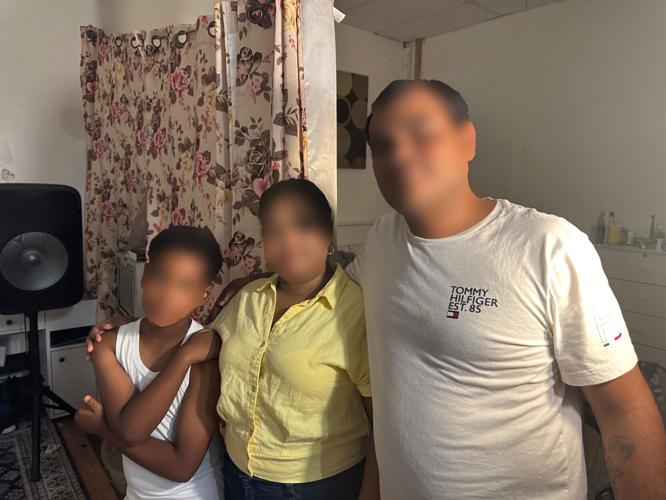



Jacob, Claribeth y Oswaldo. (Araceli Martínez/For CALÓ News)
When Oswaldo, an asylum seeker from Colombia, was asked to report to the Immigration and Customs Enforcement (ICE) offices in downtown Los Angeles, he never imagined it was a trap to arrest him.
“I felt safe going to ICE offices in downtown Los Angeles. I had a court date scheduled for November 13, but upon arrival, immigration agents took me into a small room and informed me that I lacked legal status and was being detained,” says Oswaldo. “Those words hit me like a bucket of cold water. In my panic, I wanted to run, but the ICE agents shackled my hands and feet.”
Oswaldo was detained on August 27 and deported to Colombia on September 10.
Two years ago
Oswaldo, his partner Claribeth and their son, now ten years old, had entered the United States in September 2024 as asylum seekers.
Nine months earlier, in January 2024, they had fled the La Guajira region of Colombia after being stripped of their land and receiving death threats.
Although they applied for asylum as a family, immigration authorities separated their cases, placing the minor with his father while assigning the mother a separate case.
This year, Claribeth was detained by ICE on January 6, this year, accused of arriving late for a fingerprinting appointment and failing to answer a supervision call on time. She spent four months at the Adelanto Detention Center. She regained her freedom through a habeas corpus petition, a legal mechanism used to challenge the lawfulness of unlawful or prolonged detention by immigration authorities.
Days after her release on May 14, Osvaldo was denied asylum and issued a deportation order for himself and his son, Jacob. On June 29, Osvaldo filed an appeal against his deportation, but it arrived late, leading to his arrest on August 27 and his subsequent deportation.
The real danger for this family is that their son Jacob has a deportation order against him.
Unexpected detention

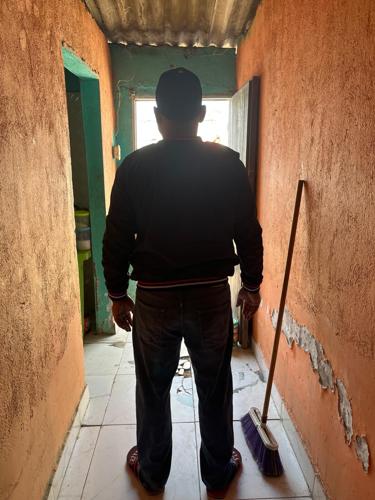
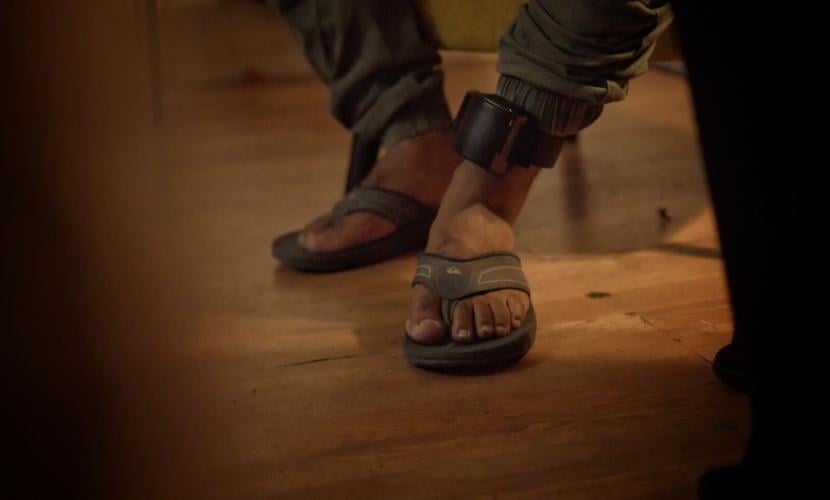
Oswaldo was detained by ICE and deported to Colombia. (Images from the documentary "Los Hijos del Miedo")
In a telephone interview with CALÓ News from Colombia, Osvaldo says that when he was detained, he asked to speak with a lawyer. The ICE agents agreed, but never gave him a phone to make contact.
“They took my fingerprints and started asking for information.” he says.” When I refused, they told me that if I didn't cooperate, they would mistreat me. In desperation, I told them I had a Social Security number, that I wasn't a criminal, and that I had come to this country seeking asylum because people in Colombia wanted to kill me over a land dispute.”
His words fell on deaf ears as far as the ICE agents were concerned.
Oswaldo was taken to a room he describes as extremely cold inside the federal building in downtown Los Angeles.
“That same day, around six in the evening, hooded officers put me and other immigrants into a van and took us to the Adelanto Detention Center.”
Upon arriving at Adelanto, when he was issued a blue uniform, he broke down.
“This is the end of my time in the United States, I thought."
He recounts that the weeks he spent at Adelanto were a true nightmare.
“That place is horrible. The people working at Adelanto have no heart, no feelings. The food is bad. I went many days without sleep. All you can do is cling to God and pray,” he remembers.
In September, he was taken out of Adelanto; for a week, ICE agents shuttled him between Arizona, Louisiana and another state whose name he cannot recall.
“They were picking up people all over the country. They made us sleep in hallways, crammed together on the floor, with about 200 immigrants. They only gave us two slices of white bread and a small cookie to eat.”
Deported to Colombia
On September 10, they put him on a plane and deported him to Colombia.

Oswaldo in Colombia after his deportation. (Photo courtesy Oswaldo)
“It’s been ten days since my deportation, and when I wake up, I think it’s all a dream. It hurts to have been separated from my wife and my child, whom I miss so much,” he says between sobs.
In Bogotá, where a friend offered him temporary shelter, he says he is deeply hurt by the way he was treated like a criminal.
“If I had committed a crime, I would understand having to go to jail and serve my sentence, but all I did was arrive in the United States to seek refuge because people wanted to kill me in Colombia,” he says.
Ten days after his deportation, Oswaldo is still processing what happened and how his dreams of a life free from danger for himself and his family crumbled in seconds.
“For now, I’m going to stay in Bogotá. I can’t go to my hometown because my life would be in danger. I’ll stay here and work for a while until I save enough money to go to Mexico. That’s where I want to live and work, because it will make me feel closer to my wife and child.”
He adds that things in La Guajira, his hometown in Colombia, are bad.
“I haven’t been able to see my parents and siblings.”
Oswaldo says he cannot help feeling sad, and he frequently breaks down in tears. All he would like is to return to the United States to be with his wife and son.
“I miss them so much! What we are going through as a family is very hard,” he says.
Lack of a lawyer
Oswaldo blames his deportation and family separation on the lack of a lawyer and legal representation.
“At first, Project Esperanza (Esperanza Immigrant Rights Project) helped me, but later they told me they couldn't anymore.”
An ACLU research report, “No Fighting Chance: ICE’s Denial of Access to Counsel in U.S. Immigration Detention Centers,” legal representation can make an enormous difference in the outcome of detained immigrants’ cases.
“Detained immigrants with legal representation are 10 times more likely to win their immigration cases compared to those who lack counsel, and are seven times more likely to be released from custody than those without counsel,” states the report. “Yet if they can’t actually communicate with attorneys, their constitutional right to due process is rendered meaningless.”
Pastor Guillermo Torres of Clergy and Laity United for Economic Justice (CLUE) said that because thousands of immigrants are seeking legal help during this second term of the Trump administration, non-profit legal advocacy organizations such Esperanza or Public Counsel are overwhelmed, unable to assist so many immigrants.
“Some only focus on strong cases with evidence, cases they think they can win,” said Pastor Guillermo.
“They are at full capacity; the best alternative for asylum seekers is a private immigration lawyer who doesn't charge too much and allows for installment payments,” he said. “It is a very difficult situation because the federal government is also unwilling to approve asylum cases.”
In October 2025, President Trump reinstated the refugee program with a historically low annual cap of 7,500 refugees, prioritizing South Africans.
Oswaldo's partner, Claribeth has launched a campaign to collect funds to pay for legal assistance: Help prevent a 10-year-old child from being deported!









(0) comments
Welcome to the discussion.
Log In
Keep it Clean. Please avoid obscene, vulgar, lewd, racist or sexually-oriented language.
PLEASE TURN OFF YOUR CAPS LOCK.
Don't Threaten. Threats of harming another person will not be tolerated.
Be Truthful. Don't knowingly lie about anyone or anything.
Be Nice. No racism, sexism or any sort of -ism that is degrading to another person.
Be Proactive. Use the 'Report' link on each comment to let us know of abusive posts.
Share with Us. We'd love to hear eyewitness accounts, the history behind an article.