




In this Jan. 12, 2010 file photo, Wells Fargo customer Malinda Lievers of Edgewood, Md., signs paperwork on a loan mortgage modification, at the Baltimore Convention Center in Baltimore. (AP Photo/Rob Carr, File)
For over a decade, California homeownership data has shown the same thing: Black and Latino borrowers receive home loans at half the rate as White borrowers.
A bill sitting on Gov. Gavin Newsom’s desk hopes to address this issue by directing the Department of Financial Protection and Innovation (DFPI) to examine the lending practices of all mortgage lenders in the state, focusing on preventing violations of nondiscrimination laws.
“The reality is that we're kind of in a national context where … the disparities between homeowners who are able to get a mortgage who are Black and Latino versus those who are White is pretty significant,” AB 801 author Assemblymember Mia Bonta said in a CALÓ News interview. “What that means is that it's a dream on paper for many in my community.”
A Legislative Black Caucus priority bill, the California Fair Lending Examination Act would require the DFPI to examine all mortgage companies, banks and nonbank lenders, including credit unions and “fintech” companies like SoFi and Rocket Mortgage, every four years for compliance with state and federal fair lending laws.
Mortgage lenders will be examined not only on the direct impact of their lending practices, but the disparate impact – meaning companies will also be held accountable for practices that are shown to have disproportionately impacted certain classes of consumers, regardless of intent.
While the bill does not outline the direct consequences for institutions found to be discriminating, either intentional or unintentional, it directs the DFPI to bring “an appropriate enforcement action based on the nature of the violation.”
AB 801 was originally introduced as the California Community Reinvestment Act (CRA), modeled after the federal program that requires banks to reinvest a portion of their earnings into the communities they serve.
Industry pushback deemed the bill too broad and having potentially unintended consequences on lenders, which led Bonta, a Democrat from Oakland, to restructure AB 801 as an examination bill. The assemblymember said there is "definitely an interest” in a California CRA down the line.
“The federal administration has essentially gutted the ability for us to have any visibility as to whether or not there are fair lending practices in place,” Bonta said. “Our community deserves to be able to own a home and build generational wealth, like so many do, and the federal administration has taken a very tactical effort to basically dismantle any kind of fair lending opportunities of review.”
Disproportional loans
The Federal Home Mortgage Disclosure Act (HMDA) offers a look into demographic trends in home ownership throughout the country. The HMDA data for California has shown that since 2015, Black and Latino borrowers have continued to receive home loans at half the rate as White borrowers.

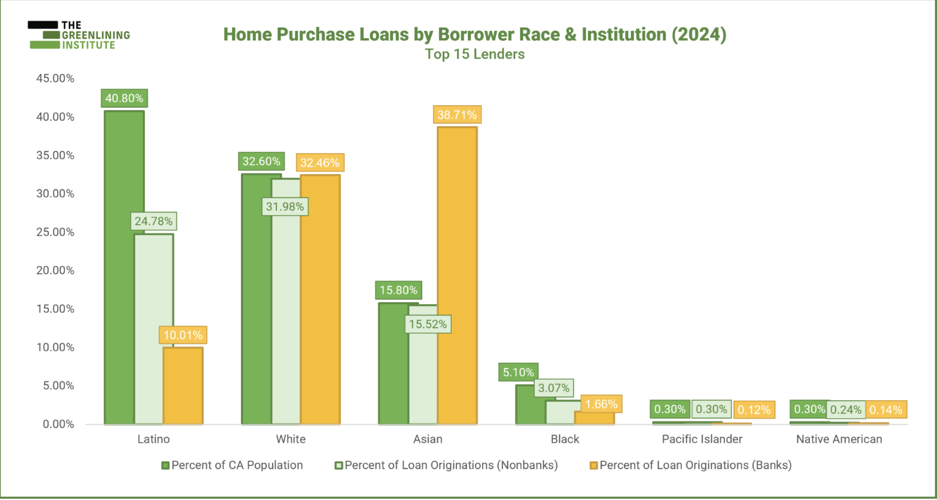
2024 California homeownership rates by race. (Graph courtesy of the Greenlining Institute, Kareema Nahavandi)
In 2024, despite making up 40% of California’s population, only 24% of Latinos received home loan offers from nonbank lenders. Traditional lenders, like banks, only offered loans to 10% of California Latino borrowers.
Black borrowers made up 5% of the population – 3% received nonbank loans while only 1.6% were offered bank loans.
White borrowers, around 32% of the California population, were the only group where the percentage of both bank and nonbank home loans matched almost equally to the size of the population.
“Homeownership is not improving at the rate that we want it to,” said Rami Ibrahim, program manager for the economic equity team at the Greenlining Institute, AB 801’s sponsor. “Communities of color, Black and Latino communities, are not accessing homeownership at the same rates as White communities, being that it's a key pathway to building wealth and stability.”
How we got here
Although it was banned by the Fair Housing Act of 1968, communities of color were discriminated against for decades through redlining. Financial institutions looked at “security maps” that had neighborhoods with mostly minority populations outlined in red; these neighborhoods were ineligible for federal loans and denied for mortgage loans, insurance and more.
On paper, redlining has been prohibited since the 1968 Act, but communities of color are still feeling both intentional and unintentional effects. Redlining hasn't disappeared; rather, it has taken “new forms,” Ibrahim said.
Borrowers of color have been found to pay hundreds of dollars more than White borrowers in origination fees. In many cases, neighborhoods of color have far less physical branches to go into.
And nearly 60 years later, blatant cases of redlining are still being uncovered.
From 2017 through 2020, City National Bank actively discriminated against those communities through redlining, the U.S. Department of Justice (DOJ) found.
The bank paid a $31 million settlement after it was found by the DOJ to have avoided financing mortgage loans in majority-Black and Latino Los Angeles neighborhoods.
“Communities of color are being flat-out rejected or they're having to pay more,” Ibrahim said. “There's no option where they succeed, and we have to ask ourselves ‘why are our communities treated like they either aren't worthy of qualifying for a mortgage loan or being forced to pay more?’”
Nonbank lenders
Nonbank lenders are still widely unregulated, despite expanding their hold in the California home mortgage market by nearly 15% since 2015.
In 2024, HMDA data showed that nonbank mortgage companies made up 10 of the 15 top mortgage lenders in the state. Nonbank lenders aren’t subject to the federal CRA and don’t have the same requirements as traditional banks to meet credit needs for low and moderate-income borrowers.
Bonta’s bill would subject all nonbank lenders operating in the state to the DFPI’s authority. This addition is “absolutely a huge win,” Ibrahim said.
These lenders have become increasingly present in low-income and communities of color due to many traditional banks shuttering branches in certain neighborhoods after home lending became unprofitable following the 2008 housing crash.
While credit unions and fintechs have filled some of that gap, not being held to the same standards as banks has left many borrowers of color with the short end of the stick.
“What we need to do is we need to realize our power, we need to fight for the things that keep us healthy, wealthy and thriving,” Ibrahim said, “and not allow all of this to happen without us fighting back.”
Newsom has until Sept. 30 to sign or veto the hundreds of bills left on his desk. Bonta said AB 801 is a “strong, compelling bill,” deserving of Newsom’s signature.
“We've done everything that we can to make [that] the case,” Bonta said. “Beyond that, he has the power.”








(0) comments
Welcome to the discussion.
Log In
Keep it Clean. Please avoid obscene, vulgar, lewd, racist or sexually-oriented language.
PLEASE TURN OFF YOUR CAPS LOCK.
Don't Threaten. Threats of harming another person will not be tolerated.
Be Truthful. Don't knowingly lie about anyone or anything.
Be Nice. No racism, sexism or any sort of -ism that is degrading to another person.
Be Proactive. Use the 'Report' link on each comment to let us know of abusive posts.
Share with Us. We'd love to hear eyewitness accounts, the history behind an article.