

This story was originally published by EdSource. Sign up for their daily newsletter.
Top Takeaways
- Work permit renewals for undocumented California teachers with protected status are taking an ‘unprecedented’ amount of time.
- Expired work permits mean educators must legally stop working until the renewal arrives.
- Thousands of California’s DACA recipients are educators.
When Alma Mendoza Tlachi’s work permit expired while she waited for the federal government to process her renewal, she had to stop teaching her high school students and could not return to work over the summer or prepare her classroom for the new school year.
As a Deferred Action for Childhood Arrivals, or DACA, recipient, Mendoza Tlachi relies on an employment authorization document, or work permit, to legally work in the United States.
Alma Mendoza Tlachi is a Spanish language and literature teacher at a high school in Los Angeles and a DACA recipient. This year, she had to stop working after a prolonged delay in the renewal of her work authorization document. Photo credit: Alma Mendoza TlachiCredit: Alma Mendoza Tlachi
Mendoza Tlachi has paid to renew her work authorization every two years, as required, since she first applied for DACA in 2017 at age 16. But this year, processing delays caused her work permit to expire before U.S. Citizenship and Immigration Services reviewed her renewal application, even though she filed nearly six months before it was set to expire. She said her previous renewal applications had all been processed in under one month.
“I constantly found myself wondering: ‘Will I be able to continue teaching? Will I be able to support my family? Will I be able to finish school?’ ” said Mendoza Tlachi at a press conference Thursday morning. She is a third-year Spanish language and literature teacher completing her master’s degree in education at Cal State Fullerton.
The delays prompted California lawmakers to call on the federal government to act. Assemblymember José Luis Solache, Jr., D-Paramount, introduced House Resolution 124, which the state Assembly recently approved unanimously. The resolution urges federal agencies, including USCIS, which oversees DACA renewals, to expedite work authorization renewals for DACA recipients.
The resolution passed after months of uncertainty over prolonged delays and a lawsuit seeking information from the federal government on DACA processing times.
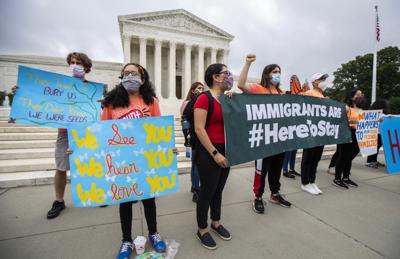
Over a quarter of the nation’s roughly 506,000 DACA recipients live in California, and thousands of them are educators in the state’s K-12 and higher education systems.
“Immigration cases are often delayed. That is not unusual,” said Tess Feldman, a supervising attorney at Loyola Law School’s Immigrant Justice Clinic, at Thursday’s news conference. “But what we’re talking about today for DACA renewals are unprecedented delays impacting a very sensitive group of students and teachers and educators that this program is designed to protect, not cause further harm to.”
One of Feldman’s clients, a 10th grade teacher, cannot return to work this school year because of renewal application delays, Feldman said. “By comparison, one of her applications in the past was renewed and approved on the same day.”
Impact extends to students, community of DACA recipients
Related Reading
Prolonged DACA renewals put California educators with temporary immigration status in limbo
April 23, 2026
The DACA program was created by the Obama administration in 2012 to provide temporary protection from deportation and work authorization to certain undocumented immigrants who were brought to the United States as children. The program grew out of years of organizing by undocumented immigrants seeking protection and a pathway to citizenship.
DACA has since faced a series of legal challenges. A federal court order currently prevents the government from approving new applications to the program while still allowing renewals to be processed.
Pablo Villavicencio, CEO of Alliance College-Ready Public Schools, said the delays cause a domino effect of disruptions that affect many people beyond the individual DACA recipient.
“For our students, that disruption matters. It can affect their academic progress and preparation for college. Many of our students will be the first in their families to graduate from high school and to attend college and, at such a critical point in their education, losing a teacher who knows them, believes in them, and is helping prepare for what comes next in their life has a lasting impact,” Villavicencio said. Educator Mendoza Tlachi teaches at one of the 25 sites in the Los Angeles-based network of public charter schools that he leads.
The delays can also disrupt an educator’s financial stability as well as the larger communities that depend on their work, said Jacob Sandoval, state director with civil rights organization League of United Latin American Citizens, or LULAC.
“Employers lose workers, families lose income, the federal government loses taxes and communities lose economic activity. This is why processing timely applications is not simply a matter of immigration policy, it’s about civil rights, workforce stability, family stability and our economy,” he said.
Feldman, of Loyola Law School, said some DACA recipients whose work permits have expired are relying on savings while waiting for their cases to be processed. Others are being supported by employers who are holding their jobs open while they wait.
Related Reading
Q&A: Big drop in enrollment of low-income undocumented students at California’s public universities
September 24, 2024
“They’re very much living day to day. They’re checking their status on their case when they wake up and when they go to bed at night, and they’re living off savings, and they’re living in a space of hope,” Feldman said.
Faculty at California State University are also working on legislation to support students awaiting their renewal applications to be processed.
“What we see happening many times is students leave halfway through the semester and then, without any date of return, they actually have to start all over again to apply to the university,” said Theresa Montaño, a CSU faculty member and president of the Los Angeles County Board of Education.
The legislation would allow students facing disruptions such as delayed DACA renewals to temporarily pause their studies and return without having to start the process over, Montaño said. Once they can return, “they would be able to start where they left off,” she said.
For Mendoza Tlachi, the wait finally ended a few days ago. She was brought to the United States at age 7, first received DACA in 2017 and has renewed it about five times. Her latest renewal was approved about six months after she applied.
It meant that, instead of spending her summer working and preparing for the new school year, she spent that time checking the USCIS website for any update on her renewal application until, finally, it arrived.
“I hope we can create a process where educators like me do not have to wonder whether a process and delay will keep us from our classrooms, and where our students do not have to wonder whether their teachers will come back the next day,” she said.







(0) comments
Welcome to the discussion.
Log In
Keep it Clean. Please avoid obscene, vulgar, lewd, racist or sexually-oriented language.
PLEASE TURN OFF YOUR CAPS LOCK.
Don't Threaten. Threats of harming another person will not be tolerated.
Be Truthful. Don't knowingly lie about anyone or anything.
Be Nice. No racism, sexism or any sort of -ism that is degrading to another person.
Be Proactive. Use the 'Report' link on each comment to let us know of abusive posts.
Share with Us. We'd love to hear eyewitness accounts, the history behind an article.