
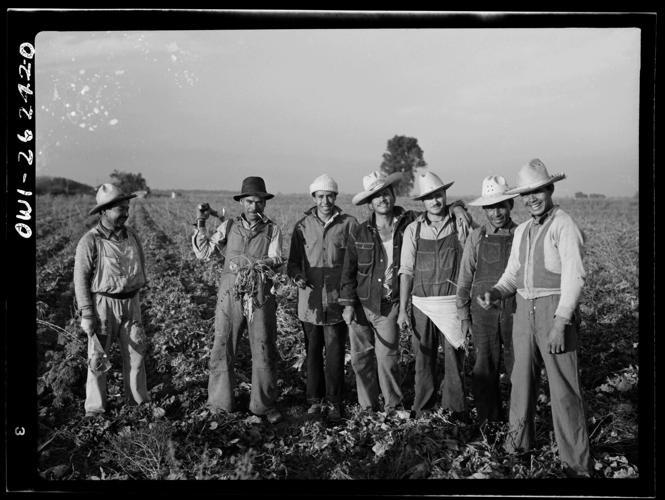


Beetworkers pose in fields near Stockton, California, in May, 1943. (Marjory Collins/Library of Congress)
Though it's now known as a sanctuary state, one where its leaders fight against the mass deportation and indefinite detention of immigrants, California has a history of recruiting and welcoming immigrants, only to later shut them out.
During and after World War II, the Golden State benefited from the cheap labor of Mexican workers, known as braceros, who were later mass deported by President Dwight D. Eisenhower.
On August 13, the California Museum launched a new exhibit titled “Help Wanted/Leave Now,” highlighting Eisenhower’s mass deportation campaign. Operation Wetback, named after a racial slur targeting Latinos, is known as the largest mass deportation campaign in U.S. history, estimated to have deported over 1 million individuals.
“To me, the idea of education through an exhibit like this to raise awareness and hopefully for people to take action, not in a political way necessarily, but in a community and social way, is incredibly important,” said Pablo Espinoza, a member of the Museum’s board and part of the advisory council for the exhibit.
Espinoza first had the idea for this exhibit 10 years ago, while walking through the California Museum’s signature exhibit on Japanese American internment with his son. The timing for the exhibit never lined up – until now.

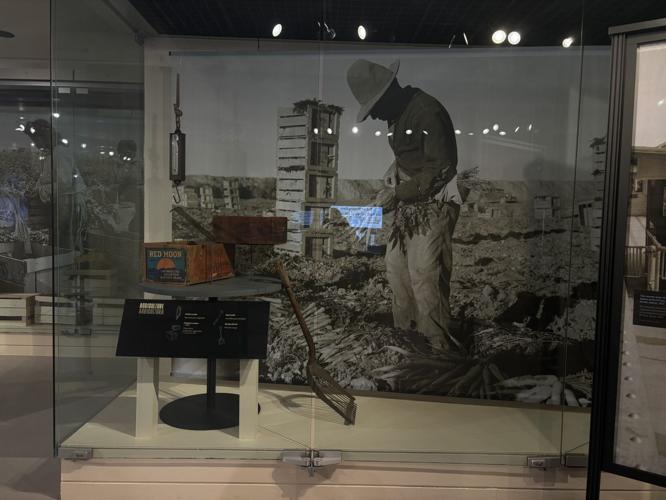
The exhibit walks you through what life was like for braceros, including the conditions while working in agriculture. (Andrea Valadez/CALÓ News)
Seeing history repeat itself 72 years later, with the Trump administration carrying out its own mass deportation agenda, the Museum started work on this exhibit over a year ago, with a goal of not shying away from the state’s dark past.
The exhibit will run through January 2027. After its run in Sacramento, the exhibit will be turned into a traveling installment, available to museums, libraries and other institutions nationwide that want to feature it.
The fully bilingual exhibit focuses mainly on the recruitment and deportation of hundreds of thousands of mainly Mexican immigrant workers through the Bracero Program. The U.S. and Mexico created the Bracero Program to bring millions of Mexican laborers to the U.S. to fill labor shortages during and after the Second World War.
Immigrants were promised high wages, housing and safety while they helped the country, though these promises were often broken. Mainly working in agriculture, on the railroads and in mines, braceros did back-breaking work with no promises of citizenship.

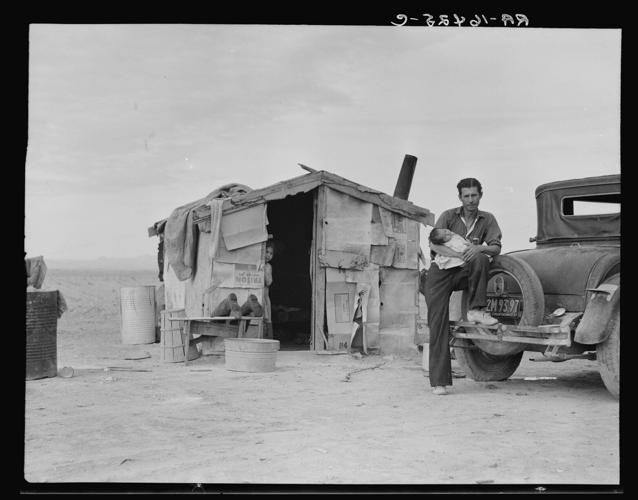
A farm worker family at substandard field housing. Imperial Valley, California, 1937. (Dorothea Lange/Library of Congress)
The exhibit
Walking past the first “revolving door” of photos of braceros, museum visitors are transported in time through the exact steps the immigrant laborers of the 1930s-1960s underwent.
The exhibit is broken up into sections: leaving home, the border, memories of home, work, racism, the order to leave, first-person accounts and deportation today. Ending on a hopeful note, the exhibit leaves guests with profiles of Latinos who are now leaving their legacy on the country as well as a focus on the contributions of the Latino community.
“I think nothing replaces storytelling other than seeing it and feeling it yourself,” Espinoza said.
With this in mind, the exhibit was curated to be extremely visual and even interactive at some points. Visitors will see photographs and home videos from immigrants involved in the Bracero program as well as first-hand accounts of individuals deported then and now.

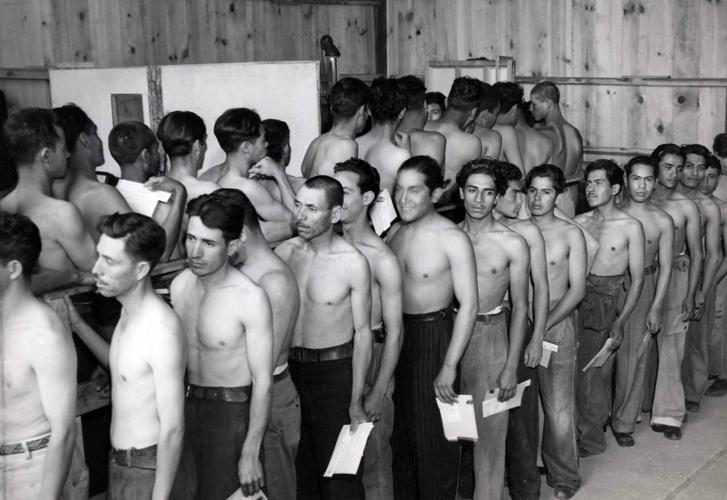
Bracero Program applicants line up for chest x-rays. Mexico City, 1942. (Howard Rosenberg, Ag Personnel Management Program, UC Berkeley Labor Management Decisions (1993), UC Agriculture and Natural Resources)
Visitors can also put on headphones and listen to the corridos music immigrants might have listened to at the time or touch a short-handled hoe, a tool braceros used that California eventually banned due to the back injuries it caused workers.
Wanting to keep kids interested, too, the exhibit even has a few child-height discs that can be lifted to smell dirt and garlic – something braceros would have smelled all day long while working in the fields.
President Donald Trump’s administration has said the 1953 operation is a model for its own mass deportation agenda.
“We haven't learned from that mistake, we're tolerating … the same mistakes being made again.” Espinoza said.
First-hand accounts
The exhibit features various first-hand accounts of immigrants who were deported during both Eisenhower’s and Trump’s deportation campaigns, including accounts from Gonzalo Alvarado Sr. and Vilma Palacios.
Alvarado was 16, working as a ranch hand in Fresno, when he was swept up as part of Operation Wetback.
“Everyone was afraid when they saw the uniform,” Alvarado recalled during an interview with CALÓ News. “When you see them, you just give yourself up.”
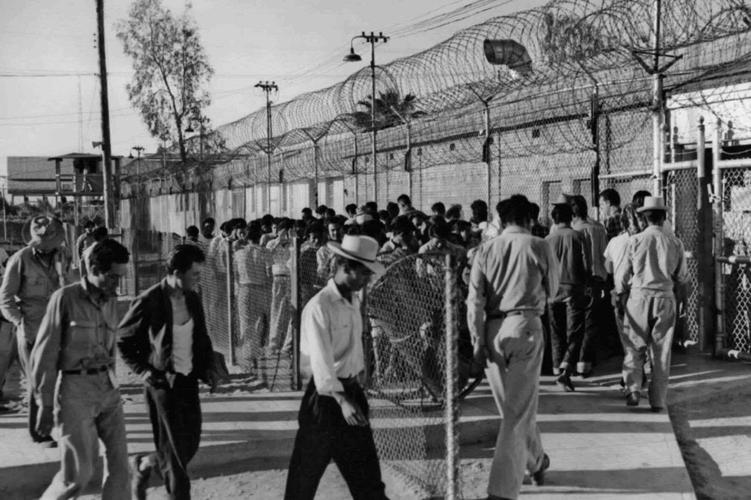
Alvarado described the weeks-long journey home with immigration officials taking him from Fresno to the El Centro station in California, to McAllen, Texas, to Puerto de la Esperanza, then finally to Veracruz, Mexico.

Detainees are incarcerated prior to deportation in El Centro, California in 1954. (Larry Sharkey/L.A. Times Archive/UCLA Special Collections)
Sean Manwaring, a museum curator, said immigrants were purposefully dropped off far from the border and their homes, to make it harder for them to return to the U.S.
Over 70 years after Alvarado’s deportation, Palacios, 23, was deported after being in the U.S. since the age of six.
Soon after graduating with her nursing degree from Louisiana State University last year, Palacios was detained by Immigration and Customs Enforcement (ICE).
Palacios asked to see a warrant multiple times, saying during an interview with CALÓ News that agents told her not to make their job “more difficult.” Palacios was detained for six months before being deported to Honduras.
She described her experience in a GEO detention center as “an emotional roller coaster every single day.” Detainees were cooped up 60 to a room, made to eat breakfast at 4 a.m. or forego eating until several hours later and were often denied time to go outside, Palacios said.
Similar to Alvarado’s experience, Palacios said the day she was deported was “a very long process,” with detainees waiting for hours to be processed. While waiting to board a plane, detainees were shackled, patted down and had their mouths searched.

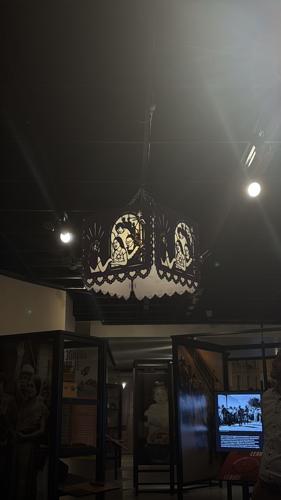
The exhibit ends with a spotlight on Latino contributions to American society, highlighting art pieces, including this light fixture. (Andrea Valadez/CALÓ News)
“I just saw it as something very unnecessary and inhumane to be doing,” Palacios said.
Palacios was ultimately put in touch with Health Match B.C, a program in Canada that recruits international healthcare workers. She is set to start a nursing job in a neuroscience department in a Canadian hospital.
“There's still a world outside of just one country,” she said, adding she feels accepted and welcomed in her new home.
“Change needs to happen. History cannot be repeating itself,” Palacios said. “It just breaks my heart a lot that there's just so much hate in this world. There's still not enough people that [are] just spreading goodness and love out there.”






(0) comments
Welcome to the discussion.
Log In
Keep it Clean. Please avoid obscene, vulgar, lewd, racist or sexually-oriented language.
PLEASE TURN OFF YOUR CAPS LOCK.
Don't Threaten. Threats of harming another person will not be tolerated.
Be Truthful. Don't knowingly lie about anyone or anything.
Be Nice. No racism, sexism or any sort of -ism that is degrading to another person.
Be Proactive. Use the 'Report' link on each comment to let us know of abusive posts.
Share with Us. We'd love to hear eyewitness accounts, the history behind an article.