
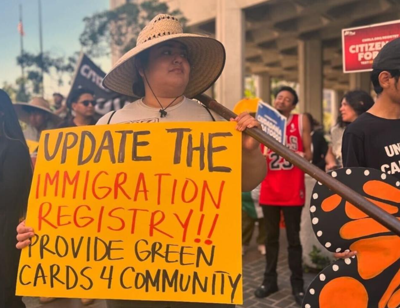


Two years ago farmworkers, DACA recipients and immigration reform allies gathered together to march the streets of Los Angeles and urge Congress to pass a pathway to citizenship. (Photo by Amairani Hernandez.)
Last month, the Trump administration decided to revive the public charge rule, which denies green cards to applicants who use or will use public benefits like Medicaid, housing assistance or food stamps. The new rule is scheduled to take effect on September 18, 2026.
This new law also authorizes immigration officials to determine whether an applicant might become a public charge. However, even before its implementation date, it has already created a chilling effect on many immigrant families, which has led them to drop out of critical safety net programs for food and medical care in fear of invoking the public charge rule.
The American Community Media held a briefing on August 7, highlighting who will specifically be impacted by the expansion of the new public charge rule.
Xiao Wang, CEO and Co-Founder of Boundless Immigration, has helped over 150,000 immigrant families and employers get through the United States immigration system. He explained that in 2022 immigration officers had specific criteria to deny a green card application, such as insufficient financial stability or the inability to provide for themselves. Now with this new ruling immigration officers have a wide range of discretion to deny the green card for those who are involved in safety net programs or have plans to apply.
“This rule hasn’t been in effect yet, but the fear of it and the impact of it on families and to the health of you know families around the country has just as much of an impact as the eventual number of applications that might be affected by this rule,” said Wang.
He also added that the last time Trump’s administration tried to revive the public charge rule, many families pulled their kids out of the government programs in fear that the children’s benefits would have counted against their green card applications, which was not the case. “This is nothing new; this has been part of federal immigration law since 1882,” he said.
Wang said that in 2019, it’s been expanded to count Medicaid, food stamps, housing assistance within the new form that applicants had to file, in which he described being the longest application the organization had to file for green card applications. He said the form was typically anywhere between a couple dozen pages up to 900 pages long, just to showcase all the evidence that was needed for the applicant.
The upcoming changes next month will rely on looking at each case by case with the following criterias: age, health, family status, financial resources, assets, education, skills and any other evidence of being self-sufficient.
Wang said that with this holistic approach, applications will get more complicated and lengthy and the adjudication and processing will also take much more time.
Joan Alker, Executive Director of the Center for Children and Families, shared that the mission of the organization based in Georgetown University is to make sure that all children and families and communities have access to high-quality health care.
Alker explained that with the new ruling taking effect next month, it will have a chilling effect on children who live in mixed status families. According to KFF Health News, one in four (26%) children have an immigrant parent, including over one in ten (12%) who are citizen children with at least one noncitizen parent.
With these upcoming changes, she explained that not only will the public charge rule have huge impacts on families but the One Big Beautiful Bill Act has already made significant changes to Medicaid, including nearly $1 trillion in spending reductions and stricter eligibility requirements affecting millions of people with low incomes.
Alker pointed out that as of now 60% of the children in the U.S. are currently getting their health insurance through Medicaid, and with the cuts being made under the H.R. 1 bill, it is expected to cause 1.3 million Californians to lose their Medi-Cal coverage, according to the California Health and Human Services Agency.
They are also at risk of losing their food assistance entirely, and reducing the value of CalFresh benefits for all three million households who participate in the Supplemental Nutrition Assistance Program (SNAP), known as CalFresh in California.
Cuts would not only affect children, working-age adults and seniors, but disproportionately affect more than half (52%) of Medi-Cal Latino enrollees, according to the Latino Policy & Policy Institute.
Alker emphasized that although the funding cuts are to go into effect next year, they have already seen 2.3 million fewer Medicaid enrollment applications for children. ”We don't know who these children are, but we certainly suspect that many of them are children living in mixed-status families,” she said, adding that some parents are hesitant to enroll their children due to the aggressive deportation agenda from the Trump administration.
“They’re scared because for the first time ever, the Department of Health and Human Services has said that they will share data from Medicaid and CHIP with ICE,” Alker said.
She explained that when Medicaid enrollment goes down, the uninsured rate per child goes up. “When children don’t have health insurance, it's harder for them to access care, primary and preventive care,” she said. “Most of these children are citizens, and when I say most, I mean 90% of these children. So, they’re clearly eligible. There should not be repercussions.”






(0) comments
Welcome to the discussion.
Log In
Keep it Clean. Please avoid obscene, vulgar, lewd, racist or sexually-oriented language.
PLEASE TURN OFF YOUR CAPS LOCK.
Don't Threaten. Threats of harming another person will not be tolerated.
Be Truthful. Don't knowingly lie about anyone or anything.
Be Nice. No racism, sexism or any sort of -ism that is degrading to another person.
Be Proactive. Use the 'Report' link on each comment to let us know of abusive posts.
Share with Us. We'd love to hear eyewitness accounts, the history behind an article.