
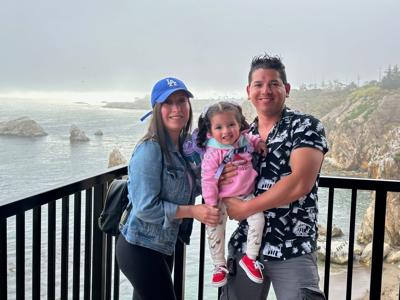



Ulises Peña Lopez, right, with his wife Aby Peña and their daughter. Photo courtsey the Peña López family.
This article was produced by Capital & Main. It is published here with permission.
What seemed to be a typical Friday morning for the San Francisco Bay Area family quickly became a nightmare when about a dozen armed and masked Immigration and Customs Enforcement agents surrounded Ulises Peña Lopez’s truck as he attempted to leave his home and head to work.
Panicked, he called his wife Aby Peña, who ran downstairs to help but was quickly blocked by two of the agents. Their 3-year-old daughter watched helplessly from their apartment window as her father exited the truck and was forced to the ground with a gun to his head, according to an account of the Feb. 22, 2025, incident in a lawsuit filed by the family.
“That day changed our lives completely,” Aby Peña said in a statement provided to Capital & Main by the family’s lawyers. “Our little girl was barely 3-years-old when she witnessed ICE agents violently pulling her father out of our vehicle. That experience was deeply traumatic for her and for our entire family.”
A spokesperson with the Department of Homeland Security, which is named in the suit along with ICE and the operators of two detention centers, would not comment directly on the lawsuit’s allegations and instead referred Capital & Main to ICE’s enforcement and removal operations policy. The suit seeks unspecified damages for physical and mental abuse.
Peña Lopez, who was 30 at the time of the incident, says in the suit that he was detained by ICE agents and beaten in a secluded alley until he was unconscious.
“What is very consistent is systematic mistreatment of everyone in detention, and that mistreatment is particularly intense for disabled folks,” said Elena Hodges, a member of the Peña Lopez family’s legal team and co-director at Pangea Legal Services, a nonprofit that defends immigrants.
People detained by immigration officials have long complained about what they say is abusive or neglectful treatment during their apprehension or confinement. A man who fought alongside U.S. Special Forces in Afghanistan died roughly 24 hours after complaining about his worsening medical condition at a Dallas detention center, his brother said. A 25-year-old transgender woman from Venezuela said she was assaulted, threatened and deprived of medical care while being held at a detention center for men in Louisiana. And an asylum seeker from Venezuela said she was sexually assaulted by a male nurse at a detention facility in Georgia.
In his lawsuit, Peña Lopez says ICE agents took him to a hospital in Mountain View where he was was shackled to his bed and subjected to intimidation by ICE agents.
Because of the presence of ICE agents, the suit says, nurses had to communicate with him discreetly, often writing small notes and carefully handing them to him.
Laura Murchie, a member of the family’s legal team, said she has heard several similar anecdotes from clients and believes such behavior by agents violates the Health Insurance Portability and Accountability Act privacy rules.
After spending the night at the hospital, Peña Lopez was transferred to Golden State Annex detention center outside Bakersfield, where he was detained for approximately six months. During his time at the facility, he told his lawyers, he experienced poor treatment and discrimination from staff.
According to the lawsuit, staff frequently denied Peña Lopez adequate medical care and failed to provide basic accessibility accommodations, including a cane, hearing aids and a lower bunk assignment — none of which he needed prior to the beating, the suit alleges.
“I’ve seen this in other cases where they just don’t provide the accommodations,” Murchie said. “At best it’s kind of negligence; at worst, it’s malicious.”
Christopher Ferreira, spokesperson for GEO Group, which operates Golden State Annex, did not comment directly on the lawsuit and its allegations. He said the facility’s support services are reviewed regularly.
After about six months, Peña Lopez was transferred to California City Detention Facility in the Mojave Desert, where, the lawsuit says, his cane was confiscated along with his medications for his mobility and mental health. ICE requires that each detainee undergo a mandatory intake process that includes review of medications and disability accommodations.
CoreCivic spokesperson Ryan Gustin said in an email that he could not discuss Peña Lopez’s case. “We are unable to discuss the medical records, treatment history or disability status of any specific individual due to federal privacy requirements.”
CoreCivic operates the California City Detention Facility, where verbal abuse from staff was common, according to the lawsuit. When Peña Lopez complained and submitted grievances about his treatment, the suit says he was often mocked and ridiculed.
“Staff are expected to comply with CoreCivic’s Human Rights Policy and Code of Ethics. Allegations of misconduct are taken seriously and are reviewed in accordance with company policies and applicable standards,” Gustin said.
Peña Lopez was deported in October to Mexico, where, the suit says, he is now living in hiding. While his wife and daughter are U.S. citizens, he is not. He fled Mexico when he was 18 due to threats and violence, according to his lawyers.
The lawsuit does not contest his deportation. In the U.S., he was convicted of misdemeanor assault in 2019 and sentenced to probation. He was convicted of driving under the influence the following year and sentenced to 14 days in jail.
“Ulises’s past criminal legal history is not relevant to his family’s federal civil rights case, which is about holding ICE and private prison contractors accountable for the abuses and disability rights violations that he suffered during the ICE arrest and for months in detention,” Hodges said in an email to Capital & Main.
The deportation bus journey took 36 hours and ended at a holding room, where Peña Lopez was left without his cane, medications or any food, the suit alleges.
According to Aby Peña, her husband’s physical health has continued to deteriorate since being deported, while she and her daughter have also suffered both mentally and emotionally. She has since been diagnosed with post-traumatic stress disorder and their daughter, now 5, has regressed in development, she said in her statement.
“After his deportation, I had to face the responsibility of raising my daughter, supporting our household, and rebuilding our lives on my own, all while grappling with fear, uncertainty, and emotional pain,” she said in the statement.
Despite the upheaval, she plans to continue to seek justice for her family and those in similar circumstances.
“It is possible to find the strength to move forward. Do not let fear take away your voice,” she said in her statement to Capital & Main. “Even though the path may be difficult, our stories matter, and sharing them can help bring justice and hope to many other families.”
Kani’ya Davis is an Ida B. Wells Society for Investigative Reporting Intern.







(0) comments
Welcome to the discussion.
Log In
Keep it Clean. Please avoid obscene, vulgar, lewd, racist or sexually-oriented language.
PLEASE TURN OFF YOUR CAPS LOCK.
Don't Threaten. Threats of harming another person will not be tolerated.
Be Truthful. Don't knowingly lie about anyone or anything.
Be Nice. No racism, sexism or any sort of -ism that is degrading to another person.
Be Proactive. Use the 'Report' link on each comment to let us know of abusive posts.
Share with Us. We'd love to hear eyewitness accounts, the history behind an article.