
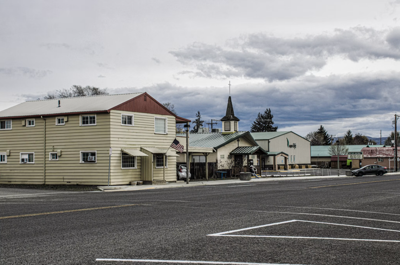


Kittitas is a small agricultural city located in central Washington State, with about 1,440 residents. Photo by Peter Robbinson
While the Trump administration argues that the immigration crackdown has led to a negative net migration in 2025, the real effect of thousands of deportations is transforming rural areas and communities.
This was the theme of a virtual conference centered on how the current immigration policy is actively reshaping the small-town United States.
Since January 2025, the Trump administration has deported more than 675,000 individuals, in addition to approximately 2.2 million others who have voluntarily self-deported, resulting in a negative net migration for the first time in half a century.
The virtual briefing was hosted by American Community Media and featured a list of panel speakers, including Tim Slack, professor of sociology at Louisiana State University; Jennie Murray, president of the National Immigration Forum; Rachel Perić, executive director of Welcoming America; Mark Prosser, former chief of police in Storm Lake, Iowa; and Carl Ruby, senior pastor at the Central Christian Church, in Springfield, Ohio
Murray said it was important to understand the national landscape of immigrants to see the macroeconomic consequences of an ongoing, declining immigrant population.
“Immigration is at a negative rate now and 2025 is the first year in our nation's history where we have had a negative immigration number. We are on track for this to be the same in 2026,” she said.
Murray said fewer people contributing to the federal tax base and American businesses having fewer workers will create a dark and dire economic climate not only for big cities like L.A. but also small towns. “We are extremely concerned about what this is doing,” she said.
In addition to the ongoing immigration and ICE operations and the self-deportations in the last few months, the ending of programs like Temporary Protected Status could also contribute to the downfall of rural communities.
TPS, the federal humanitarian program created in 1990, gives eligible immigrants permission to remain and work in the U.S. without threat of deportation for periods of six to 18 months. When Trump returned to office in 2025, 17 countries had this designation, but today he has since ended or moved to end 13 of the 17 designations, including for Venezuelans, Haitians and Hondurans.
Slack said immigration has provided a population lifeline for many rural communities and said depopulation is a big problem in rural America.
“Of rural counties [in the U.S.] that managed growth from 2020 to 2025, [about] 200 only did so because of non-white immigration increases,” he said. “Nearly all the positive net migration in those areas was international.”
A lot of Slack’s research has also focused on dismantling the false notion that rural America is majority white. He said, despite popular belief, rural towns are actually racially and ethnically diverse.
“The idea that rural America is mostly white has never been true in the American South and West. Today about one in four rural residents are non-white. Indigenous people have the greatest share of their populations living in rural areas out of any racial or ethnic group.”
The panel also touched on how, despite national conversation on immigration focusing on the U.S.-Mexico border and federal politics, some of the most significant consequences of immigration policy are playing out far from the border.
Peric said that despite the growing anti-immigration sentiments at a national level, there are also rural communities who remain committed to building welcoming and safe places for immigrants. She talked about Emporia, a very small city in the state of Kansas, which Welcoming America certified as a welcoming place in 2025.
“The community really rallied to put together a proactive effort over years to make sure that when people arrived, they were seen as valued contributors to the community and that there was a deliberate effort to incorporate people into community life. We know that when communities have trust, that makes for a stronger community,” she said.
Prosser, former chief of police in Storm Lake, Iowa, said he saw firsthand how immigrants have brought great stability to rural communities where he patrolled.
He said that similar to big cities like L.A., small places in Iowa have also been hit by the national ICE raids that have hit different corners of the U.S. “There are waves of fear growing through our immigrant communities based on what they see in the news, what statements are being made in Washington, D.C., or what happens down the streets. It is causing people not to go to work or to their doctor's appointments or church,” he said.
Ruby, a pastor in Springfield, Ohio, said ICE operations have affected his church, which used to have a big population of Haitians. “In the last two days ICE has been picking up people in Springfield," he said. “My emotions are very raw today.”
He said the church where he serves would have about 50 Haitians at church service every week and this past weekend, there were almost none.
Springfield, Ohio has had the arrival of 12,000 to 15,000 Haitian immigrants over several years, but during the September 2024 presidential debate and campaign cycle, there were false claims alleging that Haitian immigrants were stealing and eating domestic pets.
"They're eating the dogs. They're eating the cats. They're eating the pets of the people that live there," Trump said in September 2024.
Ruby said that the majority of Springfield residents appreciate and recognize immigrant contributions in many things, but especially in the building of new housing facilities that would not have been possible without Haitians.
"Our community values [Haitians]. They are helping us grow,” he said.






(0) comments
Welcome to the discussion.
Log In
Keep it Clean. Please avoid obscene, vulgar, lewd, racist or sexually-oriented language.
PLEASE TURN OFF YOUR CAPS LOCK.
Don't Threaten. Threats of harming another person will not be tolerated.
Be Truthful. Don't knowingly lie about anyone or anything.
Be Nice. No racism, sexism or any sort of -ism that is degrading to another person.
Be Proactive. Use the 'Report' link on each comment to let us know of abusive posts.
Share with Us. We'd love to hear eyewitness accounts, the history behind an article.