
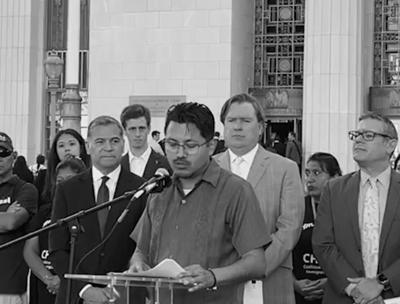


Pedro Trujillo, one of the plaintiffs in the lawsuit. Photo courtesy of Brenda Verano
Local and state organizations arrived in Los Angeles on Wednesday morning to denounce what they say are forms of voter intimidation by the Department of Homeland Security (DHS) and the U.S. Department of Justice (DOJ).
The UCLA Voting Rights Project (VRP) and the Coalition for Humane Immigrant Rights (CHIRLA) filed a major federal voting rights lawsuit against the Trump administration for using federal databases to cross-reference state voter registries and bolster accusations of voter fraud.
Two months away from the midterm elections this upcoming November, community and state leaders say the federal government is using databases to erroneously target naturalized citizens and instill fear so that they do not vote.
Plaintiffs in the lawsuit, including CHIRLA and Pedro Trujillo, who became a U.S. citizen after almost two decades, said the government is interfering with free and fair elections by using unlawful and inaccurate federal databases at a time when Latino voters are essential for upcoming elections.
“I was born outside the United States, but I earned my citizenship and became a naturalized U.S. citizen in 2021. I have the same right to vote as any citizen born here and I plan to exercise that right in November,” Trujillo said. “I should not have to fear being treated like a criminal simply because I am an immigrant and choose to vote. My citizenship is real, my voice matters and my right to participate in our democracy should not be questioned.”
For many people, like Trujillo, becoming a citizen does not only mean safety from deportation but also exercising one of the oldest forms of democracy, and one that he says is also a great responsibility.
According to U.S. Citizenship and Immigration Services (USCIS), the agency that processes citizenship applications, more than 7.9 million legal residents have become naturalized citizens of the U.S. during the last decade.
Earlier this year, the National Public Radio (NPR) also stated that the latest USCIS data showed there was a fluctuation in applications for naturalization at the beginning of 2025. While the year began with numerous citizenship applications, by the end of the year fewer immigrants were applying to become citizens and even fewer were granted actual citizenship.
Xavier Becerra, who was senior advisor in the lawsuit and who looks to become California's first Latino governor in over a century, was also present at Wednesday's press conference announcing the lawsuit. He said citizens need to cherish their right to vote and make sure they exercise it come November.
“Naturalized citizens, like my mother, are not second-class citizens. They have the right to exercise their vote, just like all citizens,” Becerra said. “The Trump Administration’s attacks on voting are premeditated and their schemes to interfere in our November 3rd elections are predictable. Today, we file this action against Donald Trump to defend voters like my mom who believe in free and fair elections.”
In July, during an election speech, President Donald Trump warned of “shocking vulnerabilities in our election infrastructure” and talked about intelligence documents that he claimed exposed major security flaws in American voting systems.
In this speech, which lasted more than 20 minutes, he made a reference to never watching “a stolen election again.”
The White House website also outlines multiple investigations by DHS related to allegations of non-citizen voting and registration. According to the department, there are more than 250,000 non-citizens who are illegally registered to vote.
“State election officials in California, Pennsylvania, New Jersey and Nevada have been notified of this serious threat to national security and DHS stands ready to support their efforts to identify and remove ineligible registrants,” a DHS document reads. “There is an undeniable pattern emerging as DHS begins to unravel the horrific damage done by the open border policies of the Biden administration. States that have adopted alien-first policies instead of American-first policies have a disproportionate number of non-citizens on their voter rolls.”
But civil and immigrant rights organizations say these claims hold no weight, as national officials have not disclosed the methodology or evidence supporting the alleged non-citizen voters.
“Unsupported claims of noncitizen voting are creating fear and confusion in immigrant communities and among naturalized citizens who have every right to vote. These threats are designed to intimidate eligible voters and undermine the civic engagement work we do at CHIRLA to ensure immigrant communities can participate fully and confidently in our democracy,” said Angelica Salas, executive director of CHIRLA. “We will not stand by while baseless allegations are used to silence voters.”
Chad Dunn, legal director of the VRP, said that comparing voter rolls with undisclosed government databases to allegedly detect non-citizen voters is dangerous and unethical because many times those systems do not reflect the exact time that a lawful permanent resident later becomes a U.S. citizen. Dunn said the databases the federal government is using are outdated, incomplete or inconsistent.
The plaintiffs allege that DHS’s treatment of naturalized citizens, its use of government databases containing voters’ personal information and its dissemination of unsupported claims violate the Constitution and federal privacy and administrative laws.
“The Constitution gives states responsibility for administering elections and permits Congress, not the White House or federal agencies, to alter the rules for federal elections,” Dunn said. “The executive branch cannot take control of state voter rolls or create a national voter-screening system without authorization from Congress.”
Civil and immigrant rights organizations say this voter intimidation will not only affect their local and state elections but also California’s funding and budget. This is because, since May 2025, the DOJ began demanding full, unredacted voter files, including driver’s licenses and partial Social Security numbers, from at least 44 states, including California. Deciding not to comply could put them in a position of losing federal funding.
Following this, the DOJ began suing 24 of those jurisdictions for refusing to hand over their voters’ sensitive information, but states like California say the federal government is not entitled to voter files.
“Threatening states with prosecution or the loss of federal funding does not give them authority that the Constitution and federal law do not provide,” Dunn said.




(0) comments
Welcome to the discussion.
Log In
Keep it Clean. Please avoid obscene, vulgar, lewd, racist or sexually-oriented language.
PLEASE TURN OFF YOUR CAPS LOCK.
Don't Threaten. Threats of harming another person will not be tolerated.
Be Truthful. Don't knowingly lie about anyone or anything.
Be Nice. No racism, sexism or any sort of -ism that is degrading to another person.
Be Proactive. Use the 'Report' link on each comment to let us know of abusive posts.
Share with Us. We'd love to hear eyewitness accounts, the history behind an article.