
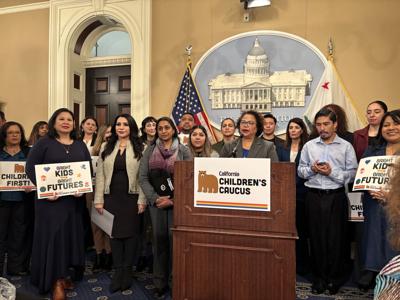


Assemblymember Mia Bonta held a press conference at the Capitol on Tuesday announcing the launch of the state's first ever Children's Caucus. (Andrea Valadez / CALÓ News)
A group of around 40 assemblymembers and senators, both Republicans and Democrats, are set to form California’s first ever Children’s Caucus.
The bipartisan caucus will focus on legislation that supports children and families across a spectrum of policy points including childcare access, child welfare, housing security, foster care and more.
“Being in the California legislature, one thing that you find very, very challenging is trying to figure out how to ensure that we have the ability to center children and youth and [their] voice in the work that we do,” said Assemblymember and Children’s Caucus Founding Chair Mia Bonta (D-Oakland) during a press conference on Tuesday. “It can be very challenging, and the reality is that as we ask that question ‘how are our children?,’ the answer, despite our very best efforts today in California, is not so good.”
Child poverty in the state has more than doubled since 2021, rising from 7.5% to 18.6% in 2024. Latino and Black children continue to face higher rates of poverty at 22.7% and 23.3%, respectively.
Caucus members are already working on or are planning to introduce several pieces of legislation aimed at supporting children in the state. Some of the bills include:
Assembly Bill 1969 (Bonta) will create a three year grant program for cradle-to-career networks across the state;
AB 1709 (Josh Lowenthal, D-Long Beach) would seek to follow in Australia's footsteps and set a minimum age requirement for social media platforms; and
AB 1914 (Pilar Schiavo, D-Santa Clarita), would require cities and counties to include childcare in their long term growth strategies by allocating space for child care providers in their jurisdictions
Coincidentally, the group End Child Poverty California held a press conference at the Capitol last week calling on legislators to address the coalition’s Imagine 2026 agenda that features policy points ranging from the expansion of family tax credits to increased child care access.
To that second point, the coalition made it clear they expect legislators to follow through on a 2021 promise to fund and create 200,000 child care slots. To date, there have been approximately 129,000 slots created while the rest remain unfunded.
“That will certainly be one of the areas that the caucus will focus in on,” Bonta told CALÓ News. The assemblymember clarified that the Children’s Caucus, alongside the California Legislative Women’s Caucus, is focused on increasing child care slots across the state.
“They continue to be deferred and defunded in our budget priorities and I think this is our opportunity to put kids first in all aspects of our budget,” Bonta said.
During Tuesday’s press conference Bonta also introduced AB 1996, the No More Child Poverty Act, which sets a goal to cut child poverty in half within ten years and establishes an 18 member council to hold the state accountable towards this goal.
Many of the children’s bills Lowenthal has co-authored this session are around public health. AB 1700 involves establishing an eSafety commission for oversight of what minors are doing online. One of Lowenthal’s bills that has yet to be introduced would prohibit the sale of fat loss and muscle building supplements to minors, and another would limit certain products kids can buy online.
“We are failing because this generation is not surpassing the generation before it, as every generation has,” said Lowenthal. “And so it's incumbent upon us to put things together to protect all Californians.”
Assemblymember Rick Zbur, a Democrat representing East Hollywood up to Santa Monica, recently introduced AB 1967, a bill that would strengthen protections for youth in foster care.
The bill seeks to create additional safeguards for children who report feeling unsafe in foster homes, and requires child welfare agencies to respond and investigate in a timely manner, as well as ensuring young adults between the ages of 18 and 21 can access extended foster care benefits when they age out of the system.
“When we look at who the most vulnerable kids are today, it's the kids of immigrants, it's our immigrant kids, kids who are children of color and it's LGBTQ kids, especially our trans kids,” Zbur said.
Senate Bill 845, authored by Sen. Sasha Renee Pérez (D-Pasadena) would expand career technical education and youth apprenticeships in the state by providing hands-on learning opportunities and removing barriers to industry participation. The bill is moving through the state senate and is currently waiting for a second committee review.
“California’s career education system is leaving many students behind, especially low-income, Black, Latino and English learner youth who enroll in college at lower rates and face barriers to degree completion,” Pérez said in a press release. “Our career education system must improve to meet the needs of students and the demands of our state’s workforce.”








(0) comments
Welcome to the discussion.
Log In
Keep it Clean. Please avoid obscene, vulgar, lewd, racist or sexually-oriented language.
PLEASE TURN OFF YOUR CAPS LOCK.
Don't Threaten. Threats of harming another person will not be tolerated.
Be Truthful. Don't knowingly lie about anyone or anything.
Be Nice. No racism, sexism or any sort of -ism that is degrading to another person.
Be Proactive. Use the 'Report' link on each comment to let us know of abusive posts.
Share with Us. We'd love to hear eyewitness accounts, the history behind an article.