
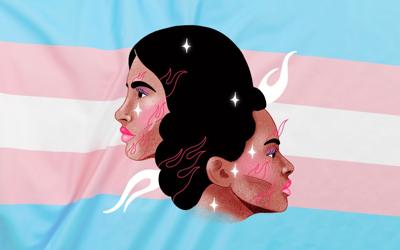

The trans umbrella represents inclusivity. But who is actually being accounted for under this term? Nonbinary, gender nonconforming, queer, genderqueer and genderfluid people– everyone but trans Chicanas and Latinas.
In a time where LGBTQ+ lives are constantly being scrutinized and contested, it is crucial to protect trans Chicana and Latina identity, by not using language that diminishes our visibility or erases our existence. There is a need for an intersectional and more inclusive definition of transgender.
Besides, we must ask ourselves: for a movement so keen on diversity, why the need to squeeze an ever-expansive number of gender identities into a singular category?
Trans scholar T. Benjamin Singer warns us of the trouble of the trans umbrella in an article published by Transgender Studies Quarterly at Duke University.
“Umbrellas should arrive with a disclaimer,” Singer cautions. “One size does not fit all.”
And it is true. Boxing me into the trans umbrella eradicates the multifacetedness and complexity of my trans Chicana and Latina identity, which is why I agree with Singer’s ‘one size does not fit all’ argument.
I mean—when has that ever been true?
Trans Chicanas and Latinas do not fit neatly into mainstream definitions of transgender that render trans identity as a limitless umbrella term capable of holding any and all gender identities, mainly because trans Chicanas and Latinas embody a unidirectional gender identity.
To force such a loose definition on trans Chicanas and Latinas, would be to erase the intersectional identity of the brown trans female subject, and therefore, erase trans Chicanas and Latinas altogether.
Singer is one of many voices cautioning against the umbrella metaphor. Trans Chicana and Latina Eden Estrada–famously known as Eden the Doll–touched on the topic of the trans umbrella in an interview with YouTuber Matt Cullen. “There’s also a lot of negative stigma now because of how big the umbrella term is,” Estrada admits.
I have experienced the stigmatization Estrada mentions, which usually manifests itself in being branded as someone who is unstable, perverse, and confused. This form of trans de-legitimacy is doubly harmful to trans Chicanas and Latinas because we contend with racism on top of transphobia.
Equally concerned about the trans umbrella argument is Dr. Natalia P. Zhikhareva, a clinical psychologist and trans specialist, who wrote the letter that expressed my readiness for sex reassignment surgery in 2020.
“Transgender is a huge, huge umbrella term right,” said Dr. Zhikhareva in a video posted to her YouTube channel. “And that’s another problem with the language that we have today. We’re using the word trans and transgender … to cluster everybody underneath, and I personally think that’s quite problematic.”
Many trans Chicanas and Latinas fit into the gender binary system, however, not without posing challenges to cis-heteronormative spaces. Trans Chicanas and Latinas embody a form of transness with a specific landing locale–meaning that for many trans Chicanas and Latinas transition looks like undergoing social and medical transition from male to female, and while there might be stops along the way, the end point is typically womanhood.
A video posted by the Trans Latin@ Coalition website titled “Dying to be a Woman, Morir Por Ser Mujer,” Dr. Johanna Olson-Kennedy, and even the CEO and Founder of Trans Latin@ Coalition, Bamby Salcedo, spoke on the urgency for many trans Latinas to medically transition and embody a form of cis-femininity and womanhood.
The problem with a definition of transgender that deems it an umbrella term is that it lacks nuance. Transgender is a gender category contingent upon time, geography, and racial or ethnic backgrounds.
As a self-identified trans Chicana and Latina, who lived as a hyper-femme, gay man for over five years, I have often felt misplaced when gender variant people, genderfluid, or those who do not subscribe to the gender binary are placed within the transgender category.
It feels like being a guest in your own home.
Make no mistake. This critique of the trans umbrella metaphor is not a call to exclude gender identities that don’t meet a laundry list of requirements to be transgender nor an attempt to start a conversation surrounding the construction of qualifications for being transgender.
My critique simply highlights the fact that a universal definition of transgender that deems it an all-inclusive gender category is not representative of the intersectional identity of trans Chicanas and Latinas, and, in fact, erases Chicana and Latina trans-ness.







(0) comments
Welcome to the discussion.
Log In
Keep it Clean. Please avoid obscene, vulgar, lewd, racist or sexually-oriented language.
PLEASE TURN OFF YOUR CAPS LOCK.
Don't Threaten. Threats of harming another person will not be tolerated.
Be Truthful. Don't knowingly lie about anyone or anything.
Be Nice. No racism, sexism or any sort of -ism that is degrading to another person.
Be Proactive. Use the 'Report' link on each comment to let us know of abusive posts.
Share with Us. We'd love to hear eyewitness accounts, the history behind an article.