
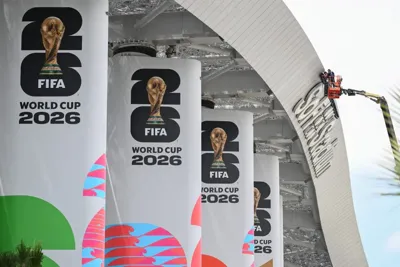

Workers are seen on a crane at Los Angeles Stadium (temporarily renamed from SoFi Stadium) ahead of the 2026 FIFA World Cup, in LA on June 7, 2026. (Credit: Patrick T. Fallon / AFP via Getty Images)
In Los Angeles, a group of Angelenos play soccer together as part of a nonprofit called the People’s Football Club, established on the principles of working-class solidarity and anti-racism. The group’s matches often draw attention to social issues. In March, for example, the club organized a match called “Football Belongs to the People,” which aimed to mobilize working-class people against the impending FIFA 2026 World Cup tournament.
The international men’s soccer championship takes place every four years, with the World Cup kicking off June 12 in LA. Considered the “marquee host city,” eight of the tournament’s 104 international matches will take place at LA’s SoFi Stadium.
But not everyone is happy about the megasports event touching down in the city.
A promotional flyer for the People’s Football Club event focused on the World Cup depicts a Mexican soccer player between two masked federal immigration agents, with the words “Abolish ICE Abolish FIFA.” Agencies such as Customs and Border Protection and Immigration and Customs Enforcement are routinely deployed to large sporting events, stoking fear in immigrant communities.
“People’s Football has players who have varying degrees of consciousness,” said Victor Quintero, an organizer with the football club. “I think the one unifying factor amongst all players in [recreational] soccer is FIFA is universally hated. I don’t think it requires much consciousness or politicization to understand that FIFA is really a cancer on the game.”
While soccer is often seen by players as a great unifier, Quintero said the way FIFA operates is antithetical to the sport. He pointed to the organization’s reliance on tech companies that partner with the Department of Homeland Security, and how its exorbitant ticket prices have left working-class Angelenos unable to attend the games happening in their own backyard.
Beyond FIFA’s impact on soccer, there is also a deep resistance mounting at each of the sporting event’s host cities, where organizers are fighting against the displacement, gentrification, and state violence that go hand in hand with the World Cup.
“You do, you pay, we take”
Distinct from other World Cup games, this year’s tournament will take place across 16 cities and 104 matches in three countries: Canada, the U.S., and Mexico. LA, host to the greatest number of games after Dallas, Texas, will also host the 2028 Summer Olympics, leaving local organizers on edge about the growing potential for unprecedented human rights violations and further displacement and gentrification.
In March, Amnesty International released a report warning of the repressive practices and human rights crises likely to emerge as part of “the largest and most lucrative FIFA World Cup in history.” This includes the displacement of unhoused populations through street sweeps; ethnic profiling; indiscriminate raids; unlawful detention and deportation; and crackdowns on organizing, peaceful assembly, and protest. Another report from Human Rights Research tracks the patterns of human rights violations associated with megasporting events like the World Cup and the Olympics, finding labor exploitation, displacement and evictions, and the suppression of civil liberties common in host cities.
FIFA has also made a practice of papering over the reputations of authoritarian regimes. Most recently, FIFA awarded President Donald Trump its inaugural “FIFA Peace Prize,” a blatant attempt to curry favor with the president, according to human rights groups.
“Angelenos love football, and we have a long history of being a football-loving city,” said Eric Sheehan, organizer with NOlympics LA, a coalition of dozens of organizations fighting to prevent local officials from using the 2028 Olympics as a justification to host more “catastrophic megaevents” in the future. “But the people who run FIFA cannot be trusted to run major events because they use it to empower themselves and their friends, and to wash the reputations of state actors like the U.S. and Israel.”
Other critics have decried the intensive, lengthy restrictions FIFA implements on host cities. In LA, FIFA retains all commercial rights to the event but the entirety of the event’s financial burden rests on the host city, creating what Towson University sports management assistant professor Robert Sroka characterized in a September 2025 academic journal article as a “you do, you pay, we take” proposition benefiting FIFA.
While FIFA required each host city to create “human rights risk assessments” for the sporting event, a majority of the cities missed the August 2025 extended deadline. However, even advocates from cities that successfully created “human rights strategies” expressed skepticism that these efforts would have a substantial outcome.
Laura Macintyre, a staff lawyer with Vancouver, British Columbia’s human rights law firm Pivot Legal Society, noted that when FIFA host city Vancouver published its human rights strategies in February, it was a “laundry list” of existing policies and procedures, most of which lacked funding or measures to scale up.
“We tried to get a meeting with the host city committee for a year and a half, but were ignored,” Macintyre explained to Prism. “We made our earliest request in June 2024, and we finally got a meeting with them on Feb. 20, 2026—the day after the draft plan was released.”
Many host city’s plans for the sporting event include beautification projects, as required by FIFA. In the LA host city agreement, for example, the city is “to render the public facilities and public spaces within the Host City as attractive as possible … and shall, at its own expense, carry out the respective beautification measures.”
Advocates and organizers decried these obligations as instruments of displacement.
In Vancouver, officials implemented a “beautification” zone over a mile long around the BC Place stadium that encompasses the Downtown Eastside neighborhood, home to many community members experiencing homelessness, substance dependence, and poverty. Many have expressed a fear of displacement, similar to what occurred during the 2010 Olympics.
The amenities constructed solely for the benefit of tourists also inspires resentment among local residents.
Seattle is spending $32 million to host six FIFA matches this year. “Something that all of Seattle is feeling is that any of these improvements—like bathrooms, water fountains, trash, free transit—are magically available for FIFA passholders. What about the rest of us for the rest of the year?” said Em, who is using a pseudonym for safety reasons. The Seattle-based organizer is a member of the Chinatown International District Coalition, a grassroots group of community organizers fighting displacement.
“The social ills of the urban fabric”
Megasports events have significant social impacts, according to organizers, but perhaps none more dangerous than the ability they provide officials to rid cities of their perceived undesirable populations.
For example, Al Jazeera reported that as part of preparations for the 2014 World Cup in Brazil, 250,000 of the country’s poorest residents—primarily located in São Paulo, Rio de Janeiro, and Porto Alegre—bore the brunt of the sporting event when they were threatened with eviction or displaced from their housing.
Tyeshia Redden, an assistant professor of urban planning at the University of Toronto, studies the impact of megasports events on majority-Black cities. She told Prism that there are many examples of the World Cup displacing entire neighborhoods.
“Particularly for South Africa, we saw the World Cup being used as a premise for displacement before the World Cup,” she explained. “But then we also saw evictions and displacement continue for years after. So what we actually see is that these megasporting events are instruments for massive urban transformation—and that urban transformation usually does not include Black residents in a positive way. Usually they are considered a part of the social ills of the urban fabric.”
Redden emphasized that “history doesn’t repeat, but it rhymes,” noting that World Cup host city Atlanta issued citations to Black unhoused residents en masse ahead of the 1996 Summer Olympics. Police officers also prefilled citations with “Black, male, homeless” in anticipation of clearing unhoused people from the streets.
Major sporting events are also used to clear the streets of community members who are criminalized and moralized by the public, including those who use drugs or engage in sex work.
According to some local advocates, the LA mayoral race has also proven to be a factor in the city’s latest efforts to address long-standing social issues with criminalization.
“The heightened visibility offered by this moment has since translated into a war on harm reduction and syringe services driven by LA’s ongoing mayoral race,” said Benton Oliver, a researcher from York University in Toronto focused on displacement. “While some [mayoral] candidates have capitalized on this momentum to moralize drug users and make use of the low-hanging political fruit to further their campaigns, it is ultimately the city’s most vulnerable who will bear the burden of these decisions and remain subjected to displacement, violence, and death for the purpose of watching sports.”
Em pointed to the numerous Asian immigrant massage workers in Seattle and greater King County whose businesses are being raided under the guise of anti-trafficking efforts. As a petition from the Massage Parlor Organizing Project notes, it is low-income Asian immigrant massage workers who are disproportionately targeted.
The insidious impacts of the FIFA World Cup may look slightly different depending on the host city, but the strategies employed by local officials to displace and “beautify” are markedly similar. The repercussions will be particularly severe for Angelenos due to the 2028 Olympics.
LA previously hosted the 1984 Summer Olympics, where unprecedented city funds were pumped into more personnel and weapons, further militarizing police who conducted sweeps in working-class neighborhoods near the stadiums. Before and during the 1984 Olympics, this drastic increase in policing led to the criminalization of Black and Latinx youth in South LA. NOlympics LA connects the city’s increased militarized policing and violence during this time to the tinderbox conditions lit aflame after the police beating of Rodney King in 1991.
Decades later, with the approach of both the World Cup and the Olympics, Sheehan, the NOlympics organizer, said local residents would feel the repercussions for years to come.
“We’re seeing rents in Inglewood skyrocket since the announcement for the Olympics, which happened to coincide with the building of SoFi Stadium. … The Olympics was definitely a big part of the calculus for that,” Sheehan told Prism.
While the construction of SoFi Stadium, where the World Cup games are scheduled to take place, did not directly expropriate land and housing from existing residents, it led to a series of cascading consequences. For example, locals report increases in housing costs and gentrification, which pushed out Black and Latinx residents. Tenants in Inglewood homes directly around the stadium have also reported rent increases, evictions, landlord harassment, increased policing, and the presence of real estate companies flipping the foreclosed homes of Black and Latinx people for a higher profit.
A network of cities rising up
While officials trumpet the so-called benefits of being a host city, residents are fully aware of the World Cup and Olympics’ negative impacts on their communities—and they’re organizing against these events and building power together.
Sheehan told Prism that there is a growing coalition of organizations in LA determined to make the city inhospitable to megaevents as a part of NOlympics LA. A similar movement also exists internationally.
When Brazil hosted the World Cup in 2014, thousands of protesters took to the streets in São Paulo, Rio, and other Brazilian cities. More recently, residents in host cities have protested to express their anger and frustration with the heightened cost of living, evictions, and displacement from the World Cup.
In Mexico City, these issues have hit a breaking point. Residents are facing increased rent hikes as long-term residences are converted into Airbnbs, in addition to a recent influx of “digital nomads,” or U.S. citizens with well-paying jobs that allow them to work remotely. These American workers are exacerbating housing demands in the city and increasing the cost of living, leading to large-scale protests. The World Cup is only accelerating Mexico City’s gentrification. Despite commitments from high-ranking lawmakers to increase rent regulation and implement other strategies, housing groups, researchers, and advocates say the proposed reforms are insufficient.
When the FIFA Congress met in Vancouver in April, hundreds rallied in opposition. Local community groups, including Pivot Legal Society, emphasized how three single-room occupancy hotels—home to almost 300 people—will be closed in time for the World Cup, leaving these community members without housing.
“[Our goals are] one, to draw attention to our work and to our demands, but two, to tie the thread between local impacts on Vancouver, like criminalization and displacement, and the global impact, like FIFA’s complicity in genocide, and the fact that they will not be acting against Israel despite the military killing over 400 Palestinian football players,” said Macintyre, in reference to Israel being allowed to compete.
Quintero, the organizer with People’s Football Club, is resolute about the future and FIFA’s relationship to soccer. He views soccer as a site of struggle, separate from the institution of FIFA. This is why the football club fundraiser matches are organized in collaboration with local organizations to uplift social justice issues, including recent partnerships with Dyke Soccer to support the local trans community, and Palestinian Youth Movement to support residents in Gaza.
As the union that represents more than 2,000 SoFi Stadium workers voted to authorize a strike ahead of the World Cup, Quintero said much of his disdain for FIFA lies with the association’s plutocratic underpinnings.
“FIFA is a symptom of capitalism, and capitalism is the main disease here,” Quintero said. “We’re calling to abolish FIFA. Football belongs to the people.”







(0) comments
Welcome to the discussion.
Log In
Keep it Clean. Please avoid obscene, vulgar, lewd, racist or sexually-oriented language.
PLEASE TURN OFF YOUR CAPS LOCK.
Don't Threaten. Threats of harming another person will not be tolerated.
Be Truthful. Don't knowingly lie about anyone or anything.
Be Nice. No racism, sexism or any sort of -ism that is degrading to another person.
Be Proactive. Use the 'Report' link on each comment to let us know of abusive posts.
Share with Us. We'd love to hear eyewitness accounts, the history behind an article.