
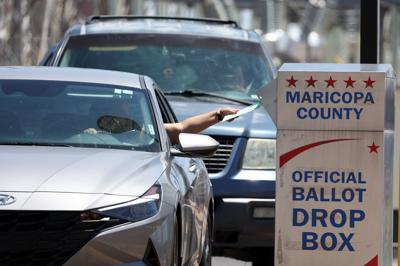


PHOENIX, ARIZONA - AUGUST 02: A voter places a ballot in a drop box outside of the Maricopa County Elections Department on August 02, 2022 in Phoenix, Arizona. Arizonans are heading to the polls to vote in the state's midterm primary election. (Photo by Justin Sullivan/Getty Images)
This story was originally published by Votebeat.
It’s Election Day, and all eyes are on the desert as voters, pundits, and national politicos await primary results from Arizona. But when will those results be known?
The first batch of primary election results are expected to drop about an hour after the polls close Tuesday, with more to follow throughout the night.
But full results are likely to take days. Arizonans are allowed to drop off their mail ballots until polls close on Election Day, and those ballots must be processed before they can be counted. Specifically, mail ballots go through a signature verification process that acts as a safeguard against voter fraud. In total, the state gives county election officials about two weeks to completely wrap up counting.
Here’s what to know about the counting process and when to expect results.
When will ballots be counted, and which will be counted first?
Arizonans don’t just vote on Election Day.
Rather, voters cast ballots over a period of weeks, by various means — via mail, by ballot drop box, or early in person. That means their votes get tabulated, and the results reported, in a specific order after polls close.
Ballots cast in the weeks leading up to Election Day are usually the first to be counted.
The state allows election staff to start processing votes as soon as preelection tests are performed on vote-counting machines, or tabulators. That testing, a safeguard to ensure accurate results, occurred last month. Voting — and counting — has been ongoing since then.
Those ballots are likely to be included in the first round of results from the counties at about 8 p.m. MST on Tuesday. In Arizona, the vast majority of voters cast their ballots by mail, so that drop will represent a sizable chunk of the state’s results.
Already, the ballots counted in Maricopa and Pima counties represent more than half of the total votes cast in each jurisdiction during the 2022 midterm primaries: Around 867,000 in Maricopa and 228,000 in Pima. Overall, turnout statewide is trending lower than in 2022, which saw record-breaking participation.
On election night, workers will report results from ballots cast by in-person voters at the polls and mail ballots dropped off by voters who chose to show ID to verify their vote, a new option implemented statewide this year that aims to speed counting. Mail ballots that aren’t ID-verified must go through the lengthier signature verification process.
Many of the state’s counties are geographically massive, so it may take a few hours for polling places in the farthest reaches of each region to report results. Typically, counties post several rounds of results through the early morning hours on Wednesday.
In the days after the election, workers will process and tally early ballots dropped off immediately before and on Election Day. New batches of ballots are usually reported each day.
Finally, elections staff will process ballots that require a closer look. They’ll investigate provisional ballots, which are used when there are questions about a voter’s eligibility. They’ll ask voters to bring in photo ID to process conditional provisional ballots, which are used when a voter forgets to bring identification with them to the polls. They’ll also contact voters to “cure,” or verify, any questionable signatures on early ballots.
Those voters will have up to five calendar days — for this year’s primary, until Sunday, July 26 — to respond to election officials’ inquiries. Counties usually wrap up counting shortly thereafter.
Where can I find Arizona election results?
Results are available online. Check the Arizona secretary of state’s website or your county elections department’s website. Several media outlets will also post results on their websites; their results may differ slightly from those on government websites because they sometimes input results in a different order.
When do results become official?
Results on election night are unofficial.
For this year’s primary, counties must complete their canvass by August 3. The state canvass is scheduled for August 6. Results are official once the state canvass concludes.
When will races be called?
Media outlets and political pundits usually don’t wait for results to become official to call races. Although these calls don’t have the force of law, media outlets will declare winners in a race when one candidate has a large enough lead that the uncounted votes are extremely unlikely to change the outcome of the contest.
That means races with large vote disparities can often be called on election night before full results are in. But in swingy Arizona, many races often have tight margins and take longer — sometimes several days — to call.
What happens if there are recounts?
In Arizona, any races decided by a margin of half a percentage point or less are subject to an automatic recount.
A recount truly means a complete recount. If a contest falls within the recount margin, election workers have to completely retest their county’s tabulators, retally the ballots, and repeat a hand count audit of a statistically significant number of ballots.
All of that happens after county officials certify election results, so recounts may not be completed until a few weeks after Election Day.
What happens if there are election challenges?
Candidates have a five-day window after the state canvass to challenge the result of an election in court. For this year’s primary, all challenges must be filed by August 11.
How quickly such a challenge would be resolved is up to the courts — and depends in part on how serious and complex the challenge is. But, given that general election ballots need to be printed with the correct candidates by September, courts typically try to resolve these cases as fast as they can.
Sasha Hupka is a reporter for Votebeat based in Arizona. Contact Sasha at shupka@votebeat.org.










(0) comments
Welcome to the discussion.
Log In
Keep it Clean. Please avoid obscene, vulgar, lewd, racist or sexually-oriented language.
PLEASE TURN OFF YOUR CAPS LOCK.
Don't Threaten. Threats of harming another person will not be tolerated.
Be Truthful. Don't knowingly lie about anyone or anything.
Be Nice. No racism, sexism or any sort of -ism that is degrading to another person.
Be Proactive. Use the 'Report' link on each comment to let us know of abusive posts.
Share with Us. We'd love to hear eyewitness accounts, the history behind an article.