
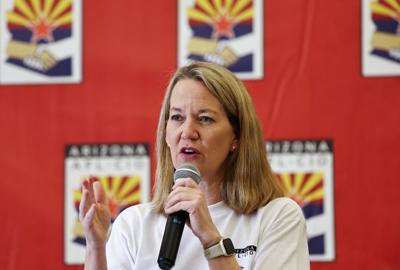


Arizona Attorney General Kris Mayes speaks at an Arizona AFL-CIO GOTV (Get Out the Vote) canvass launch with union members and supporters at IUPAT Hall on November 2, 2024 in Phoenix, Arizona. (Photo by Mario Tama/Getty Images)
A knock on Ryan Whitaker’s door reverberated through his apartment at approximately 10:52 p.m on May 21, 2020, while he was playing video games on the couch with his girlfriend. Less than a minute later, his body collapsed to the tile floor of his entryway, following multiple shots from a Phoenix police officer.
An upstairs neighbor had called 911 to report a “domestic dispute” coming from Whitaker’s apartment. Shortly after, the neighbor called again and Officers John Ferragamo and Jeff Cooke responded. They approached the apartment through a dimly lit hallway and knocked on the door.
Whitaker opened the door shirtless and stepped out to confront whoever knocked.
Ferragamo’s flashlight illuminated a gun in Whitaker’s right hand, and yelling ensued. Whitaker began to crouch, raising his empty left hand. He didn’t make it very far before he was shot.
During the investigation of the fatal shooting, Cooke would later say he acted to protect his partner from what he saw as an immediate deadly threat. He drew his department-issued gun and shot Whitaker twice before Whitaker’s gun could scrape the ground.
 The moment Ryan Whitaker was shot by a Phoenix police officer after answering the door with a gun in his hand on the night of May 21, 2020. (Courtesy of the Phoenix Police Department)
Cooke was investigated and placed on administrative leave. Allister Adel, the Maricopa County Attorney at the time, determined that neither Whitaker nor Cooke violated any criminal laws. The Phoenix City Council voted 9-0 to pay $3 million to Whitaker’s family in December 2020, seven months after the shooting. By the end of 2021, after a private session, the Phoenix Civil Service Board rescinded Cooke’s termination and reduced his punishment from dismissal to a 240-hour suspension with back pay, in accordance with Officer’s Bill of Rights.
The case illustrates the conflict Arizona Attorney General Kris Mayes brought up in her Jan. 23 comments on Arizona’s “stand your ground” law. She made the comments during an interview with 12News after the killing of Renee Good by ICE agents in Minneapolis. Mayes’ comments brought the collision of cowboy culture and the legal grey area surrounding stand your ground laws into sharper focus. Advocates and experts said despite the controversy, Mayes hit on a murky conflict between an Arizonan’s right to self-defense and encounters with law enforcement.
“We have a stand your ground law that says that if you reasonably believe that your life is in danger and you're in your house or your car or on your property, that you can defend yourself with lethal force," Mayes said.
Her comments also came just days before the killing of Alex Pretti, who was carrying a legal firearm, by Border Patrol agents in Minneapolis. The killings brought the Second Amendment to the forefront of the national conversation surrounding the immigration enforcement tactics of the Department of Homeland Security.
Arizona House and Senate Republicans recently censured Mayes, passing a resolution that also called for her resignation.
“HR 2004 condemns the Attorney General’s public remarks concerning the use of force against law enforcement officers and declares the House’s disapproval of statements that law enforcement leaders and even Governor Hobbs warned were incomplete, misleading, and dangerous,” according to a press release about the resolution.
Mayes, in response to the wave of criticism, stressed that she was not encouraging violence against law enforcement.
“Arizonans do not want masked agents entering their homes without warrants. It is un-American and threatens the rights and safety of everyone in our state,” she said in a statement.
Whitaker’s family and the Phoenix Police Department did not respond to requests for comment.
Ricardo Reyes is the executive director of Vets Forward and treated protesters who had been pepper sprayed by ICE agents in the aftermath of the protests outside of a Zipps Sports Grill during a Valley-wide raid in January. At similar protests outside of a Zipps Sports Grill location in Phoenix, there were reports of a protester wearing what appeared to be an assault-style rifle confronting an ICE agent.
“Guns are very prevalent in Arizona, way more prevalent than they are in Minneapolis,” Reyes said. “So we're worried that things are going to escalate and things are going to get bad because of the poorly trained agents that don't know how to handle those situations.”
By law, Arizonans have “no duty to retreat before threatening or using deadly physical force,” allowing them to defend themselves if they “believe that deadly physical force is immediately necessary to protect himself against the other's use or attempted use of unlawful deadly physical force.”
The law gets more complicated when applied to law enforcement, according to Charles Heller, co-founder of the Arizona Citizen’s Defense League. Heller has been involved in the gun rights legislative process for the past 20 years and is a concealed carry and self-defense instructor.
“If someone comes into your home or your car and you believe they're an immediate deadly threat, you can use whatever means are necessary to resist something you believe could be lethal to you. However, the law specifically exempts law enforcement in that,” Heller said.
Standing your ground against a law enforcement officer is illegal unless the officer is using “excessive force.” Arizona’s self-defense law clarifies that “the threat or use of physical force against another is not justified to resist an arrest that the person knows or should know is being made by a peace officer or by a person acting in a peace officer's presence and at his direction, whether the arrest is lawful or unlawful.”
But the law has one caveat: “unless the physical force used by the peace officer exceeds that allowed by law.”
April Gendill is chapter president of the Tucson Pink Pistols, a national LGBTQIA+ gun rights organization focused on gun safety, education and first aid. It has multiple chapters in Arizona and offers gun-related safety courses.
“Arizona is the Wild West of gun ownership,” she said. “We have very relaxed gun laws here, very self-defense friendly laws.”
Gendill said she believes an armed agent with a mask on and no visible law enforcement identifiers confronting an Arizonan could lead to a dangerous encounter.
“It's a very real possibility that if they approach someone here in Arizona the same way they have in other states, something terrible could happen and that would be a tragedy,” Gendill said.
After serving on the largest police force in the country for decades, a retired NYPD captain thinks ICE needs to have an overall reform with local sensibilities. He said what works in one state does not necessarily translate to another. He thinks ICE would benefit from the “advice and wisdom of local law enforcement.” But he said he has no qualms about law enforcement shooting someone pointing a gun at them.
"I tend to believe that if someone's got a gun, and that gun is not hitting the floor fast, you know, he's hitting it next," said the retired captain who declined to give his name for professional implications.
While not directly involved in ICE operations, local law enforcement can be deployed to deal with situations involving ICE and the public. According to the former captain, a group of ICE agents surrounded by protestors could be freed by local law enforcement, who would then deal with the aftermath of the confrontation. He said the key to avoiding tragedy is training.
 Border patrol agents on horseback before a press conference with United States Secretary of Homeland Security Kristi Noem, at the Mexico-United States border wall on Wednesday, Feb. 4, 2026, in Nogales. (Matthew Marengo/Cronkite News)
"It's a danger to everybody to have under trained police, because now we got all of these people with guns," he said referring to ICE agents. "But now we've given them some authority, and we've given them guns, and we've given them no training. So what? What can we expect, other than people getting innocent people getting shot?"
As federal immigration operations in Arizona increase, the Phoenix Police Department released a statement clarifying how officers will differentiate themselves from federal agents. Phoenix officers will clearly identify themselves and they will not wear face coverings.
The department reaffirmed that they cannot participate in ICE operations but also cannot “interrupt or prevent” operations in the city of Phoenix.
Matthew Cavedon, director of the Cato Institute’s project on criminal justice, said he believes that a lack of easy identification puts all parties in danger.
“In any place where you have people who are armed or who might defend themselves through any means if they don't know that the police people coming up are law enforcement or are government agents, that's an incredibly dangerous situation for police officers, for homeowners,” Cavedon said.
Historically, Border Patrol agents were used to do what Cavedon characterized as “man the border” and run checkpoints at airports. According to Cavedon, putting ICE agents in street settings is new territory, and the lack of understanding displayed by ICE agents about First Amendment rights reflects a lack of training.
“The sense of ‘we're going to arrest anybody who gets too close to us with a gun, or anybody who's criticizing us verbally while we're doing our work,’ that's illegal,” Cavedon said.
Other law enforcement officers often live and work in the same community, interacting with the people they are sworn to protect in that area on a daily basis, experts said. They also have a beat and patrol the same neighborhoods regularly, which creates an incentive for accountability.
“If you're a masked person whose name is not on your uniform, who was flown in from four states away, who's not going to be there next week?” Cavedon said. “I can't help but think that that changes the incentives for how you interact with members of the public.”
As the Valley braces for increased ICE presence, Secretary of Homeland Security Kristi Noem visited the border in Nogales, Arizona.
 United States Secretary of Homeland Security Kristi Noem during a press conference at the Mexico-United States border wall on Wednesday, Feb. 4, 2026, in Nogales. (Photo by Matthew Marengo/Cronkite News)
Government officials and local organizations have been encouraging bystanders to film interactions with ICE agents, which is legal in a public setting, such as a street or sidewalk, under the First Amendment.
Arizona Gov. Katie Hobbs on Feb. 4 launched Know Your Rights Arizona, an online resource providing information to help Arizonans understand their constitutional rights.
The website provides guidance on what to do if stopped by ICE and what forms of identification should be carried and includes an online portal to report federal misconduct for personal rights violations.
In the Whitaker case, then Maricopa County Attorney Adel summarized the conflict in her conclusion on the incient.
“This is precisely why this case is so heart-wrenching: while both Officer Cooke and Mr. Whitaker could have made decisions that would have avoided this terrible result, neither did anything that is prohibited by our criminal laws,” Adel said.
This article first appeared on Cronkite News and is republished here under a Creative Commons Attribution-NoDerivatives 4.0 International License.







(0) comments
Welcome to the discussion.
Log In
Keep it Clean. Please avoid obscene, vulgar, lewd, racist or sexually-oriented language.
PLEASE TURN OFF YOUR CAPS LOCK.
Don't Threaten. Threats of harming another person will not be tolerated.
Be Truthful. Don't knowingly lie about anyone or anything.
Be Nice. No racism, sexism or any sort of -ism that is degrading to another person.
Be Proactive. Use the 'Report' link on each comment to let us know of abusive posts.
Share with Us. We'd love to hear eyewitness accounts, the history behind an article.