
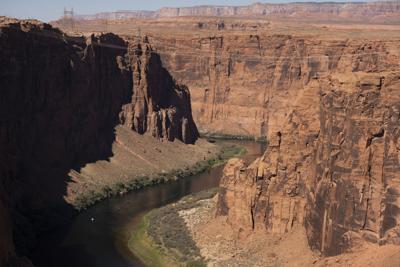

The Colorado River snakes through a canyon just outside Glen Canyon National Recreation Area on July 10, 2025 in Page, Arizona. Lake Powell, a critical Colorado River reservoir, is only at a third of its capacity as drought conditions in the Southwest worsen. (Rebecca Noble/Getty Images)
This story was originally published by AZPM.
The seven western states that rely on the Colorado River for water have failed to come up with new operating guidelines for a second time.
Arizona Governor Katie Hobbs released a joint statement with California Governor Gavin Newsom and Nevada Governor Joe Lombardo on Friday, Feb. 13 – before the federally imposed deadline of Saturday, Feb. 14, stating that the stakes couldn’t be higher for the Lower Basin states.
“Approximately 75% of the population, employment, and agricultural crop sales of the Colorado River Basin are in our states. This also includes 25 of the 30 sovereign Tribal nations that live in the Basin.”
The Upper Basin – made up of Utah, Colorado, New Mexico and Wyoming – argues that the Lower Basin – made up of Arizona, California and Nevada – should take on more cuts since they use more water.
Arizona has offered to reduce its allocation by 27% followed by Nevada by 17% and California by 10% the statement said.
However, the Lower Basin argues that all seven western states must share the responsibility of conservation.
Doug Burgum, Secretary of the Interior said in a statement that negotiations have been productive and believes that a fair compromise between the states is within reach.
“We remained dedicated to working with them and their representatives to identify shared solutions and reduce litigation risk,” Burgum said. “Additionally, we will continue consultations with Tribal nations and coordinate with Mexico to ensure we are prepared for Water Year 2027.”
Sharon Megdal is the director of the water resources research center at the University of Arizona. She says part of the reason why these negotiations have been so contentious is that for a long time, the states planned on getting predictable amounts of water per year.
“Historically, what the big concern was, is what happens when we have too much water and how does that get divvied up among the states? But then we realized that the problem may be more having insufficient water, a shortage of water compared to the average or below what is obligated to the states,” Megdal said.
In 2007, a set of guidelines was adopted by the Department of the Interior based on negotiations among the seven states as to how to share shortage. These guidelines were to be renegotiated at the end of 20 years.
Megdal says that water stakeholders didn’t anticipate the low flows of the last two decades at the time that those guidelines were set.
“What’s happened with the storage in the reservoirs is that around the turn of the century, they were pretty full but since 2000, we’ve had these drier years, we’ve been pulling from storage,” Megdal said. “And so now here we are in 2026, we have to look at a new approach to sharing the shortage and we don’t have the benefit of the buffer of storage savings.”
The availability of this water depends on snowpack levels in the Upper Basin, however there are some reductions in precipitation in snowpack as well as higher temperatures, Megdal said.
“So the flows are not the same,” she said.
Ongoing drought spanning 25 years and a significant reduction in inflow to Lake Powell – by 1.5 million acre-feet according to a recent forecast – shows worsening hydrological conditions across the Colorado River basin.
The Colorado River provides water for about 40 million people for municipal use according to the Bureau of Reclamation, as well as serving as a vital resource for 30 Tribal nations and two Mexican states.
Tucson relies on Colorado River water. Its annual contract allocation is about 140,000 acre feet, which is transported to Tucson via the Central Arizona Project - a 330 mile system that supplies Colorado River water to Arizona’s most populated regions.
Despite the CAP potentially facing significant cutbacks in new operating guidelines, Megdal says Tucson is not using all of its allocated water.
“If there are some cutbacks, we can absorb some of the cutbacks and we do have water in storage,” she said.
Megdal said she hopes that the states strike a deal even if only for a few years.
“I’m still going to be hopeful that we avoid heavy litigation, but given that both in Arizona and other states people are building up their legal war chests, maybe that’s where we’re going to end up,” Megdal said. “Maybe that’s where we’re going to end up, but this will probably be a very long, drawn out battle.”










(0) comments
Welcome to the discussion.
Log In
Keep it Clean. Please avoid obscene, vulgar, lewd, racist or sexually-oriented language.
PLEASE TURN OFF YOUR CAPS LOCK.
Don't Threaten. Threats of harming another person will not be tolerated.
Be Truthful. Don't knowingly lie about anyone or anything.
Be Nice. No racism, sexism or any sort of -ism that is degrading to another person.
Be Proactive. Use the 'Report' link on each comment to let us know of abusive posts.
Share with Us. We'd love to hear eyewitness accounts, the history behind an article.