
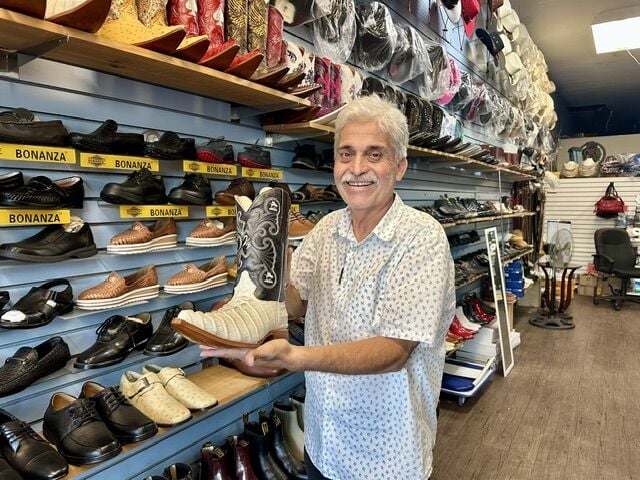
José Montañez, during the final days of his iconic shoe store in South Central Los Angeles. Photo credit: Araceli Martinez
A drop in sales caused by aggressive immigration enforcement operations led José Montañez to close his South Central Los Angeles shoe store, which had become a favorite spot for the Mexican migrant community to buy cowboy boots.
“To be honest, we decided to close because sales dropped to zero. We aren't even making enough to cover the cost of gas,” said Don José, as neighbors and customers know the Mexican immigrant who established his business selling boots, hats, huaraches, footwear and jackets in South Central Los Angeles 25 years ago.
“Everything was going very well, but since this president took office, sales have dried up, and with the raids, people just aren't buying anymore,” he says.
The merchant learned the shoemaking trade from his father in his hometown of León, Guanajuato, Mexico. When he immigrated to the United States in 1996, he began importing footwear directly from Mexican artisans to sell in Los Angeles.
He established his first business selling cowboy boots, piteado belts (leather goods embroidered with agave fiber), jackets and Mexican footwear in South Central Los Angeles in 1996; thirteen years ago, he opened Zapatería Montañez just south of Broadway, near the corner of 43rd Street.
“Our success was due to the fact that our boots, jackets and vests are authentic products from León, Guanajuato, made of genuine leather; I don't sell anything synthetic, and some of the designs are created by myself.”
He also had a reputation for catering to his customers' specific tastes. “If a customer asked for boots or a jacket with a certain design that we didn't have in the shop, I would have it custom-made in Mexico.”
Don José attributes the slump in sales to drastic immigration enforcement operations and the fact that the majority of his customers are undocumented immigrants. “My customers were hardworking rural laborers, masons, construction workers and gardeners. Because of the raids, they’ve left the country or are afraid to go out.”
Before Trump became U.S. president, he had plans to open a third store, but when the raids began and sales dropped, he backed out.
“I told the person who was going to rent to me that I wasn't going through with it after all.”
The situation is so critical that he is three months behind on rent.
“Right now, the rent is $1,950. Just as we were coming out of the pandemic, they raised it by $500; and the landlords want their money; they don’t care whether you’re making sales or not.”
For a while, he borrowed money at interest to survive and keep the shoe store open, but when customers stopped coming altogether, he had no choice but to close.
“I was sinking deeper into debt by borrowing. I didn’t want to close, but without sales, I can’t go on; it’s not worth continuing to rack up debt.”
Don José laments the lack of support from municipal and state governments.
“Local and state officials just go on TV saying they’re going to provide aid. It’s not true. I’ve submitted requests two or three times, and they just send messages saying I’ve moved to phase one or two, but they’ve never actually given me anything.”
The 64-year-old merchant makes no secret of his disappointment at seeing his dream of a shoe business crumble.
“I feel a bit sad, because I always tried to help the community with toys and shoes. Just recently, I sent 200 pairs of shoes to Mexicali for low-income families. That’s what hurts, not being able to help the most needy anymore.”
In his heyday, he employed two people and sold up to $12,000 worth of merchandise a week; today, he says, he’d be happy just to bring in $500. However, all is not lost. Don José says he is going to focus on the boot stall he runs at the Ontario swap meet, where he sells on weekends and pays rent between $470 and $520 a month.
“With the closing of this shoe store, a chapter comes to an end, but I’m going to keep selling and set up a shoe workshop in León, Guanajuato. Selling shoes has been my life since I was a child, and I’m not giving it up.”
He adds: “Maybe when this president leaves office, I’ll open a bigger shoe store in Los Angeles.”
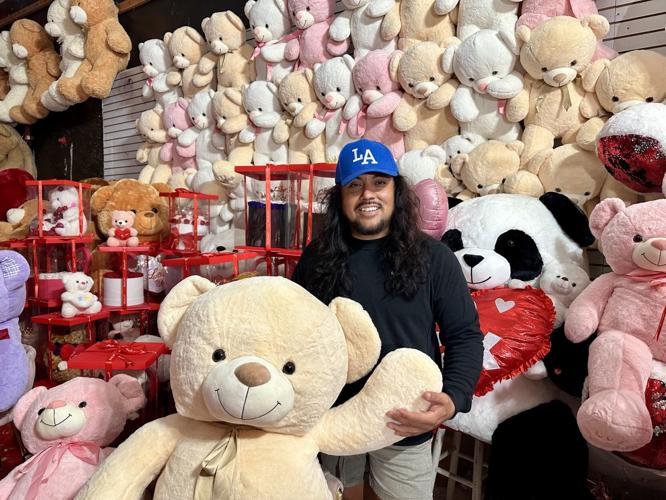
Joshua Montalvo, owner of two small businesses, Melody Rosy (La Casa de Ositos Gigantes) and Love Teddy Bears, and a neighbor of Zapatería Montañez, cannot believe that Don José, whom he considers a fellow fighter, is leaving.

Joshua Montalvo, small business owner in South Central Los Angeles. (Photo credit: Araceli Martinez)
“His business became very strong. It was a very well-stocked shop. I liked coming in to buy things or just to chat with Don José because the smell of the leather took me back to Mexico,” he says. “Don José has been an inspiration to small business owners in South Central like me because, through his shoe store, he supported Mexican artisans and the community. I first met him while he was handing out toys to children in South Central on Three Kings' Day.”
Joshua, who closed his small musical instrument shop early in the Trump administration, says he hopes to survive the impact of the crackdown on immigrants.
“I only sell two or three teddy bears, and I live with the constant stress of figuring out how to sell more. I open at 8:30 in the morning and close at 11 at night. Small business owners have been suffering ever since Trump became president.”
Almost a year after the massive raids in Los Angeles, 95% of business owners continue to experience financial stress, and more than half say that revenue no longer consistently covers operating costs, according to a study, “Cost of Fears,”from theUCLA Latino Policy and Politics Institute(LPPI) in partnership withInclusive Action for the City.
According to the July report, owners describe depleted savings, mounting debt, staff reductions, declining health and postponed or abandoned growth plans.
“Our research shows that immigration enforcement functioned as an economic shock that extended far beyond the immediate disruption associated with enforcement operations,” said Amada Armenta, director of LPPI and a co-author of the report.
“The loss of customers disrupted businesses across sectors and formats, regardless of the owner’s immigration status. A year later, many business owners remain financially vulnerable, with fear, uncertainty and financial strain contributing to worsening health and wellbeing.”




(0) comments
Welcome to the discussion.
Log In
Keep it Clean. Please avoid obscene, vulgar, lewd, racist or sexually-oriented language.
PLEASE TURN OFF YOUR CAPS LOCK.
Don't Threaten. Threats of harming another person will not be tolerated.
Be Truthful. Don't knowingly lie about anyone or anything.
Be Nice. No racism, sexism or any sort of -ism that is degrading to another person.
Be Proactive. Use the 'Report' link on each comment to let us know of abusive posts.
Share with Us. We'd love to hear eyewitness accounts, the history behind an article.