
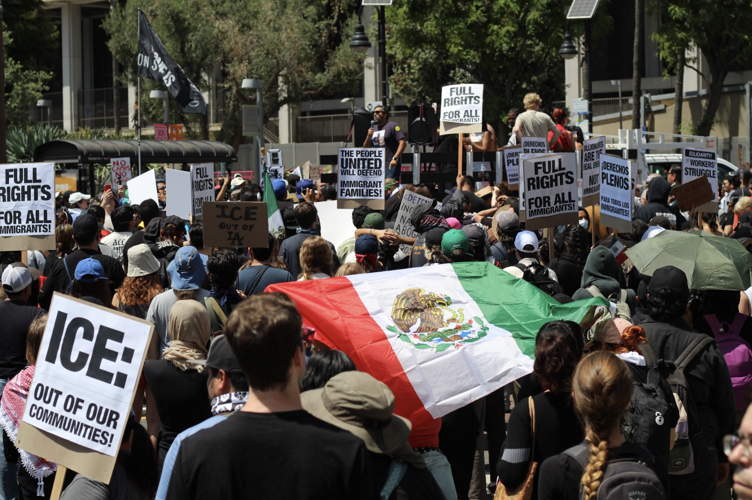
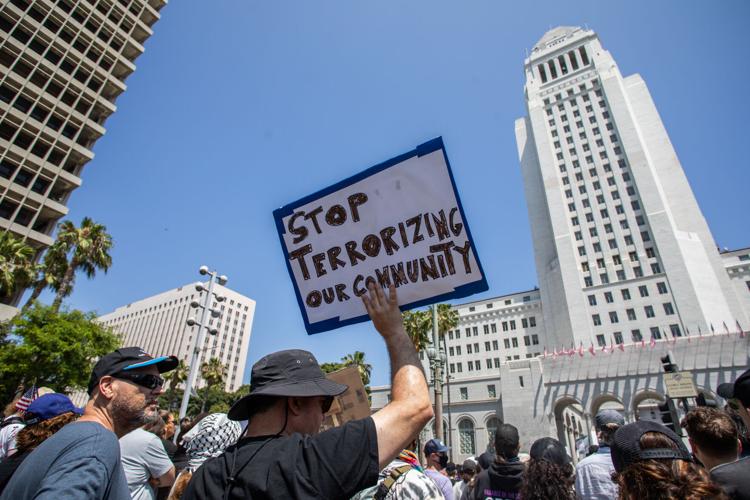


Protestors gather in front of L.A. City Hall on Sunday June 8, 2025 to speak out against immigrations sweeps throughout Southern California. (Image credit: Michelle Zacarias)
The 2025-26 California legislative session ended this week, and Democrats succeeded in passing the majority of tough-on-Trump immigration bills introduced this year.
The beginning of this session coincided with President Donald Trump’s return to office and subsequent mass deportation agenda. The administration's often violent immigration enforcement, alongside subpar conditions inside detention centers, led Democratic lawmakers, many of them Latinos, to introduce a slew of legislation this year aimed at protecting California’s immigrant communities.
The California Assembly and Senate officially wrapped up their sessions on Tuesday, ultimately passing hundreds of bills. These bills now head to Gov. Gavin Newsom’s desk, where he has until the end of the month to either sign the bills into law or issue vetoes.
Here are some of the immigration bills lawmakers that got to the finish line.

Protestors against immigration raids gather in front of the Los Angeles City Hall on June 08, 2025 in Los Angeles, California. Tensions in the city remain high after the Trump administration called in the National Guard against the wishes of city leaders following two days of clashes with police during a series of immigration raids. (Apu Gomes/Getty Images)
Protecting Vulnerable Immigrant Detainees Model Act
One of the more last-minute bills passed at the end of session was Sen. Sasha Renée Pérez’ (D-Alhambra) SB 957, a late gut-and-amend of Pérez’ SB 955, which was killed in the Assembly Appropriations Committee in August.
SB 957, dubbed the Protecting Vulnerable Immigrant Detainees Model Act, would require the California attorney general to identify the most effective ways in which the state could develop a comprehensive detention facility oversight plan by Dec. 31, 2027, and signal the governor to direct the proper state agencies to cooperate with and conduct the oversight plan.
“We cannot accept inhumane conditions and the loss of life that is happening at these facilities,” Pérez told CALÓ News in a written statement. “I am hopeful that Governor Newsom will sign this critical legislation.”
Pérez said her team has been in touch with Newsom’s office to discuss the policy specifics and express the need for an oversight plan. The senator also said California Attorney General Rob Bonta has expressed support for the bill.
“The bottom line is if these privately-operated facilities are going to operate in California, we have the authority to ensure they are following California’s health and safety laws,” Pérez said.
“GTFO” Act
AB 1896, the Get the Feds Out (GTFO) Act, would bar individuals who participated in federal immigration enforcement between 2025-29 from most local and state jobs, including working as peace officers.
The bill received heavy debate during its Assembly floor vote in May, with various Republican lawmakers saying it is unconstitutional.
"The GTFO Act makes clear that if you were part of the machinery that terrorized our communities through immigration enforcement, California will not employ you,” Assemblymember Mark Gonzalez (D-Los Angeles), bill co-author, told CALÓ News.

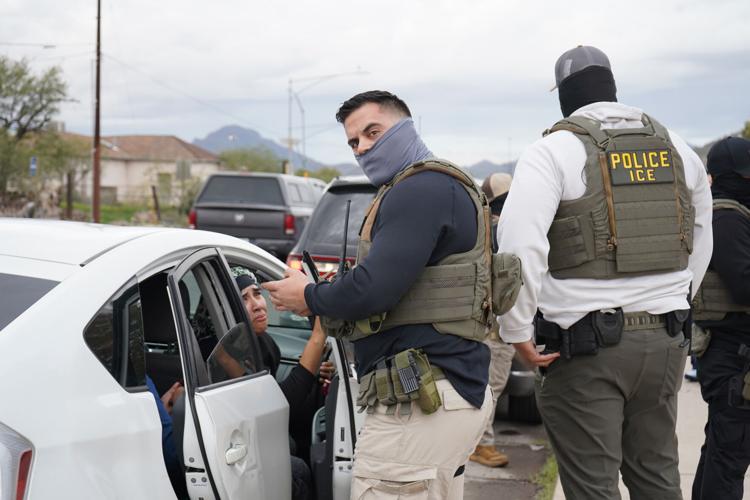
An Immigration and Customs Enforcement (ICE) agent stares at a CALÓ News reporter witnessing people being detained during a traffic stop on Friday, Jan. 23, 2026, in Tucson, Arizona.
Assembly Speaker Robert Rivas (D-Salinas), one of the most influential players in the Legislature, is also a co-author of the bill.
Assemblymember Gonzalez said he calls on the governor to sign the bill and “send a clear message.”
"I’m urging the Governor to sign this crucial bill and show the country California protects its people first," Gonzalez said.
Detention Facility Transparency Act
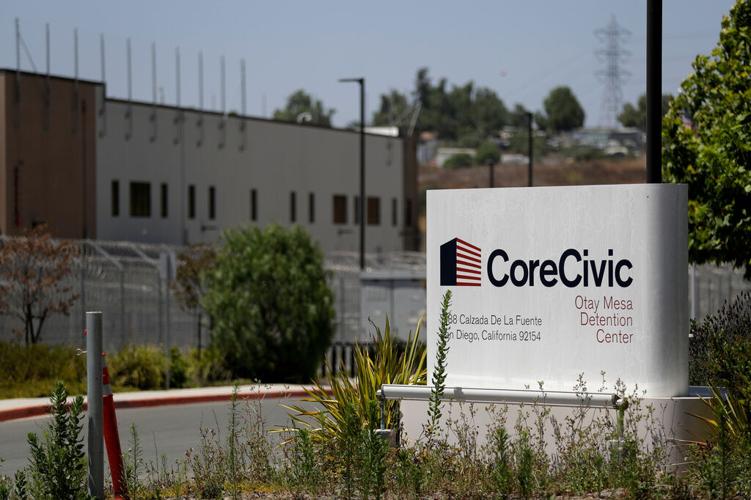
Sen. Lena Gonzalez (D-Long Beach) has said this bill came about in part due to a CalMatters investigation that found reports of rape at the Otay Mesa immigration detention center were being investigated by the warden instead of the sheriff’s department.
CalMatters reporters were denied access to certain records under the California Public Records Act (CPRA) because they were part of an ongoing law enforcement investigation.

A sign for the Otay Mesa Detention Center sits in front of the building, in San Diego, July 7, 2020. AP Photo/Gregory Bull, File)
SB 423 would amend the CPRA to require local agencies to disclose all audio recordings and other records relating to 911 calls that come from inside privately owned detention facilities like Otay Mesa.
Under the bill, there would still be limitations on which records could be released based on whether they are deemed to interfere with an active investigation, while simultaneously ensuring that “illegitimate claims of confidentiality cannot be used to shield these facilities from public scrutiny,” according to a press release.
“I am proud to author SB 423, not only because it is sound public policy that prioritizes transparency and accountability, but because it is morally the right thing to do,” the senator said in a statement.
Civil Detainees’ Bill of Rights
The Legislature passed Sen. Anna Caballero’s (D-Merced) SB 942, a bill looking to enshrine into state law a first-of-its-kind list of protections for individuals in detention facilities.
“We are serious about meaningful action that protects human health and welfare and creates enforceable standards,” Caballero said in a statement.
During an August Latino Caucus press conference, Caballero said the bill ensures “basic standards of care,” including detainees’ right to:
Dignity, privacy, and humane care;
Mental health services;
Medical and dental care and treatment;
A right to clean drinking water and functioning toilets and showers; and
Adequate food that is prepared and served in a “healthful manner.”
No Kings Act
Sen. Scott Wiener (D-San Francisco) introduced SB 747 last November, hoping to make it easier for people to sue federal agents who violate their Constitutional rights.
If signed into law, the bill would create a legal pathway at the state level for individuals to file lawsuits against any federal, state or local enforcement officer who violates the law. The current federal pathway for this kind of lawsuit is extremely limited.
“A loophole in the law has protected ICE, CBP and other Trump officials from accountability for these crimes,” Wiener said in a statement. “That impunity has helped to power ICE’s terror campaign, and the No Kings Act is a powerful step to end it.”
The bill would allow lawsuits in cases involving First, Fourth and Fifth Amendment violations. It would apply to cases dating as far back as March 1, 2025 and has a two-year statute of limitations on claims.
The Democratic supermajority in the Legislature also passed bills that would strip state tax credits from companies invested in detention facilities and prohibit immigration enforcement from detaining individuals participating in lawful court proceedings.
A controversial bill regarding the private information of immigrant support providers has already been signed by Newsom.





(0) comments
Welcome to the discussion.
Log In
Keep it Clean. Please avoid obscene, vulgar, lewd, racist or sexually-oriented language.
PLEASE TURN OFF YOUR CAPS LOCK.
Don't Threaten. Threats of harming another person will not be tolerated.
Be Truthful. Don't knowingly lie about anyone or anything.
Be Nice. No racism, sexism or any sort of -ism that is degrading to another person.
Be Proactive. Use the 'Report' link on each comment to let us know of abusive posts.
Share with Us. We'd love to hear eyewitness accounts, the history behind an article.