
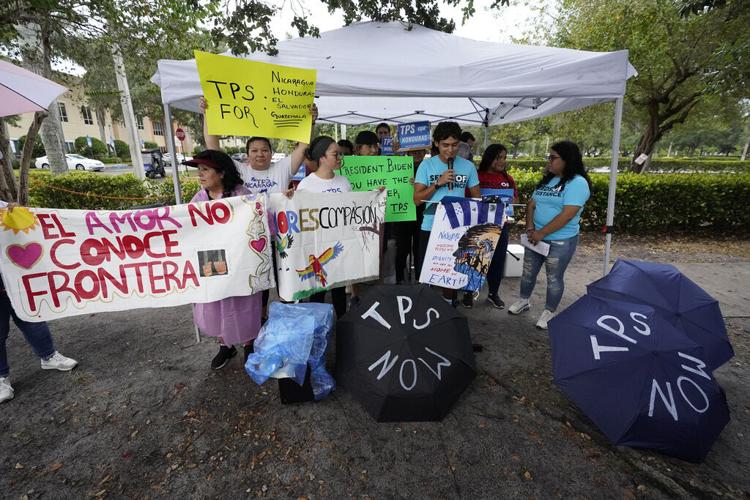



Demonstrators hold signs calling for a new designation of Temporary Protected Status (TPS) for migrants from Nicaragua, El Salvador, and Honduras, in front of the Immigration and Customs Enforcement (ICE) offices, Wednesday, July 26, 2023, in Miramar, Fla. (AP Photo/Wilfredo Lee)
Since 1990, individuals from countries that are experiencing turmoil have been able to migrate to and work in the United States under Temporary Protected Status (TPS). Only immigrants from four countries qualify for TPS, and one of those, El Salvador, might be losing its status on Sept. 9.
The Trump administration has systematically been ending TPS for various countries and immigrants since early 2025. Since last March, the administration has terminated TPS for over one million individuals, according to data from Congress. Around 170,000 Salvadoran immigrants living in the U.S. could lose their status once the country’s designation expires on Wednesday.
In a statement to CALÓ News, a DHS spokesperson said an announcement regarding El Salvador’s TPS will be made at the “appropriate time,” and Salvadoran TPS holders "retain protection” until an announcement is made.
In March 2025, less than two months after the second Trump administration began, 17 countries had TPS. Today, only four countries remain protected: El Salvador, Lebanon, Sudan and Ukraine.
The 50,000 TPS holders from Honduras lost their protection on Sept. 8, 2025.
Venezuela’s TPS designation expired on May 19, 2025, though some of its TPS recipients who received an Employment Authorization Document on or before February 5, 2025, are authorized to work in the U.S. until Oct. 2, 2026.
25 years of protection
El Salvador was originally granted TPS in 2001 following two devastating earthquakes, and has been renewed repeatedly due to environmental and political conditions. It is the longest-standing TPS designation in the U.S.
The designation was last renewed in January 2025 by former Department of Homeland Security (DHS) Secretary Alejandro Mayorkas, appointed by former President Joe Biden. Just 10 days before his appointment ended, Mayorkas extended the program for 18 months, citing “environmental conditions in El Salvador that prevent individuals from safely returning.”
The TPS designation is set to expire on Sept. 9, unless current DHS Secretary Markwayne Mullin issues a renewal.
The DHS Secretary, who has full discretion over TPS designations, is legally required to issue a decision on whether a country still qualifies for TPS at least 60 days before the designation expires.
This means the Federal Register should have noted Mullin’s decision in July, but to this day there has been no notice. Last-minute renewals have happened before — most recently, DHS did not file a notice in the Federal Register officially renewing the TPS designation for Lebanon until two days after it had expired.
Although TPS holders were notified on Aug. 12 that their protection status would be terminated on Sept. 9, DHS has not publicly stated whether the designation will be renewed.
The Central American Resource Center of L.A. (CARECEN-LA) held an overnight vigil from 6 p.m. on Sept. 8 to 6 a.m. on Sept. 9, where local Salvadoran TPS holders came together to pray for clarity “that should have come months ago,” CARECEN-LA Communications Manager Martin Pineda told CALÓ News.
“After nearly 25 years of living, working, and raising their children in this country, they deserve more than silence and uncertainty,” Pineda said.
If a formal notice is not filed by Wednesday’s official expiration deadline, protections are automatically extended for another six months. However, Pineda said some TPS holders’ work authorizations are only valid until Sept. 9, meaning even if their TPS protections remain intact, they could be unable to legally work.
If and when the Salvadoran TPS designation does expire, beneficiaries will be reverted back to the immigration status they held before receiving TPS. For some, this would mean a return to an undocumented status and a possibility of removal from the country.
DHS’ silence on the future of Salvadoran TPS holders has led to confusion and uncertainty for the community, advocates say.
“DHS must immediately provide clear written guidance so that TPS holders, their families and their employers are not left to navigate fear and confusion,” Pineda said. “Last night’s vigil demonstrated that this community is exhausted, but it is not defeated. We will continue organizing and fighting for the stability, dignity and permanent protections Salvadoran families have earned."
History of TPS
As of March 31, 2025, the latest dataset available, California was home to nearly 80,000 immigrants protected by TPS.
With the designation deadline looming, California Attorney General Rob Bonta issued guidance to the state’s employers and workers, reminding both of California’s workplace protections for employees with TPS.
“Changes to Temporary Protected Status can create uncertainty for workers and employers alike, but uncertainty does not erase workers’ rights,” Bonta said in a statement. “California employers must continue to follow the law when verifying employment authorization and must not discriminate or retaliate against workers based on their national origin or immigration status.”
Legal battles surrounding TPS

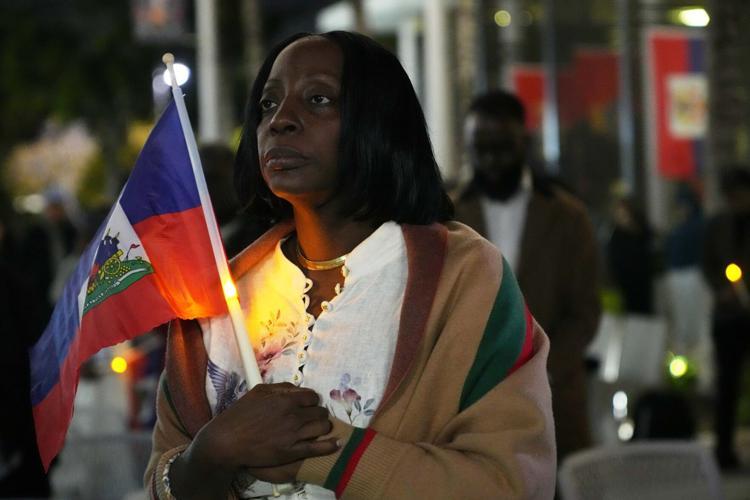
Linda Joseph holds a candle during a vigil at the Little Haiti Cultural Complex after a federal judge blocked the Trump administration from ending temporary immigration status, or TPS, for Haitians, Tuesday, Feb. 3, 2026, in North Miami. (AP Photo/Lynne Sladky, File)
The administration’s sweeping changes to the TPS program have resulted in an onslaught of legal challenges.
Most recently, the U.S. Supreme Court ruled in the Trump administration’s favor in the case of Mullin v. Doe.
Seven Syrian nationals filed the lawsuit against DHS after the agency abruptly terminated TPS for Syria last year. Syria was designated for TPS in 2012, resulting from the country’s civil war.
At the same time, the administration was attempting to end TPS for Haiti, resulting in the lawsuit Miot v. Trump. However, after a long round of lower-court rulings against the federal government followed by federal appeals, the Supreme Court combined both cases on April 29 of this year.
On June 25, SCOTUS ruled that courts have no jurisdiction over DHS’ TPS designations, allowing the Trump administration to end protections for Haitians and Syrians. The Court also rejected a claim that DHS designations were being made because of race, writing it was “unlikely” that was the case.
“The Supreme Court has consistently ruled against the rights of immigrant communities in important cases in the last several years, and this case fits that pattern,” Ahilan Arulanantham, co-director of the Miñana Family Center for Immigration Law and Policy at the UCLA School of Law, said during a June press call.
“The decision hands to the administration, and to the far-right wing of the anti-immigrant movement, an important victory that they have been unable to obtain through Congress for a number of years,” Arulanantham said at the time.






(0) comments
Welcome to the discussion.
Log In
Keep it Clean. Please avoid obscene, vulgar, lewd, racist or sexually-oriented language.
PLEASE TURN OFF YOUR CAPS LOCK.
Don't Threaten. Threats of harming another person will not be tolerated.
Be Truthful. Don't knowingly lie about anyone or anything.
Be Nice. No racism, sexism or any sort of -ism that is degrading to another person.
Be Proactive. Use the 'Report' link on each comment to let us know of abusive posts.
Share with Us. We'd love to hear eyewitness accounts, the history behind an article.