
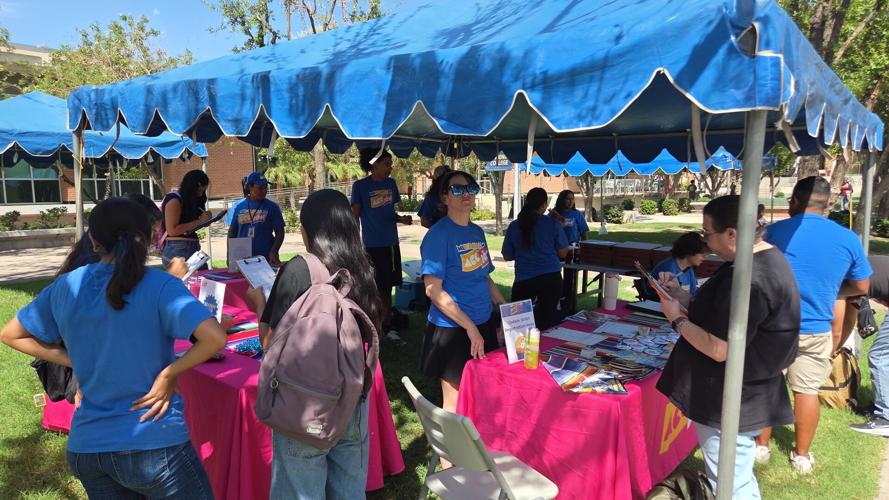

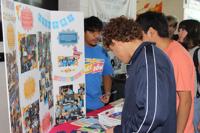

Members of Mi Familia en Acción speak with attendees about voter registration and other resources during a community event in Arizona. | Integrantes de Mi Familia en Acción hablan con asistentes sobre registro electoral y otros recursos durante una actividad comunitaria en Arizona. (Courtesy of Voz en Acción)
Irma has one last trip to make. Almost everything she owns is already packed. Left on the table is a court hearing notice for non-payment of rent, scheduled for Sept. 30 and addressed to her partner. He will be unable to appear or pay what’s due; immigration agents detained him on Aug. 17 while he was on his way to work.
They had been living in that Phoenix apartment with their one-year-old daughter before he was taken.
“This has been very stressful. I’m not doing well emotionally,” said Irma — whose name has been changed for her and her family’s safety — in an interview with CALÓ News.
She will soon have a new home; she has already secured a job and a room to rent in the Valley. “My only day off is Wednesday,” she said. Her grandmother is helping her care for the child.
Before the detention, her partner worked and covered expenses while she looked after their daughter. Irma, a U.S. citizen, said they had planned to begin filing immigration paperwork to change his status, but money was barely enough to cover bills, so the process kept getting put on hold.
The bills piled up: electricity, rent, car insurance — everything that a single paycheck used to cover.
The Voz en Acción platform, launched on Sept. 23 by the Arizona chapter of Mi Familia en Acción (MFA), highlights many of the issues weighing on Irma's household. It identifies four pillars: the cost of living and utilities, access to healthcare and food assistance, immigration rights and voter participation.
Through this platform, the organization aims to explain who makes decisions in Arizona regarding these issues and how the community can get involved.
Monica Sandschafer, the organization's state director in Arizona, said the campaign addresses a cost-of-living crisis that is hitting families and disproportionately affecting people of color. According to Sandschafer, more and more families are turning to food banks. “We're seeing people who were barely getting by before, not getting by now,” she said. “We're seeing a huge increase in people using food banks, struggling. If something like their car breaks down, they don't have the extra money to fix it.”
She described the nonpartisan campaign as a way to turn their “beliefs into action… It's about turning our values into door knocks and phone calls and mail.” The campaign registers voters in Maricopa and Pima counties and recruits volunteers to speak with people within their own networks.
“Everyone is tired of candidate ads and candidate texts and all of those things,” she said. “What cuts through that is when somebody that you know talks to you about something.”
On Election Day, the organization plans to station volunteers outside polling centers to report issues and answer questions. According to Sandschafer, this effort is a response to the unprecedented amount of election-related misinformation reaching the Latino community. Threats such as the presence of immigration agents at polling places and federal attempts to eliminate mail-in voting, according to her, are intended to make people afraid to vote.
“What we're out here doing is making sure that folks know that their vote still counts, they can still vote by mail, their voice on these issues still matters and they can vote safely and securely,” Sandschafer said.
High cost of utilities
The clearest link between an everyday expense and civic engagement runs through the Arizona Corporation Commission (ACC), a five-member elected body that regulates utility companies and sets their rates.
“Not having electricity is not an option in Arizona,” said Sandschafer. You don't survive without air conditioning, right? So you can't say no to electricity, so you pay your bill.”
You can’t choose your utility company, either, she explained. Anyone living in the APS or SRP service areas has no other choice. “What you do have a choice about is who regulates them, and most people don't know that.”
APS recently asked the ACC for permission to raise its rates by nearly 14%, which would generate approximately $579.5 million in additional revenue for the company. For nearly a year, Mi Familia en Acción has been organizing customers to submit public comments and attend Commission meetings to oppose the increase.
Two of the Commission’s five seats are on the November ballot.

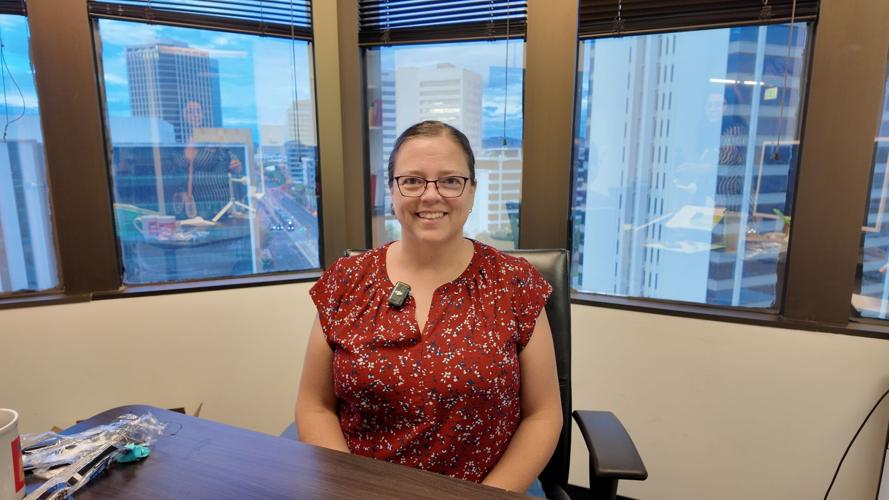
Monica Sandschafer, Arizona State Director of Mi Familia en Acción, during an interview about the Voz en Acción campaign and its civic engagement efforts. | Monica Sandschafer, directora estatal de Mi Familia en Acción en Arizona, durante una entrevista sobre la campaña Voz en Acción y sus esfuerzos de participación cívica. (Celia Montoya/CALÓ News)
“Your electricity bill is literally on the ballot,” said Sandschafer.
But the midterm vote in November will not determine this rate increase. The Commission must resolve the case after the election but before the new commissioners take office. The Commission has until Dec. 31 to vote, and if it approves new rates, they are expected to take effect in early 2027.
Through its campaign, MFA is trying to ensure more people know who regulates electric utility companies, vote in that race and stay engaged afterward. Those elected will shape future decisions on rates and utility services.
“What we… want to say loud and clear in this election is that the Arizona Corporation Commission works for us, that we are the voters, we decide who works for us — not APS, not any, not TEP and none of the other utility companies,” she said.
Health benefits and food assistance
Irma had already started an application for food assistance and state-sponsored healthcare when her partner was living with her. She didn't finish it. The application asked for information on both their incomes and, as she understood it, her partner’s income could disqualify them from the assistance they needed, she said.
After his detention, she returned to the Arizona Department of Economic Security (DES) office. At first, she was told she didn't qualify, but after she explained that she no longer lived with her partner, she “started crying in the office,” she said.
She was approved for emergency benefits.
Irma enrolled in a program that Arizona cut by nearly half over the course of a year. According to preliminary data from the Department of Agriculture, participation in the Supplemental Nutrition Assistance Program (SNAP) dropped by 49.7% — from 892,565 people in February 2025 to 448,976 in February 2026.
During the same period, enrollment in Affordable Care Act (ACA) marketplace plans fell by 30% in Arizona, according to KFF. The decline coincided with the expiration of expanded tax credits and higher consumer costs, although the data does not explain why each individual lost coverage.
The Voz en Acción campaign encourages people to review how candidates and officials have voted on Medicaid, the ACA and SNAP benefits "because what we find is talk is cheap; action is real," Sandschafer said. After the election, she explained, pressure must be maintained on municipal governments, the state legislature and Congress.
Civic engagement goes beyond the ballot
Regarding immigration, the campaign does not draw as direct a line between voting and a specific policy outcome. Furthermore, many of the people most affected by immigration policies are ineligible to vote.
"Not everyone can be at the front, right? Not everyone, based on their situation, can take the risk of going in person to a rally or a march," she said.
She said U.S. citizens can shoulder some of the risk of speaking out publicly when others do not feel they can. Other organizations within the coalition provide training on how to document enforcement operations, as well as Know Your Rights cards and trainings.
She also mentioned less visible forms of participation, such as helping families affected by deportation or participating in mutual aid networks.

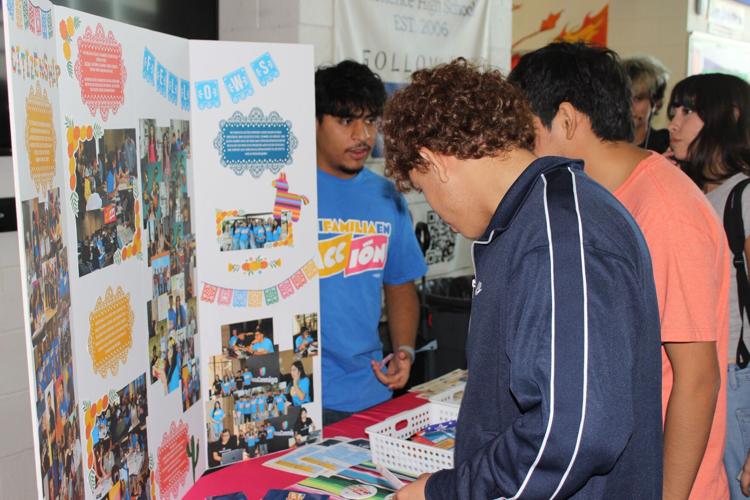
Students visit a Mi Familia en Acción information table during an activity at an Arizona high school, where the organization shared materials on voter registration and civic engagement. | Estudiantes visitan una mesa informativa de Mi Familia en Acción durante una actividad en una preparatoria de Arizona, donde la organización compartió materiales sobre registro electoral y participación cívica. (Courtesy of Voz en Acción)
Finding ways to get people involved
When asked how to reach people who are too overwhelmed to participate, Sandschafer said organizers often make the mistake of deciding for them what should matter.
“I think a lot of times we tend to tell people what they should care about instead of asking them what they care about,” she said.
The strategy, she explained, is to start with the issue that already concerns each person and offer ways to get involved based on their time and circumstances — such as making calls, writing postcards from home or asking someone else to attend a meeting.
Irma knows that lack of time all too well. She works, cares for her daughter and is finishing up a move to a new home.
In the nearly empty apartment, Irma keeps moving boxes. It is close to eight o'clock at night. She has to work the next day. A few weeks ago, she registered to vote for the first time.
“I’ve never agreed with what’s going on,” she said. “I wasn’t registered before, but now I am, and I’m going to vote.”
In Arizona, voter registration closes on Oct. 5, early voting begins on Oct. 7 and the general election is on Nov. 3.
Celia Montoya is a bilingual narrative reporter and writer who works primarily in Spanish-language media, covering migration, culture and everyday life along the U.S.-Mexico border. Her work won second place in the Podcast category at the NAHJ 2026 Ñ Awards for "El precio de los elotes," and first place in the Spanish-language Feature at the Arizona Press Club Journalism Contest.






(0) comments
Welcome to the discussion.
Log In
Keep it Clean. Please avoid obscene, vulgar, lewd, racist or sexually-oriented language.
PLEASE TURN OFF YOUR CAPS LOCK.
Don't Threaten. Threats of harming another person will not be tolerated.
Be Truthful. Don't knowingly lie about anyone or anything.
Be Nice. No racism, sexism or any sort of -ism that is degrading to another person.
Be Proactive. Use the 'Report' link on each comment to let us know of abusive posts.
Share with Us. We'd love to hear eyewitness accounts, the history behind an article.