
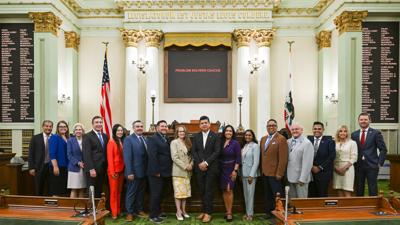



Members of the California Problem Solver Caucus. (By CPSC)
At a time of so much division over policy and priorities between Republicans and Democrats, a group in California is proving bipartisanship can coexist.
For the past seven years, the California Problem Solvers Caucus, a bicameral caucus, has focused on complex state challenges that involve affordability issues.
The caucus is both a convener and a catalyst that interacts with issue experts and crafts legislative solutions based on common ground rather than rigid partisan ideology.
The group is based on a national model, in a bicameral, bipartisan way to get legislators together to focus on solving problems instead of concentrating on party affiliation, according to Assemblymember Anamarie Ávila Farias (D-Martinez), one of the four co-chairs.
“We're committed to people over party and collaborating to produce better public policy,” she said.
Their mission focuses on advancing political results focused on solutions and strengthening the economy through affordability. By doing so, they hope to enhance the quality of life for Californians through legislation.
“We believe that economic prosperity and affordability are not competing priorities, but they're inseparable as well,” she said.
The other three co-chairs are Assemblymembers David Alvarez (D–San Diego), Heath Flora (R–Ripon), and Senator Suzette Valladares (R–Santa Clarita).
The group made up of close to 30 members — senators and assembly members — also presents innovative ideas and invites diverse stakeholders to help advance pragmatic policymaking.
What the caucus has delivered
Assemblymember Farias said a recap of the work that has been done in the past two years includes cap and invest.
“We were instrumental as a caucus in making sure that the state cap and invest regulations did not punish in-state energy producers and protecting jobs and keeping the cost of utilities and gasoline down for our constituents,” she said.
Another promise delivered was AB 30, which approved a cleaner, cheaper E15 fuel blend, projected to save California drivers up to 20 cents a gallon
“So roughly about $2.7 billion annually statewide,” she said.
The third item was sustainable aviation fuel, highlighting the need to support companies that have chosen to embrace California sustainable fuel goals. This led the California governor to propose a sustainable fuel aviation tax credit included in the governor's budget this year.
The caucus is currently waiting on two bills it helped advance in 2025. One of them is the Vehicle Mileage Traveled (VMT) reform, SB 508. This bill deals with VMT mitigation under the California Environmental Quality Act (CEQA), instead of the employee mileage reimbursement rate.
And AB 2552 aims to reduce housing development risk and improve project certainty through thoughtful VMT mitigation reform.
The caucus has also presented immigration principles for state and federal policymakers to consider. This included securing the border, honoring due process and providing a pathway to legal status for essential workers that drive California’s economy.
The work keeps growing
The California Problems Solver Caucus is the largest functioning non-ethnic caucus that focuses on legislation. Farias said she feels the caucus is creating a positive impact in the state. About 25% of California's 120 legislators belong to the caucus.
Farias said in order to join the caucus, Democrats are interviewed by the Republicans, and vice versa.
“That's how people are able to join. That you have to be vetted by the other side and then voted on by the whole committee or the caucus,” she said. “This is the first time the caucus is all Latino-centric, so we're all Latino leadership, which is also an interesting new fact of its current form, and we're growing.”
The chairs meet every week and the caucus meets every other week during lunchtime in Sacramento. That’s when they invite representatives from various industries to tell them about their work, obstacles and how to address affordability.
“You can't be a master of every policy area, so this caucus is a great place to obtain high-level knowledge of issues that are impacting the state, or will be coming before the legislature,” she said.
The caucus encourages internal and external participation. Those outside of legislation are encouraged to do a presentation or join the caucus’s annual conferences
“And for individual constituents, they're always welcome to reach out to us as problem solvers, legislators,” she said.







(0) comments
Welcome to the discussion.
Log In
Keep it Clean. Please avoid obscene, vulgar, lewd, racist or sexually-oriented language.
PLEASE TURN OFF YOUR CAPS LOCK.
Don't Threaten. Threats of harming another person will not be tolerated.
Be Truthful. Don't knowingly lie about anyone or anything.
Be Nice. No racism, sexism or any sort of -ism that is degrading to another person.
Be Proactive. Use the 'Report' link on each comment to let us know of abusive posts.
Share with Us. We'd love to hear eyewitness accounts, the history behind an article.