
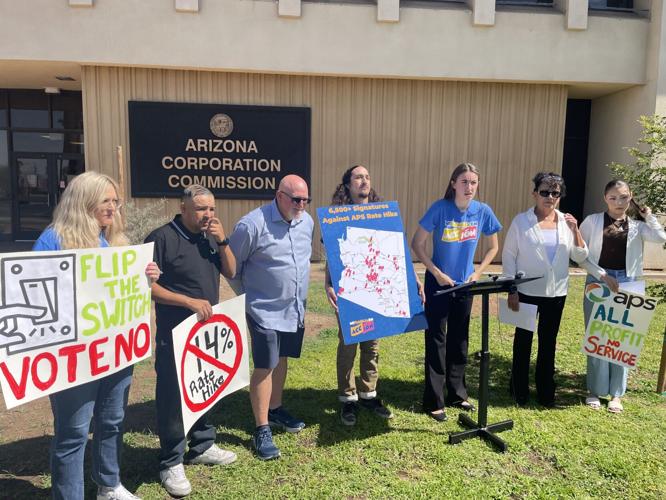



Mi Familia En Acción members and Valley residents stand outside of the Arizona Corporation Commission building, prepared to speak out against the rate increase proposed by APS, on Wednesday, May 6, 2026. (River Graziano/CALÓ News)
We’ve always taught our children that education and hard work would lead to a better life. But as thousands of students graduate and step into adulthood, many will face the same struggles families like mine already know too well: rising utility bills, higher living costs and the growing fear that hard work is no longer enough.
Is this nation setting them up for failure or success? I ask myself if I am contributing enough for a safer, more affordable future for my children and my granddaughter. Right now, electricity, a basic need, is getting harder for many Arizona families to afford; in fact, over 160,000 Arizona households are behind on utility bills. It’s hard enough for two-income families to cover these needs, but as a full-time single mom raising teenagers, I do it all on my own. I skipped my graduating child's senior pictures just to make ends meet. My story isn’t unique; many families are facing harder choices.
The students graduating today have been asked to make a five-year plan. How can they do that when costs keep rising? The lucky ones get to stay home while they continue their studies or enter the workforce; the others have to plan a little harder as they move out, into dorms, into apartments, or shared homes, where they now have to pay bills. The average rent in Tucson is over $1,500, gas is nearly $5/ a gallon and groceries are up — from cereal to tomatoes, milk and bread, everything is going up. They are being asked to pay more just to keep their homes livable. Basic necessities, no luxuries included. We must address this, and one way is by asking utilities to stop raising rates.
After a 10% increase in 2023, Tucson Electric Power (TEP) wants another 14% rate hike. For a typical household, that’s nearly $200 a year. The parent company of TEP, Fortis Inc., reported $1.7B in profits last year, and, in its rate hike, TEP is asking for a 10.5% return on equity and annual rate increases going forward. This extra money they are pocketing doesn’t give you better service or a stronger AC as we go into three-digit temperatures; it goes from your bank account to support the wealthy.
When utility costs rise, the impact is not the same for everyone. Low- and middle-income families are hit hardest. Our students will feel those hits. Parents face difficult decisions, like whether to keep the air conditioning on, fall behind on bills, or cut back on essentials. For Tucson, where extreme heat is becoming more dangerous, this issue goes beyond affordability. It’s about keeping families safe.
We must pay attention to who we put in those decision-making seats. This is where the Arizona Corporation Commission (ACC) comes in. The ACC regulates investor-owned utilities like TEP. It sets rates, oversees long-term planning, and decides which energy investments utilities make. It directly affects how much families pay each month and what kind of future our children will have.
The ACC will choose whether to meet rising energy demand with clean energy or fossil fuels, and how to share the costs. Working families shouldn’t have to pay higher bills while monopoly utilities face little accountability and higher profits. Big industrial users, such as data centers, should not be allowed to pass their infrastructure costs on to families. Instead, the ACC can focus on investments that lower bills, such as energy efficiency, weatherization, and renewable energy, while cutting pollution, especially in communities hit hardest by extreme heat. Commissioners should focus on affordability, accountability, sustainability, and public health when making decisions.
Our children deserve homes where the lights stay on and the air conditioning works when it gets hot. Arizona families should not have to choose between a cleaner, safer future and an affordable present, and our graduates should focus on building their careers rather than worrying about how to pay rising electric bills.
Let’s remember that protecting children is about more than just planning for the future. It means ensuring these students can afford to survive and thrive after graduation.

Cassandra Becerra with Mountain Mamas. (Provided by Cassandra Becerra)
Cassandra Becerra is a Tucson-based advocate, mother and grandmother committed to building healthier, more resilient communities in Southern Arizona. Originally from Guadalajara, Mexico, she spent 12 years serving with U.S. Congressman Raúl M. Grijalva, focusing on community engagement and connecting federal policy to local impact. She now works with Mountain Mamas to advance a healthier, more just future for families and future generations.









(0) comments
Welcome to the discussion.
Log In
Keep it Clean. Please avoid obscene, vulgar, lewd, racist or sexually-oriented language.
PLEASE TURN OFF YOUR CAPS LOCK.
Don't Threaten. Threats of harming another person will not be tolerated.
Be Truthful. Don't knowingly lie about anyone or anything.
Be Nice. No racism, sexism or any sort of -ism that is degrading to another person.
Be Proactive. Use the 'Report' link on each comment to let us know of abusive posts.
Share with Us. We'd love to hear eyewitness accounts, the history behind an article.