
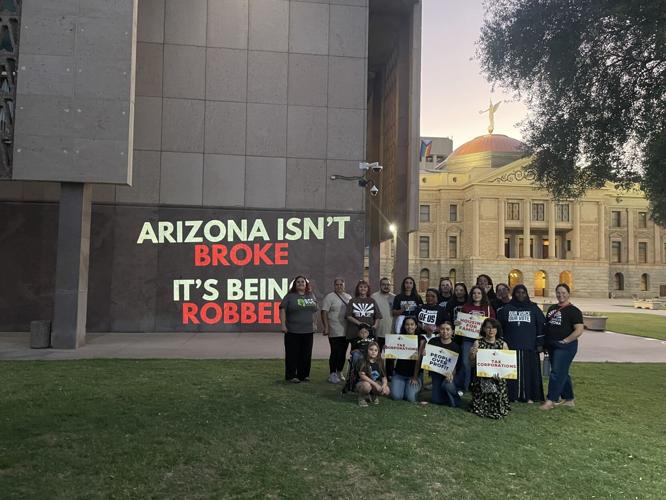
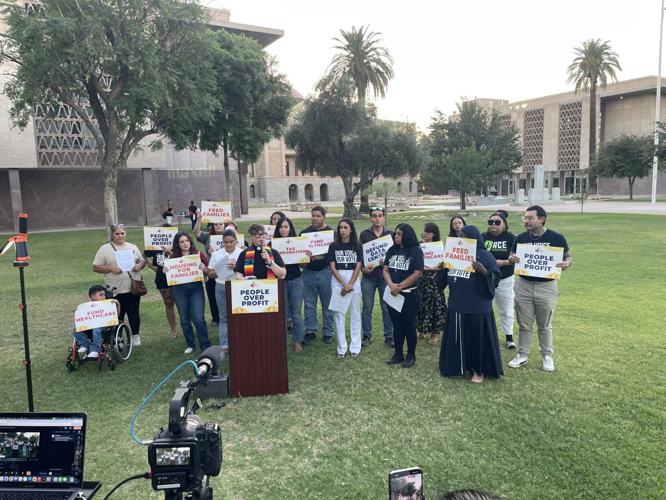
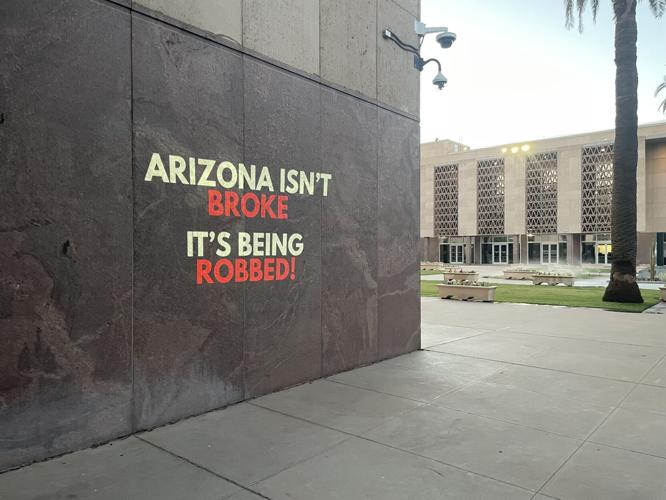

The People First Economy Coalition pose for a photo in front of the Arizona State Capitol where they project a message saying: “Arizona isn't broke, it's being robbed.” (River Graziano/CALÓ News)
A coalition of local affordability and immigration advocacy organizations held a press conference Thursday evening at the Arizona State Capitol, calling for legislators to prioritize struggling Arizonans during state budget negotiations.
Since Gov. Katie Hobbs vetoed a Republican budget proposal in May, calling it “unbalanced and reckless”, negotiations for a new state budget have been ongoing. A new budget must be finalized by July 1 to avoid a government shutdown.
The People First Economy Coalition — composed of local advocacy groups like Living United for Change in Arizona (LUCHA), Our Voice, Our Vote (OVOV) and Fuerte Arts Movement — for Arizona organized the recent press conference around a central message: “Arizona isn’t broke, it’s being robbed.” Speakers shared their personal struggles with affordability and called for Arizonans to resist economic injustice.

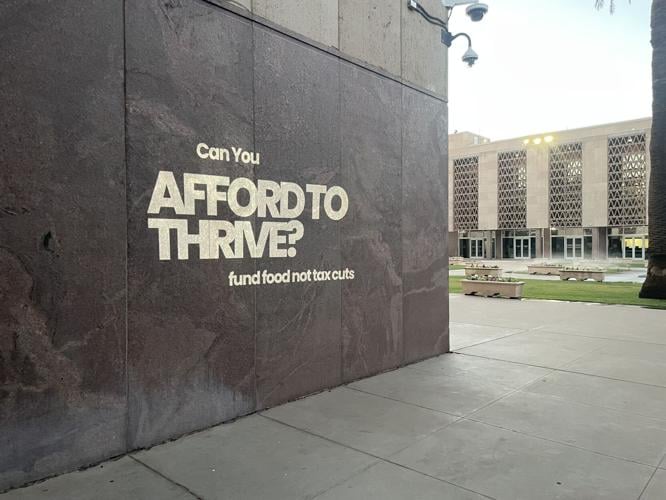
The People First Economy Coalition project messages onto the side of the Arizona Senate building, including “Can you afford to thrive? Fund food not tax cuts.” (River Graziano/CALÓ News)
Amber Rivera, political director for OVOV, spoke as a representative for the Coalition, calling on state legislators to prioritize a “people first economy” as they finalize the budget.
“We're being told there isn't enough money to help [local families], but somehow there's always enough money for corporate tax breaks, loopholes, and giveaways,” Rivera said. “Behind every line item is a family, behind every cut is a consequence, and behind every budget decision is a choice about whose voices matter.”
Javena Gittens is a Tempe resident and peer support specialist representing OVOV. During her speech, she pointed out that while organizations such as A New Leaf exist to support people experiencing homelessness or domestic violence, connecting with them is not easy. Even as early as 7 a.m., hundreds of callers could be trying to reach a single phone line, she said.
“It's kind of like calling through to a radio station. Why should it be that hard of a gamble?” Gittens said.

The People First Economy Coalition speak in front of the Arizona State Capitol where they project a message saying: “Arizona isn't broke, it's being robbed.” (River Graziano/CALÓ News)
Other unique challenges arise in rural areas of Arizona. The Communications Manager for Rural Arizona Engagement (RAZE), Araceli Aquino, said that being from a rural community like Yuma exacerbates the effects of healthcare spending cuts. As a result, she struggled to find mental health care after the birth of her daughter.
“I consider myself lucky because I know my story is not the only one,” Aquino said. “Many others in my community — my friends and family back home in Yuma — are not able to find the support they desperately want and need.”
Magdalena, a member of the Fuerte Arts Movement, told the story of her husband who, because he received $1,600 in disability benefits, was unable to qualify for food stamps. Being retired, his income is fixed, but the cost of everyday necessities are still on the rise. In her speech, Magdalena described the stress of having to choose between electricity, water, phone service and other household bills.
Alongside tax cuts for wealthy individuals, the People First Economy Coalition also called out the tax breaks proposed for data center developments.

The People First Economy Coalition project messages onto the side of the Arizona Senate building, including “Arizona isn't broke, it's being robbed.” (River Graziano/CALÓ News)
As a Buckeye resident, Yolanda Landeros expressed her concerns about the data centers that have already been approved for the area, referring to the zoning approval granted by the Maricopa County Board of Supervisors to a proposed 2,000-acre data center in Buckeye. The environmental and economical consequences of these data centers will be devastating for local families, she said.
“If data centers are as powerful, profitable, and important as their defenders claim, then they should not need a single taxpayer dollar from Arizona families,” Landeros said. “They should pay what they owe.”
Stephanie Maldonado, the political director for the Arizona Center for Empowerment (ACE), one of the main partners of the People First Economy Coalition, said that a “people first” budget should not only improve resources for welfare systems, but remove power from institutions that harm the community.
“[A people first economy] also means forming a hard stance against two things that should not receive one more dollar of our public money: corporate giveaways and immigration enforcement,” Maldonado said.
As the coalition waits for the state budget decision, speakers emphasized the continuous need for community outreach and support.
“We need to [talk] with the neighbors, the families, because this is important. Everybody needs to speak,” Magdalena said in an interview with CALÓ News. “If we stay quiet, they’re going to [do] more and more and more.”

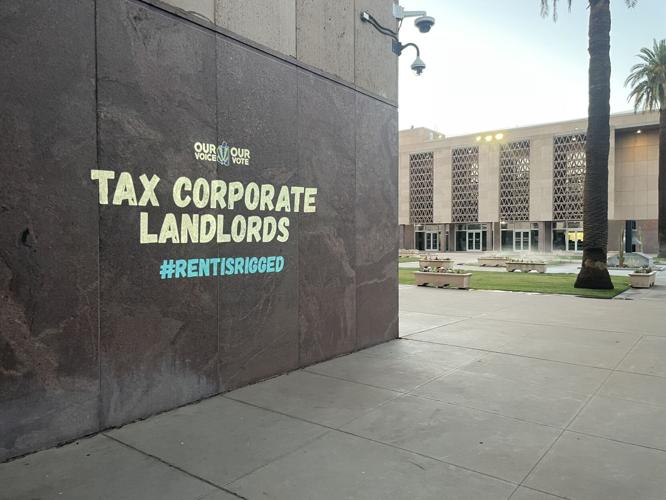
The People First Economy Coalition project messages onto the side of the Arizona Senate building, including “Tax corporate landlords.” (River Graziano/CALÓ News)
“Next time you walk outside and it's a little bit too hot for you, or you walk into a building where you love the air conditioning? Please remember that person that's outside that has nowhere to go,” Gittens said.
River Graziano is a freelance journalist for CALÓ News. They grew up in the Ahwatukee area of Phoenix and later attended ASU in Tempe, where they spent two years as an editor at The State Press. Their reporting with CALÓ News covers advocacy efforts impacting Latine communities across the Valley.






(0) comments
Welcome to the discussion.
Log In
Keep it Clean. Please avoid obscene, vulgar, lewd, racist or sexually-oriented language.
PLEASE TURN OFF YOUR CAPS LOCK.
Don't Threaten. Threats of harming another person will not be tolerated.
Be Truthful. Don't knowingly lie about anyone or anything.
Be Nice. No racism, sexism or any sort of -ism that is degrading to another person.
Be Proactive. Use the 'Report' link on each comment to let us know of abusive posts.
Share with Us. We'd love to hear eyewitness accounts, the history behind an article.