
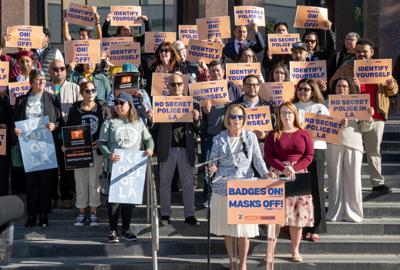


Supervisors Janice Hahn and Linsey Horvath advocate for the ordinance. (Office of Sup. Hahn)
On Tuesday, on a 4-0 vote, the Los Angeles County Board of Supervisors gave preliminary approval to an ordinance that would prohibit law enforcement, including ICE agents, from wearing masks or concealing their identities when conducting law enforcement business in unincorporated LA County.
The final vote is scheduled for Dec. 9.
The motion presented by Supervisor Janice Hahn and co-authored by Supervisor Lindsey P. Horvath was originally introduced in July, following similar legislative actions at the federal and state levels.
Hahn said in a conference before the meeting that the agents who cover their faces behave like authoritarian secret police and not like legitimate law enforcement in a democracy.
“ICE agents are violating our residents’ rights every day they are on our streets. These agents hide their faces. They refuse to wear badges. They pull people into unmarked vans at gunpoint and wonder why people resist arrest,” said Hahn. “We are declaring in no uncertain terms that in L.A. County, police do not hide their faces. That is our expectation, and this ordinance will now make it our law.”
If approved next week, the ordinance will prohibit all law enforcement, including local, state and federal, from wearing masks or personal disguises while interacting with people in unincorporated L.A. County. It will also require that all law enforcement, including local, state and federal, wear visible identification and agency affiliation in unincorporated L.A. County.
Hahn said there would be exceptions for officers wearing medical masks, breathing
Apparatuses and motorcycle helmets when riding a motorcycle, SWAT teams and
active undercover operations.
Horvath said for months, federal officers’ actions have led to the mistrust of communities to the point that L.A. County is now under a declared state of emergency.
“Today, we are taking a necessary step toward restoring transparency. Los Angeles County is ending anonymous policing in our neighborhoods. If you carry the power of a badge here, you must be visible, accountable and identifiable to the people you serve,” Horvath said.
Critics have assailed the actions of masked agents, contending that those agents generally travel in unmarked vehicles and refuse to present badges or identification when specifically asked, raising the chance of impostors carrying out kidnappings under the guise of being legitimate law-enforcement officers.
Willing to fight back
Federal authorities have defended the use of masks by ICE agents, contending there has been a massive increase in assaults on agents, and that concealing their identities helps protect them and their families from retaliation.
U.S. Homeland Security Secretary Kristi Noem has said agents' faces and home addresses have been circulated by gang members and activist groups who oppose the mass deportations being undertaken by the Trump administration.
“We will prosecute those who dox ICE agents to the fullest extent of the law,'' Noem said in a statement over the summer. “These criminals are taking the side of vicious cartels and human traffickers. We won't allow it in America.''
After California passed its law, U.S. Attorney General Pam Bondi said that the state’s anti-law enforcement policies discriminate against the federal government and are designed to create risk for the agents.
“These laws cannot stand,” she said in a statement.
It is probable that if the ordinance becomes a law it will face a legal challenge from the Trump administration questioning whether the county has the authority to restrict the activities of federal immigration agents. The federal government is already suing the state of California over a similar law approved earlier this year.
Hahn said they are aware and are willing to defend the constitutional rights of the people that the L.A. Board of Supervisors represents.
“If this leads to a fight with the federal government in the courts, I think it is a fight worth having,” said Hahn.
Supervisor Kathryn Barger abstained from voting on the ordinance. In July, when the motion was presented for the first time, she questioned who would enforce the law if it passed. The U.S. Constitution's Supremacy Clause does not allow the state or the county to regulate the actions of the federal government.
Barger said she’s not critical of the why, but the how. She also said immigrant and vulnerable communities are already afraid to approach law enforcement to make any report, yet the ordinance will imply that they can report the masked agents.
All city and county ordinances require a two-approval process; one that includes both a public hearing and public input and one that is the final vote.
If approved on Dec. 9, the ordinance will take effect 30 days later.
With CNS information.








(0) comments
Welcome to the discussion.
Log In
Keep it Clean. Please avoid obscene, vulgar, lewd, racist or sexually-oriented language.
PLEASE TURN OFF YOUR CAPS LOCK.
Don't Threaten. Threats of harming another person will not be tolerated.
Be Truthful. Don't knowingly lie about anyone or anything.
Be Nice. No racism, sexism or any sort of -ism that is degrading to another person.
Be Proactive. Use the 'Report' link on each comment to let us know of abusive posts.
Share with Us. We'd love to hear eyewitness accounts, the history behind an article.