
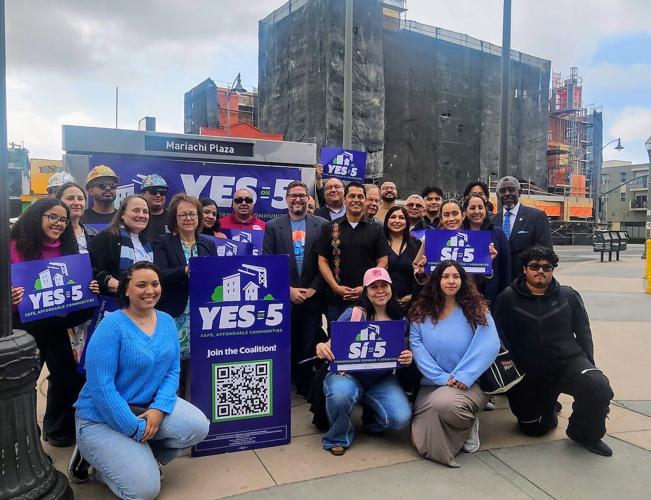



Advocates and supporters of Prop 5. (By Jacqueline García)
Chanting the words, “Build, build, build,” a group of elected officials and supporters advocated for the passing of Proposition 5 in California. The proposition intends to upgrade California’s critical public infrastructure, transportation, and housing, benefiting small and large municipalities.
Currently, the California constitution allows local governments to borrow money through voter approval with the support of at least two-thirds. If Proposition 5 is approved, it would eliminate the supermajority by lowering it to a voting margin of 55%.
During the press conference on Monday in Mariachi Plaza, California Senator Maria Elena Durazo said areas like Los Angeles and Boyle Heights need a lot of building and construction of affordable housing, transportation, water projects, and clean air projects.
She said that many construction projects are being denied or on hold because two-thirds of the population must approve them.
“Prop. 5 simply says that it will go from a two-thirds voting to 55% voting,” she said. “From homelessness housing to bike and pedestrian projects, all of these things are the projects we will be able to pass.”
Currently, state law restricts local voters' ability to approve housing and public infrastructure bonds for their communities. Prop 5 empowers local voters to approve bonds for affordable housing, critical public infrastructure, and emergency response in communities, according to the Yes on 5 website.
Elba Serrano, associate vice president of East LA Community Corporation (ELACC), said they often see how entire families are being priced out of their neighborhood in Boyle Heights. Approving Prop 5 would remove a barrier that has long held back projects like Lucha Reyes apartments, an under-construction apartment complex adjacent to Mariachi Plaza.
“With Prop 5 communities gain the power to build and renovate affordable housing that serves families, seniors and veterans,” said Serrano.

(By Jacqueline García)
Paul Moreno, president of Iron Work Local 433, came with some construction apprentices to support the Yes on Prop. 5. He said his union, along with the State Building and Construction Trades Council of California and the California Labor Federation, have endorsed Prop 5 because it will ensure project labor agreements in a skilled and trade workforce and provide good-paying jobs.
“This prop is going to guarantee a lot of more work, also with infrastructure, roadways, more renewable energy and transit. These are all the things our members love to do,” he said.
Advocates against Prop 5
The California Chamber of Commerce wrote a statement against Prop. 5, saying it will raise housing costs on top of existing taxes, making homeownership more out of reach for the average Californian.
The California Association of Realtors showed that the median cost for a single-family home in California was $904,210 in April. The base 1% property tax alone is $753 per month the first year and increases annually.
The chamber indicated that local general obligation bonds are repaid through taxes on the property's assessed value. “In some areas, local add-on taxes and bond repayments already add thousands of dollars in taxes on top of residents’ annual ad valorem property tax,” stated the chamber.
Another opponent is the National Federation of Independent Business (NFIB). In a statement, they said small business owners are concerned because it would make it much easier for local governments to deficit spend, opening “a Pandora’s Box of needless projects fueled by political favoritism. This could eventually lead to a local government’s bankruptcy.”
Proposition 5 would also make it easier for cities, counties, and special districts to raise property taxes, stated NFIB.
Increasing transparency
Assemblymember Miguel Santiago said allowing 55% of approval is how democracy works. To prove there will be accountability, he said the first and most important thing is to let voters know about the projects happening in their communities. Local governments must show the list of projects, for example, A, B, and C, so voters can decide on each one.
“No more dupe on the voters,” said Santiago.
For those worried about conflicts of interest, Santiago said that projects have to show there will not be any conflict of interest from all involved in passing this proposition. He said it is important to make sure there are performance and audit reviews constantly.
“This means that the work is looked into and there ain’t no funny things happening and that math is doing what is supposed to be doing,” he said.
The presidential elections are on Nov. 5. For more information visit:https://www.lavote.gov/








(0) comments
Welcome to the discussion.
Log In
Keep it Clean. Please avoid obscene, vulgar, lewd, racist or sexually-oriented language.
PLEASE TURN OFF YOUR CAPS LOCK.
Don't Threaten. Threats of harming another person will not be tolerated.
Be Truthful. Don't knowingly lie about anyone or anything.
Be Nice. No racism, sexism or any sort of -ism that is degrading to another person.
Be Proactive. Use the 'Report' link on each comment to let us know of abusive posts.
Share with Us. We'd love to hear eyewitness accounts, the history behind an article.