




Advocates are hoping that voters in L.A. County can provide some relief during the June 2 elections with the approval of Measure ER. (Photo from Canva library.)
This June, L.A. County voters will have the opportunity to vote on Measure ER, a proposed temporary half-cent funding measure to generate revenue for community clinics, emergency rooms and public health services.
The measure is meant to prevent loss of healthcare services that have been cut local funding by $800 million by the H.R.1, the “One Big Beautiful Bill Act” enacted last year.
Since the bill passed, 200,000 L.A. County residents have been disenrolled from full-scope Medi-Cal coverage, roughly 1,100 people per day. The data shows that one out of the five people who lost coverage is a child, including 787 infants, 4,000 toddlers and over 15,000 school-age children, according to the Department of Public Social Services (DPSS).
Additionally, seven of L.A. County’s public health clinics have closed due to grants from the Department of Health and Human Services and the Centers for Disease Control and Prevention being cut.
Healthcare leaders and county officials who support the measure include Dr. Hector Flores, President-elect of the L.A. County Medical Association, who stated in a panel about the measure that H.R.1. is expected to cost the county roughly $2 billion annually.
L.A. County Supervisor Holly Mitchell also shared that passing the measure is crucial to her, as she represents a district with over 850,000 Medi-Cal recipients in areas such as Culver City, Compton, Inglewood, Carson and several other LA neighborhoods.
“These are my constituents, my family, friends, neighbors and hardworking families who've been told by the federal government that they're not worthy of care. We all know that they deserve better, and we have the power to deliver it,” she said.
Jim Mangia, CEO and President of St. John’s Community Health, said their network of 28 community health centers currently serves more than 144,000 patients across L.A. County, with over 95% living below the federal poverty line. At their centers they not only provide medical, dental, behavioral health but also pharmaceutical care and wraparound services to communities that have long been underserved.
Mangia also shared that the centers have spent decades earning the trust of the people that they serve. “Community health centers, which are the backbone of the healthcare safety net, serve about 1.5 million patients in L.A. County, and more than a third of those patients could lose their health coverage, resulting in a 30% cut in community health center budgets. And at St. John's, we decided we were not gonna allow this to happen without a fight,” he said.
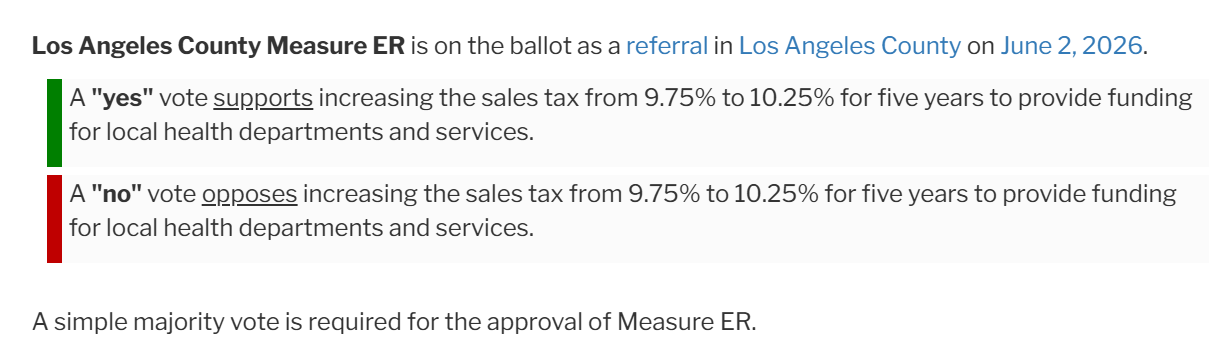
(Website screenshot from Ballotpedia.)
Miguel Santana, president of the California Community Foundation, said the issue is personal for him. Growing up in L.A. without health insurance, his parents relied on the charity of hospitals, including Children’s Hospital, to care for their eight children.
“I know what it means to depend on a system that is stretched, uncertain and not guaranteed. I also spent 16 years working for the County of L.A., including during the healthcare crisis of the 1990s. I saw what happens when the safety net is pushed to the brink, when care is delayed, clinics are overwhelmed and families fall through the cracks. It took decades to stabilize that system,” Santana said.
Crystal Marquez, a Medi-Cal recipient, emphasized that the county should support the measure and vote “Yes,” noting that many of the challenges currently facing Los Angeles County are interconnected.
She added that for unhoused residents, programs that accept Medi-Cal play a critical role in helping people secure housing while also addressing chronic illnesses and other health needs. Cutting these services, she warned, would likely lead to more people living on the streets and experiencing worsening health conditions.
She also emphasized the importance of focusing on children, noting the rise of illnesses such as RSV and the need to keep clinics open so families can access vaccinations, care and reliable information. She added that education is a key component of these services, pointing to Via Care as an example of a provider that not only treats patients but also offers vital health education for families.
Dr. Christopher Libby from Cedars-Sinai Medical Center shared that one of the benefits and challenges of working in the emergency department is the safety net to the system. “We see the cracks as they start to happen, sometimes even before everybody else, because we are capturing everyone who's falling through,” he said.
He also shared that he has been witnessing people losing health insurance.”We're losing over 1,000 people from Medi-Cal per day in Los Angeles County alone,” he said. He also noted that it feels like, currently, L.A. County is backtracking to a time where patients are afraid to get the help they need because of financial costs.
Advocates are hoping that voters in L.A. County can provide some relief during the June 2 elections with the approval of Measure ER, formerly known as the Essential Services Restoration Act, to minimize the impact of rising healthcare costs for all residents.
Measure ER aims to protect healthcare, prevent the closure of the County’s four public hospitals and many clinics as well as avoiding significant layoffs and service reductions. It proposes a 0.5% sales tax for five years, expected to raise roughly $1 billion each year.
Dr. Reza Babapour, a physician practicing in South Los Angeles and founder of Reform LA Health, said that although the measure is set to last only five years, he believes the tax increase will likely be extended beyond that period. “It would be difficult to reverse that. One thing about the Los Angeles public health system is that it is not sustainable and so there's always some deficiency,” he said.
Dr. Babapour also added that the federal cuts on Medicaid services are expected to have a devastating effect on the Los Angeles public health system. “The County has already announced ‘hiring freeze, layoffs and service reduction’ as ways to deal with the crisis,” he said.
He also shared this is not the first time that L.A. County has gone through this crisis. “This actually happened 30 years ago, when the County faced an unexpected financial deficit. History repeats itself,” Dr. Babapour said.
According to the Los Angeles Times, in 1995 L.A. County was facing the same healthcare crisis, when about 1,600 permanent employees were laid off, about 1,000 temporary employees were released and 653 employees were demoted and saw their pay reduced.
Even though Measure ER is a temporary fix, Dr. Babapour believes that the measure is not the best solution and that in his opinion the county can save money if and only if they are willing to “reform themselves.”
“This proposed half-cent increase would push us even higher, making our county less affordable for families and less appealing for consumers to shop and businesses to operate,” said Supervisor Kathryn Barger. “We are risking imposing higher everyday costs and small businesses and employers choosing to leave Los Angeles County altogether.”







(0) comments
Welcome to the discussion.
Log In
Keep it Clean. Please avoid obscene, vulgar, lewd, racist or sexually-oriented language.
PLEASE TURN OFF YOUR CAPS LOCK.
Don't Threaten. Threats of harming another person will not be tolerated.
Be Truthful. Don't knowingly lie about anyone or anything.
Be Nice. No racism, sexism or any sort of -ism that is degrading to another person.
Be Proactive. Use the 'Report' link on each comment to let us know of abusive posts.
Share with Us. We'd love to hear eyewitness accounts, the history behind an article.