




To enroll in the ADRD course, specific qualifications must be met. The ADRD course is offered to IHSS providers in San Bernardino County, California. (Photo-Canva library.)
As of now 720,000 Californians age 65 and older are living with Alzheimer’s disease, and about 13% of them are Latino. That number is projected to double by 2040, increasing the demand for trained caregivers to support older adults and people with disabilities.
Despite the growing need, many caregivers lack specialized training to recognize the early signs of Alzheimer’s Disease and Related Dementias (ADRD) and manage the physical, emotional and behavioral challenges that often accompany cognitive decline.
The Center for Caregiver Advancement (CCA) is working to address that gap by offering free dementia care training for In-Home Supportive Services (IHSS) providers. The program equips caregivers with practical skills to identify the warning signs of ADRD, respond to the associated symptoms and behaviors, and understand the differences between dementia and normal aging.
Martha Vasquez, CCA’s lead instructor for home care, has taught the ADRD course for IHSS providers in San Bernardino. She said enrollment is currently open for the program, with classes scheduled to run through September 2026.
The program will also be offered in San Francisco, San Mateo and Santa Clara counties. The course is for individuals concerned about their patients over 50 who may beat risk, and for those already working with patients who have ADRD.
“This is a huge problem right now for Californians who are suffering from Alzheimer’s, and those people need intense care. Alzheimer’s care is a full-time situation for most caregivers, and the disease is projected to double by 2040,” said Vasquez. “It's super important that caregivers get trained now to be able to anticipate this doubling.
Dementia and Alzheimer's disease
An important lesson that individuals take away from this specific course is learning the difference between dementia and Alzheimer's disease. Dementia is an umbrella term that describes a collection of symptoms, such as cognitive, functional and behavioral, and is caused by specific diseases.
While Alzheimer’s is a degenerative brain disease that is caused by complex brain changes following cell damage, it is also the most common cause of dementia, accounting for 60-80% of dementia cases.
Signs and symptoms
There are 10 recognized warning signs and symptoms of ADRD. Experts say that if a loved one, caregiver or healthcare provider notices any of these signs, they should not be ignored and should be followed up with a medical evaluation.
-Memory loss that disrupts daily life
-Challenges in planning or solving problems
-Difficulty completing familiar tasks
-Confusion with time or place
-Trouble understanding visual images and spatial relationships
-New problems with words in speaking or writing
-Misplacing things and losing the ability to retrace steps
-Decreased or poor judgment
-Withdrawal from work or social activities
-Changes in mood and personality
Communication challenges
“We understand that there’s a progression and we don’t see people getting better, and that's something that caregivers need to understand the progression of the disease and what's gonna happen next,” said Vasquez. “I think that's one of the more helpful pieces of knowledge they walk away from this course.”
IHSS providers also learn strategies to navigate the communication challenges that individuals living with dementia often experience. Vasquez explained that as Alzheimer's disease progresses, a person’s ability to communicate often changes. She added that communicating what a caregiver needs to communicate to someone who suffers from Alzheimer's, whether it's about medication, food or hygiene, is an important component for a caregiver to learn.
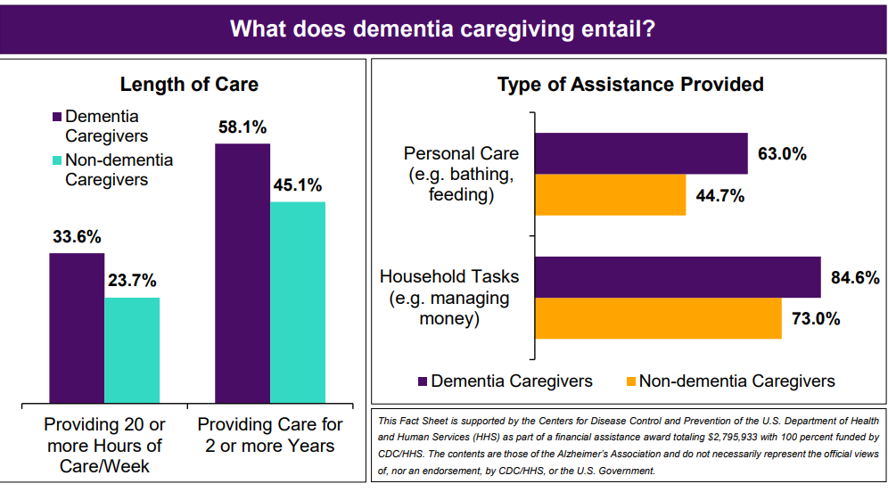
According to the Alzheimer’s Association, more than one in five caregivers in California (22.1%) provides care for someone living with Alzheimer’s disease or another form of dementia. Many of these caregivers devote 20 or more hours each week to caregiving responsibilities. In California alone, the estimated value of unpaid care provided to individuals living with dementia totals $52.3 billion annually.

The contents are those of the Alzheimer’s Association and do not necessarily represent the official views of, nor an endorsement, by CDC/HHS, or the U.S. Government. (Alzheimer's Association.)
Disease progressions
Vasquez told CALÓ News that many participants in the program share how painful it can be to watch a loved one change as Alzheimer’s disease progresses. One piece of advice she often offers caregivers is to remember that the behaviors and personality changes they may be witnessing are symptoms of the disease, not a reflection of the person they have known and loved.
She also said that many family caregivers struggle with feelings of guilt and self-blame as they watch a loved one’s condition progress.
“Once they're able to make that distinction, caregiving for someone with Alzheimer’s becomes a lot less painful,” Vasquez said. “This is a very painful situation for caregivers, especially family caregivers. A lot of times, we take these behaviors personally. We think, ‘If only I were doing a better job, they wouldn’t be acting this way.’ We tend to take that burden on ourselves as caregivers.”








(0) comments
Welcome to the discussion.
Log In
Keep it Clean. Please avoid obscene, vulgar, lewd, racist or sexually-oriented language.
PLEASE TURN OFF YOUR CAPS LOCK.
Don't Threaten. Threats of harming another person will not be tolerated.
Be Truthful. Don't knowingly lie about anyone or anything.
Be Nice. No racism, sexism or any sort of -ism that is degrading to another person.
Be Proactive. Use the 'Report' link on each comment to let us know of abusive posts.
Share with Us. We'd love to hear eyewitness accounts, the history behind an article.