
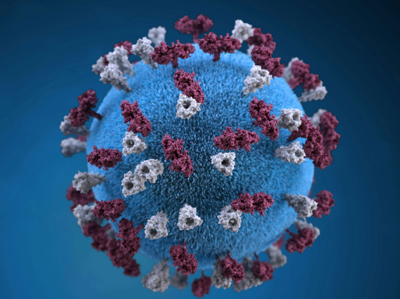


A 3D graphic representation of a spherical-shaped, measles virus particle. (CDC)
The Centers for Disease Control and Prevention report 2,170 cases of measles this year in the United States, and as of July 2, representing the highest number of reported cases in 35 years.
The American Community Media (ACOM) hosted a briefing on measles, as cases continue to rise amid declining vaccination rates.
Earlier this month the County of Los Angeles Public Health was investigating a confirmed measles case in a traveler who was infectious while passing through L.A. County.
Health officials said people may have been exposed at Los Angeles International Airport, a rental car shuttle and in at least one health care facility, making it the seventh case of measles reported by Public Health this year.
According to health officials, the infectious individual arrived on British Airways Flight 281 at Tom Bradley International Terminal on July 3, and individuals who were at Gate 155 between 3 p.m. and 4 p.m. may have been exposed.
Measles is known to spread easily through the air when an infected person breathes, talks, coughs or sneezes. The virus can stay in the air and on surfaces for many hours, even after the infected person has left. If other people breathe the contaminated air or touch the infected surface, then touch their eyes, noses, or mouths, they can become infected, according to LA Public Health.
CDC states that adults are the most vulnerable individuals to getting measles, as it has identified 625 people over the age of 20 who have had the disease this year. Last year, 11% of those infected with measles had to be hospitalized.
Speakers from the briefing discussed the surge in measles cases, the difficulties in controlling outbreaks, vaccine hesitancy and misinformation surrounding the disease.
Patsy Stinchfield, pediatric nurse practitioner and Executive Director of the Measles Collaborative, spoke about the reason behind the measles disease still being a threat 26 years after it was eradicated in the U.S..
“Measles did not come back because the virus got stronger. The virus is the same as it has been. It came back because we let our guard down; vaccination rates have been slipping naturally and in pockets of communities that are undervaccinated and measles exploits that gap,” Stinchfield said. She also added that measles lives to replicate in an unimmunized person.
“When vaccination coverage drops even a few percentage points below the threshold we need for community protections, measles is stealth. It will seek and find those unvaccinated individuals and it will spread rapidly. So again, the virus hasn't changed, but our coverage has,” she said.
Stinchfield emphasized that although measles was declared eliminated in the United States in 2000, significant work remains both nationally and globally. He said increasing vaccination rates is essential to prevent the disease from spreading and to maintain the country's elimination status.
In 2024, a CBS News investigation revealed that at least 8,500 American schools were at risk of similar outbreaks as vaccination rates dropped. In the Golden State, schools are required to keep track of students’ immunization records, even though parents must immunize their children based on medical advice.
According to the investigation, 350 Southern California schools failed to meet the recommended threshold for preventing measles outbreaks. These troubling numbers were at the forefront of many local medical professionals’ minds.
Dr. Andrew Pavia, Professor and Chief, Division of Pediatric Infectious Diseases at the University of Utah, discussed how they have been struggling with a year-long outbreak of measles. In Utah, 704 cases have been reported in the past 12 months.
Dr. Pavia shared that although his focus is on the outbreak in Utah, the factors discussed are common to measles outbreaks occurring across the U.S. and other countries. “We had a pretty high overall MMR vaccination rate in the state, but we had many pockets in which it declined quite rapidly, including some suburban counties like Utah County, but especially in the southwestern part of the state,” he said.
He also pointed to a community near the Arizona border where vaccination rates have declined significantly, with some schools reporting immunization rates between 30% and 40%. He said the decline is linked to the community's affiliation with the Fundamentalist Church of Jesus Christ of Latter-Day Saints (FLDS), a polygamous religious sect.
“FLDS cult leader had pushed hard against vaccination. Other people had moved to this beautiful desert community because they wanted to be away from civilization and government interference. So what you had was a community with low vaccination rates and with poor trust of government and of public health authorities,” Dr. Pavia said.
He explained that when the measles disease was imported into Utah, they were able to control it in the first couple of introductions and then it started to spread rapidly in this community and bled out from there across the state. “So we've had measles cases in every county in the state,” he said.
Dr. Benjamin Neuman, professor of biology at Texas A&M University, discussed how measles spreads and explained how it is significantly more contagious than other viral illnesses, including COVID-19 and seasonal influenza.
“Measles comes from people and it goes to people and that cycle has been going on in the U.S. for a long time. The strain that is circulating right now is called the D8 strain and it is nearly identical to the virus that was reported in Texas back in January of 2025,” he said.
Dr. Neuman explained that the measles virus primarily infects cells of the immune system, similar to HIV. He said the immune cells that would normally help fight infection become infected themselves, reducing their ability to respond.
As a result, measles can also cause a loss of immunological memory, leaving the body less able to recognize and fight infections it had previously developed immunity against. “Meaning that if you get cells infected that were immune to something that you encountered earlier in life, those can effectively be erased,” said Dr. Neuman.
He shared that the measles vaccine has mutations with two proteins called the C protein and the P protein, both of which are responsible for hiding the virus from the immune system and preventing the body from making that immune response with interferon.
“When you get the vaccine, it will go into the body and there will not be immunosuppression. The immune system will recognize it and you will make a very robust immune response in the safest way that we know how to make an immune response,” Dr. Neumann said. “The other change in the vaccine strains is a one-amino-acid change in the protein that attaches to the cells and it allows the vaccine strain to target cells besides the immune cells.”
How vaccines are approved
During the briefing, Dr. Jose Romero, professor of pediatrics in the Department of Pediatrics at the University of Arkansas for Medical Sciences, former Secretary of the Arkansas Department of Health and director of the CDC’s National Center for Immunization and Respiratory Diseases, shared that many countries have what's called a NITAG, a National Immunization Technical Advisory Group. In the U.S. it is called the Advisory Committee on Immunization Practice.
Most of the time, he says, the advisory group issues recommendations on a vaccine. “For example, we know that the FDA is looking at a vaccine that is probably going to be licensed in six months and so months before the vote goes forward, this group that's assembled consists of a subject matter expert and asks individuals who represent the stakeholders for this particular vaccine to participate in that work group,” he said.
He also added that the majority of the time it can consist of 35 liaisons because of the impact it can have on so many people, so it's very important that they contribute to these discussions.
Dr. Romero emphasized that the process remains flexible until a final vote is taken. He said stakeholder groups actively exchange information throughout the review process, and that more complex issues are discussed over several months to allow time for careful consideration before a final decision is made on vaccination recommendations.




(0) comments
Welcome to the discussion.
Log In
Keep it Clean. Please avoid obscene, vulgar, lewd, racist or sexually-oriented language.
PLEASE TURN OFF YOUR CAPS LOCK.
Don't Threaten. Threats of harming another person will not be tolerated.
Be Truthful. Don't knowingly lie about anyone or anything.
Be Nice. No racism, sexism or any sort of -ism that is degrading to another person.
Be Proactive. Use the 'Report' link on each comment to let us know of abusive posts.
Share with Us. We'd love to hear eyewitness accounts, the history behind an article.