
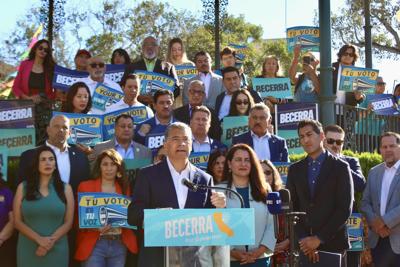

Nineteen days before the Nov. 3 general election, gubernatorial candidate Xavier Becerra arrived in Los Angeles to urge Latinos to vote despite increased immigration enforcement actions in recent weeks.
Last week, the Washington Examiner reported that U.S. Immigration and Customs Enforcement (ICE) was launching a 45-day stepped-up enforcement effort called “Operation Safe California.”
Today, Becerra, along with other state leaders including Robert Rivas, currently serving as the 71st Speaker of the California State Assembly and Monique Limón, the Senate President pro Tempore, arrived at Placita Olvera on Thursday morning to denounce the increasing and resurging ICE kidnappings in the days leading up to election day.
"Whether it is voting, whether it is going to work, whether it's having good schools, or whether it's protecting our families against ICE mercenaries, [Latinos] are here, we are present and we will fight,” Becerra said on Thursday. “But right now our fight is to get the vote out, to make sure everyone understands that our power lies in our vote.”
If elected, Becerra, the son of Mexican-American immigrants, will be the first Latino to win a California gubernatorial election since 1875. The 68-year-old state secretary advanced to the general election after winning 28% of the vote in June’s primary. He now faces Republican candidate Steve Hilton.
One of the guest speakers at Thursday’s event was Latino actor Eugenio Derbez, who said the increasing ICE raids during election season are “not coincidental.”
"Our community is being targeted with fear and intimidation right when we are supposed to be voting. This is not a coincidence. It is not,” he said.
Derbez talked about his journey of becoming a U.S. citizen. “I was determined to make my voice heard,” he said.
Derbez, who lives in Los Angeles, has, many times, publicly encouraged Mexican immigrants in the United States to learn English and consider U.S. citizenship.
“I know a lot of people, regardless of having papers or not, are fearful. We are all scared,” he said.
Rivas said this year's election can be critical to regain power over the future of the U.S.
“For the first time in California history, Latino leaders can simultaneously lead the governor's office, the state senate and the state assembly,” he said. “But this is about something much bigger than titles. It's about power and what we do with that power: the power to protect our families, make housing more affordable, ensure our children have a better future and ensure that no hardworking family is forgotten, overlooked, or left behind, and the power to tell Donald Trump that California will never, never turn its back on the people who built this state.”
It is estimated that nearly 50 million young people, ages 18-29, will be eligible to vote in the 2026 midterm elections, according to an analysis of demographic data. Rivas talked about the right to vote that many parents did not have, but that many of their children can exercise today. “They sacrificed; they dreamed of a day when their children could have the opportunities they never had,” he said.
With Latinos being the nation's second-largest group of eligible voters, with 39 million eligible voters projected in 2026, Limon said the community must feel obligated to not only participate in their local elections but also state ones.
“We are here united because we know the importance and necessity it is to have a voice in California politics and the communities across the state,” she said on Thursday.
Earlier in the summer, the American Civil Liberties Union published “Know Your Rights—Federal Agents at the Polls,” a paper aimed to remind people that the freedom to vote is the very foundation of democracy. “Voting is how we secure our civil rights and liberties and help shape our country, state and town,” the ACLU states. “Every eligible citizen has the right to cast a ballot freely, fairly, and accessibly without fear of deception or intimidation.”
If there are reports of ICE, National Guard, or other federal agents in communities during election day, the ACLU advises voters to make a plan and consider voting by mail if there is sufficient time.
While a voter can be accompanied by family members regardless of whether those family members are citizens, in an abundance of caution, non-citizens may choose not to travel to polling places. They also remind voters that they do not need to speak English to vote in any state.
“I ask you all, if your vote was not important, why are they trying to intimidate us to not vote?” Derbez said.
You can report intimidation to the Election Protection Hotline at 1-866-OUR-VOTE or 1-888-VE-Y-VOTA (Spanish/English), 888-APIVOTE (Asian languages/English), or 844-YALLA-US (Arabic/English).






(0) comments
Welcome to the discussion.
Log In
Keep it Clean. Please avoid obscene, vulgar, lewd, racist or sexually-oriented language.
PLEASE TURN OFF YOUR CAPS LOCK.
Don't Threaten. Threats of harming another person will not be tolerated.
Be Truthful. Don't knowingly lie about anyone or anything.
Be Nice. No racism, sexism or any sort of -ism that is degrading to another person.
Be Proactive. Use the 'Report' link on each comment to let us know of abusive posts.
Share with Us. We'd love to hear eyewitness accounts, the history behind an article.