




The Latina Economic Power Agenda includes 10 priorities to help Latinas build wealth, which run from affordable child care, homeownership, business growth, jobs, retirement security and making sure AI works for Latinas.
On Latina Equal Pay Day, the nonprofit organization Latino Prosperity unveiled the Latina Economic Power Agenda during their webinar, which included 10 priorities to help Latinas build wealth.
The virtual panel featured Norma Fernandez, CEO of Everyone On; Julissa Arce, author and influencer; and Marla Bilonick, president and CEO of National Association for Latino Community Asset Builders (NALCAB).
New data shows that while Latinas contribute $1.3 trillion to the U.S. economy, little of that turns into any wealth for them or their families. Oftentimes their priorities range from child care and homeownership to making sure AI creates opportunities for Latinas to build wealth, not new ways to extract it from them.
Arce highlighted that education was a key component to bettering her financial situation, but despite doing everything right, she said there’s still a need for systemic change. “Things still don’t work out for me, because there is a system that I live within that I don't always have control over,” she said.
She also spoke about the attacks on Diversity, Equity and Inclusion (DEI) and how they hurt women from all walks of life. Arce explained that, as a new mother, the high cost of childcare represents a major systemic hurdle for her.
Arce said that she pays nearly $3,000 monthly for her daughter’s schooling. Despite earning too much money under current criteria to qualify for child tax credits, her family still struggles to comfortably afford tuition while trying to save for retirement and support her mother financially.
Echoing Arce’s sentiment, Fernandez emphasized that the present system was never built to uplift or even include Latinas. To build their economic power, she emphasized the necessity to enact policies that lead to tangible, actionable outcomes.

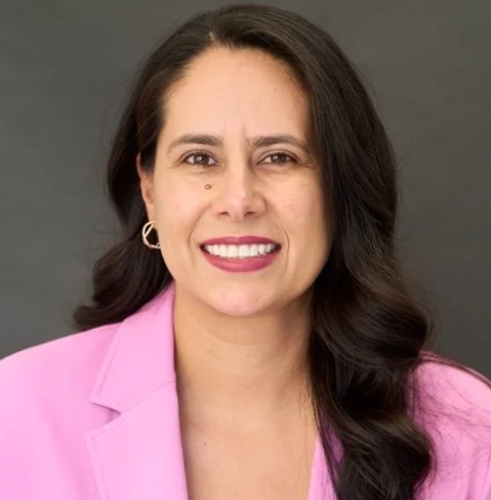
Norma Fernandez, CEO of Everyone On.
She stressed the importance of securing local, state and federal budgets that guarantee investments in workforce development initiatives that can establish career pathways for Latinas. “Budgets reflect our values and our priorities. We need to ensure that our budgets are reflecting the Latinas’ priorities,” Fernandez said.
She also voiced concerns about Artificial Intelligence (AI) and how it’s going to affect Latinas in the workforce and offered a solution that can help benefit them in the long run.
“Whether it’s the promotora who’s helping inform what a program looks like, a teacher, an attorney, nurses, women who are working in the construction trades and other [skilled] trades, they need to be at the table helping inform what workforce development programs look like,” Fernandez said. And added that these programs need to be adaptable and accessible while offering wraparound services.
To ensure Latinas genuinely benefit economically from AI, Fernandez explained, it is critical to first evaluate the current structural barriers and risks they are facing.
The Pew Research Center released a study showing that only 68% of Latino adults have broadband at home. “That means almost 30% still lack high-speed broadband at home, which is fundamental to be able to leverage the power of technology,” Fernandez said. And noted that 28% of those users who are connected are smartphone dependent.
“That is a structural challenge that is presenting challenges for Latino communities and in particular Latina women who are trying to advance themselves but yet don’t have these basic tools,” Fernandez said.
She additionally highlighted how AI is already deciding on biased data about who’s getting small business loans, home ownership loans and job interviews. “Those are real challenges, and we can’t benefit from a system that wasn’t designed to support Latinas if we don’t understand it,” she said.
Fernandez explained that the Latino Prosperity agenda advocates for mandatory notifications when employers utilize AI in HR practices such as interviewing, alongside essential human oversight. However, such measures are only effective if Latinas are aware that their applications are being evaluated by AI, to help them challenge those processes.
Pointing out a systemic economic challenge, Bilonick shared that discriminatory lending practices lead to a 13.6% mortgage denial rate for Latinas, compared to 7.6% for white applicants. “The deck is stacked against us there,” she said.
Bilonick also shared that small Latina-owned businesses are less than half as likely to receive full requested funding amounts. “So you’re not able to scale up to the level that you want to if you’re an existing business owner. There’s all sorts of limits that are being pressed down on us as this external pressure,” she said.
A barrier that Bilonick mentioned within the Latino culture is the lack of economic independence and she emphasized that oftentimes Latinas see themselves as a unit in their family.
Additionally, she addressed the misconception connecting a mother’s employment directly to childcare expenses. “If your job doesn’t make enough to cover childcare, then the logical response should be that you should stay home, which I think puts us in a disadvantaged position for many reasons,” Bilonick said.
Orozco also noted during the panel that Latinas frequently take on caregiving responsibilities while working, making it difficult to balance affordability challenges. She explained that this situation makes it impossible for Latina women to build savings.
Regarding affordability, Arce shared about a commitment she and her husband made to their daughter about not wanting her to be responsible for their retirement when they hit that age.
“That is a responsibility that does fall on a lot of Latinos, which I think is a beautiful thing in our community and in our culture,” she said. “I also think that it’s a really heavy responsibility to carry, because, as you're trying to build your career and build your savings, you’re constantly also having to think about other members of your family, not just your parents.”
When it comes down to building wealth, the Latina Economic Power agenda identifies three key systemic changes, such as expanding retirement coverage for workers excluded from employer plans, recognizing the long-term economic cost of unpaid caregiving and helping families preserve and transfer the assets they build.
While the Latino Prosperity says there is more work to be done, they will continue to advocate for Latinas so that their contribution to the U.S. comes back to them as ownership, security, wealth and economic power.
To read the full Latina Economic Power Agenda, click here.







(0) comments
Welcome to the discussion.
Log In
Keep it Clean. Please avoid obscene, vulgar, lewd, racist or sexually-oriented language.
PLEASE TURN OFF YOUR CAPS LOCK.
Don't Threaten. Threats of harming another person will not be tolerated.
Be Truthful. Don't knowingly lie about anyone or anything.
Be Nice. No racism, sexism or any sort of -ism that is degrading to another person.
Be Proactive. Use the 'Report' link on each comment to let us know of abusive posts.
Share with Us. We'd love to hear eyewitness accounts, the history behind an article.