
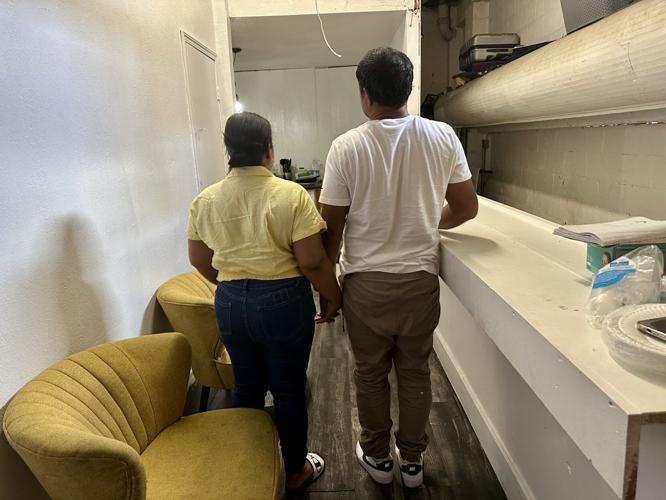

Claribeth and Oswaldo fled Colombia and are fighting to receive asylum in the U.S. (Araceli Martinez Ortega)
Wife and husband Claribeth and Oswaldo, along with Jacob, their nine-year-old, fled Colombia to save their lives, seeking refuge at the U.S. southern border. They never imagined that the asylum process would turn into a nightmare, but the solidarity of the Los Angeles community keeps them standing, fighting to remain safe in the country.
On May 14, two years after entering the United States, Oswaldo and his son were denied asylum and issued a deportation order. Just days earlier, on May 12, Claribeth had been released from the Adelanto Detention Center, where she had been held for a little over four months after suffering from medical negligence.
“We live in fear of being detained and deported,” says Claribeth. The full names of the couple and their son have been withheld for safety reasons.
The Trump Administration has taken unprecedented restrictions on refugees and asylum seekers, such as restricting work permits. Most recently, a Supreme Court ruling allowed the federal government to block asylum seekers at the border.
A long journey
It took Claribeth and Oswaldo nine months to reach the United States to seek asylum.
“We left on January 15, 2024. We traveled overland through the Colombian jungle, entered the Panamanian jungle and passed through Costa Rica, Nicaragua, Honduras, Guatemala, Mexico City, San Luis Potosí, Ciudad Valles and Ciudad Victoria, finally reaching Matamoros, a Mexican border across the Rio Grande. That is where we decided to turn ourselves in to U.S. immigration authorities in September of that same year.”
After being detained for six days, the couple and their son were released on September 12, 2024, and took a flight from Brownsville, Texas, to Los Angeles, where Oswaldo’s brother, who had arrived three years earlier seeking asylum, was already living.
On January 6, 2026, Claribeth was detained. The officer claimed that she was late for a biometric check-in and missed a phone call. She was transported to the Adelanto Detention Center.
“They took me away with my hands, waist and feet shackled. It was a horrible, traumatic experience. When they handed me the orange uniform, I asked, ‘Why? I haven’t killed anyone.’”
Claribeth said she was offered voluntary departure to Colombia on two occasions, but she never accepted.
While at Adelanto, she dislocated her right shoulder, a complication arising from her condition of bone decalcification.
“Around six in the morning, I called the officer to say I needed help,” she said. “The officer told me there was nothing they could do, so I had to deal with it however I could.”
After two or three hours of watching her weep from the intense pain, several fellow detainees at Adelanto told her to take deep breaths, as they were going to try to help pop her shoulder back into the socket.
“The pain was excruciating. I took about four or five acetaminophen pills to cope and my fellow detainees managed to reset my shoulder as best they could,” she said. “My arm was left weak and powerless. It wasn't until 15 days later that I was able to see a doctor and he just gave me a little cream.”
Thanks to the assistance of Pastor Guillermo Torres, director of immigration campaigns and programming for Clergy and Laity United for Economic Justice (CLUE) in Los Angeles, and the Esperanza Immigrant Rights Project, she was released from the detention center without paying bail, secured through a habeas corpus petition.
Through this legal resource, a detainee's attorney asks a federal judge to review the case and determine whether the detention is lawful.
Claribeth regained her freedom and reunited with Oswaldo and Jacob, but her happiness was short-lived. On May 14, her husband attended a court hearing without legal representation where he was denied asylum and issued a deportation order for himself and for their minor son.
“A judge issued a deportation order, reportedly for failing to renew his asylum status annually, yet he had never been notified that he was required to do so,” she said.

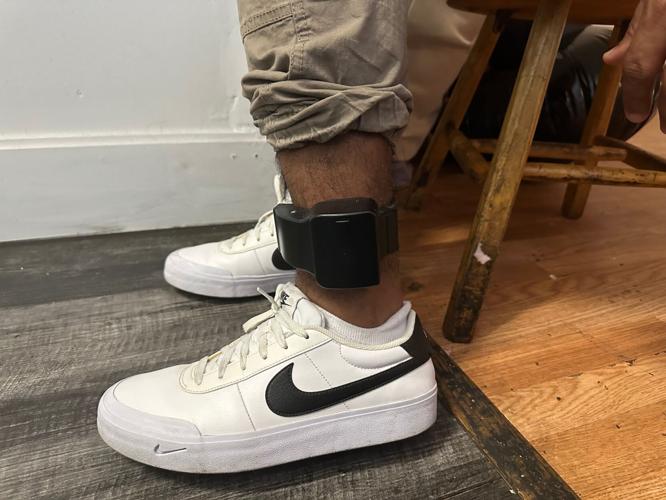
Oswaldo was denied asylum and was also fitted with an electronic monitoring shackle. (Araceli Martinez Ortega)
“Not only was he denied asylum, but he was also fitted with an electronic monitoring shackle and a deportation order was issued for both him and our son,” said Claribeth.
An increasingly difficult situation
“We applied for asylum as a family, but they separated us; they put my partner and our child together and kept me apart. We aren’t married, but we’ve been together for 16 years,” she said.
The couple fled Colombia after being stripped of their farmland in the La Guajira region and threatened with weapons when they tried to reclaim it. Oswaldo showed CALÓ News documents from the Colombian Attorney General’s Office attesting to these events.
“From the time we left Colombia until now, it’s been a nightmare and a source of constant stress. In the year and three months before I was detained, I had seven hearings with a judge," Claribeth said from the small room where they live above a warehouse in DTLA, just a couple of blocks from Skid Row.
The couple had until Monday, June 29, to file an appeal against their deportation. With the help of Long Beach Rapid Response, they organized an emergency fundraiser on social media and raised the money needed to file the appeal on time.
According to Claribeth, they have another hearing on July 13, but the fear of her partner and son being deported that same day is ever-present.
Pastor Torres of CLUE said the situation for asylum seekers has become very difficult under the Trump administration.
“What is happening to our immigrants, beneficiaries of DACA, TPS and asylum seekers and even to the U.S. citizens who support them, is cruel and immoral,” he said.
In February, the Department of Homeland Security (DHS) proposed a rule to reduce what it called the incentive for immigrants to file fraudulent asylum claims to obtain work authorizations — thereby halting the processing of new work permits and creating additional employment barriers for the nearly 4 million people with pending asylum cases.
Noah Montague, a U.S. Department of Justice-accredited representative and member of the team at Al Otro Lado, a binational legal and humanitarian advocacy organization based in San Diego, said the federal government is forcing asylum seekers already in the country to pay annual fees for their cases and work permits.
“It is making it increasingly difficult for them to work and forcing them to prove why they cannot be deported to other countries,” he said.
Montague urged asylum seekers not to lose hope and to keep fighting.
“All of Trump’s decisions have been political moves, not laws, and we have successfully sued his administration.”








(0) comments
Welcome to the discussion.
Log In
Keep it Clean. Please avoid obscene, vulgar, lewd, racist or sexually-oriented language.
PLEASE TURN OFF YOUR CAPS LOCK.
Don't Threaten. Threats of harming another person will not be tolerated.
Be Truthful. Don't knowingly lie about anyone or anything.
Be Nice. No racism, sexism or any sort of -ism that is degrading to another person.
Be Proactive. Use the 'Report' link on each comment to let us know of abusive posts.
Share with Us. We'd love to hear eyewitness accounts, the history behind an article.