
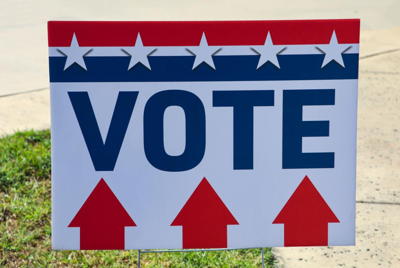


Latinos are among the fastest-growing demographic groups in the U.S. In California the Latino population is reaching 40%, with further increases projected to 50% by the year 2050. (Patricia Marroquin/Getty Images)
During the 2024 presidential election, Latino voters played a key role in securing Donald Trump's victory. According to the American Community Media (ACOM), that voting shift prompted predictions of a "historic realignment," but it's yet to materialize.
As part of a new series called “Profiling America’s Changing Electorate Vote" ahead of the 2026 midterm elections, ACOM presented its first briefing, which involved examining Latinos, the second-largest group of voters in America
Now, almost two years after the last general election, that realignment has not materialized. Poll after poll indicates that Latino support for Trump has fallen significantly. According to the Pew Research Center (PRC), about four-in-five say Trump’s policies harm Latinos, a higher share than during his first term.
PRC’s data shows that 70% of Latinos disapprove of the way Trump is handling his job as president, 65% disapprove of the administration’s approach to immigration and 61% say Trump’s economic policies have made economic conditions worse.
María Isabel Di Franco Quiñonez, Senior Research Director at Equis Research, where she leads several projects aimed at understanding and engaging Latino voters across the country, said there were moments when they felt all the signs pointed to realignment.
“I think all of us were doing what we could with the data we had at that moment. But the movement that we've seen not just in the polling but also in election results in some of the early elections that happened after 2024 really points us toward a much more swingy electorate than something just like a realignment,” said Quiñonez.
She highlighted data from Latino-majority geographies in post-2025 special elections and statewide races as evidence, noting that support for Democratic candidates had already begun to increase compared with 2024.
Quiñonez also noted that instead of a realignment, they were also seeing a dealignment of fewer Latino voters identifying with the Democratic party and identifying more as independents. Despite Republican candidates gaining support, this shift has not translated into a broader, stronger commitment to the Republican Party itself.
“Many of the presentations that we give these days start with screenshots of news headlines. ‘Latinos are lost. Latinos are back.’ That's the kind of really reactive analysis that we can get into when we're just focusing on one election cycle at a time,” she said.
Polling data indicates that Latino voters are disappointed and frustrated in the way that Trump has handled the policies around economics and immigration since returning to office. Quiñonez said that while voters from any political affiliation can feel dissatisfied with the president, this dissatisfaction does not automatically translate into support for the opposing party.
“In our latest wave of polling, we saw about 14% of Latino voters who voted for Trump back in 2024 tell us that they would now support a Democrat come November. That's a really meaningful chunk of the electorate that supported Trump, now telling us that they would support a Democrat,” she said.
Quiñonez added that while a portion of Latino voters demonstrated a shift, another 10% have shown to be undecided. “Overall, I think we were all a bit premature when it came to realignment. We've seen great levels of skepticism and frustration with both parties,” she said.
Mike Madrid, Republican political strategist and author of “The Latino Century” and co-founder of the Lincoln Project, said that one of the factors driving Latino voters' choices during the 2024 election cycle was how Trump and the Republican Party successfully recognized and tapped into key perspectives among Latino voters that Democrats overlooked.
According to him, what is currently unfolding is a widespread institutional shift away from traditional parties, alongside an emerging populist wave. “Watching both parties really struggle with this has been frustrating but also angering because you realize just how far removed our institutions are from really trying to understand what is happening in our community,” he said.
Madrid highlighted the need for Latino leaders and advocates to lead the charge on the issues affecting the community. “I think that will be the test of this election cycle for 2028 for sure because I think we're going to see Latinos come back historically, [as they move] away from Republicans,” he said.
According to a financial 2025 survey, roughly one-in-three Latinos have struggled to pay for each of the following in the last year: food or groceries (35%), medical care (30%) rent or mortgage (30%).
Madrid said that although California is the largest Latino state in terms of Latino voters, political parties need to do a better job of understanding the community's needs when it comes to the economy, as it has been a dominant issue for 30 years.
“This is not new, but we don’t have an infrastructure in our community that has ever prioritized that issue in a meaningful way. And certainly not our politicians, which is why the detainment is happening,” said Madrid. “We've dramatically overemphasized other issues at the expense of what the overwhelming majority of Latinos have been crying out desperately for help on for decades now.”
Clarissa Martínez De Castro, Vice President of the Latino Vote Initiative at UnidosUS, also shared insights from a recent expansive survey on Latino voters. She analyzed their current priorities and key motivators leading into the November elections.
“The first report looking at Hispanic voters I wrote for Needles US was in 2002. And one of the things we lifted up there is that there has always been a swing element in the Latino electorate,” she said.
De Castro emphasized that when it came down to Latino voters, Republicans were their worst enemy and Democrats their best friend. “Republicans were not even bothering reaching out to Latinos, often antagonizing them, and Democrats were reaping the rewards of that, but they didn't solidify that support to their cause,” she said.
De Castro also explained that every cycle they see that about 25% of Latinos who are showing up at the polls are new to the electorate. “You put all that together, and that swing is now either a part of the undecided or independent column, which is an identification that had been growing among young voters and certainly with Latinos who are a young electorate for some time,” she said.
In terms of economic issues, Latino voters consider that a priority topic. De Castro highlighted that eight out of 10 Latinos are from the working class and that any fluctuation in cost in expenses can make the difference between a family barely staying afloat or going under.
“It's no surprise that economic issues have not only consistently been at the top, but right now, four out of the top five top issues are pocketbook related, the cost of living, wages and jobs, the cost of housing and the cost of health care with immigration at number five,” she said.
According to the PRC 2025 survey, it demonstrates that Latinos continue to view their financial situation negatively and that their views have not changed from the year prior. About 78% say the economy is in only fair or poor shape, while 22% say it’s in excellent or good shape.
De Castro added that American workers are frustrated that their needs are being neglected and that they continue to work as hard as they can but are barely making ends meet. Latinos are feeling it as well. She explained that one of the reasons why Bernie Sanders resonated with many Latino voters is because he would talk about the economy and its impact on working families.
She said that when Latino voters are given a choice, it’s more likely for them to engage in the elections. “I think that all of this is teaching us that this old idea of voter apathy was never a correct notion for a whole lot of reasons. We do vote. We will vote when the systems allow us and the parties more than the systems allow us to vote.”







(0) comments
Welcome to the discussion.
Log In
Keep it Clean. Please avoid obscene, vulgar, lewd, racist or sexually-oriented language.
PLEASE TURN OFF YOUR CAPS LOCK.
Don't Threaten. Threats of harming another person will not be tolerated.
Be Truthful. Don't knowingly lie about anyone or anything.
Be Nice. No racism, sexism or any sort of -ism that is degrading to another person.
Be Proactive. Use the 'Report' link on each comment to let us know of abusive posts.
Share with Us. We'd love to hear eyewitness accounts, the history behind an article.