
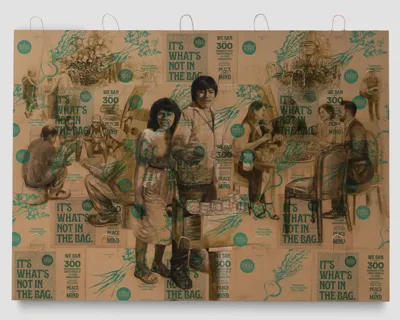


"Chinga la Migra," by Narsiso Martínez. Photo courtesy of Charlie James Gallery - Narsiso Martínez
What does it take for people in the United States to have food in their kitchens year-round? How much invisible human labor does it take for people to be well nourished?
These are questions that Latino artist Narsiso Martinez poses in “Eat Happy,” his new solo exhibition at the Charlie James Gallery in Chinatown.
From now until Saturday, November 7, the public is invited to view the exhibition, which aims to bring attention to the dissonance between agricultural abundance and the exploitation of farmworkers, who make it possible for millions of Americans to eat.
The exhibition features farmworkers' labor painted on numerous grocery and carryout bags from stores and restaurants like Whole Foods, Lazy Acres, Javiers, Trader Joe’s and Ralph’s. Martinez painted farmworkers at work, on their lunch break and carrying the food in their hands within, behind and sometimes over the major businesses' logos printed on the bags.
Martinez’s art challenges the idea that food has a direct route from the grocery store or restaurants to people's kitchens. The branded grocery bags that he uses as canvases allude to the reality that food consumption is not cruelty-free, as all food, including plant-based agriculture and global supply chains, involves human labor exploitation.
The exhibition makes art out of the different scenarios and realities that farmworkers experience while picking the food that Americans eat. One of the bags in the exhibition features a man holding a sack of fruit and dropping it into a bin and in other pieces, farmworkers are depicted at rest, having lunch or gazing out directly at the viewer.
One of the most impactful pieces of “Eat Happy” is titled “Chinga la Migra.”
The piece depicts a well dressed family having dinner together at home with a full table of food and, on the opposite side, a group of farmworkers sitting on logs and holding up their lunch as they eat and take a break from their workday.
For Martinez, who immigrated to the U.S. from Oaxaca, Mexico, at 20 years old, this exhibition is one of his most personal pieces of art.
Before earning his bachelor's and master's degrees from California State University, Long Beach, Martinez worked in the agricultural fields of Washington State for nine seasons.
This experience directly impacted the values in which he creates art. His art and exhibitions have shed light on the political and cultural resistance that many working-class Latinos have undergone throughout U.S. history.
Martinez attended Evans Community Adult School and completed high school in 2006 at the age of 29. He earned an associate degree in 2009 from Los Angeles City College. Later in the fall of 2012, he earned his bachelor's degree, followed by his master's degree in the spring of 2018.
Today, his work has been exhibited both locally and internationally in places like the Catalina Museum for Art and History, the Lucas Museum of Narrative Art in Los Angeles, LACMA, the Buffalo AKG Museum, the Phoenix Art Museum, the University of Arizona Museum of Art, the Jordan Schnitzer Museum of Art at the University of Oregon, the North Dakota Museum of Art and the Cantor Arts Center at Stanford University, among others.
Today, in California alone, there are 400,000 to 882,000 estimated farmworkers, depending on seasonal shifts. In addition, according to the American Immigration Council,r oughly 80% of California farmworkers are foreign-born, followed by an estimated 40% to 50% who are undocumented.
Despite putting food on tables, farmworkers have been heavily targeted, especially with the latest Immigration and Customs Enforcement (ICE) raids that have hit Southern California since summer 2025.
Last June, ICE agents targeted workers on produce farms in Ventura County, in one of the biggest raids in Southern California. Agents arrived at an Oxnard farm at around 6 a.m. on that summer morning and detained at least 319 alleged undocumented workers.
In 2023, Martinez also received the Frieze Impact Award, which honors artists whose work significantly impacts contemporary art and society. The award is presented in partnership with Define American, a nonprofit narrative-change organization that uses storytelling to humanize conversations about immigrants.
“Immigrants are not a monolith; their stories are diverse and nuanced. Martinez’s portraits of migrant farm workers bring to life complex, compelling and authentic immigrant stories that are often overlooked, yet part of the American experience,” Jose Antonio Vargas, founder of Define American, said in 2023. “We hope that Narsiso’s storytelling through art will reshape how people relate to the world around them and inspire a more equitable and more humane future.”
“Eat Happy” will be at the Charlie James Gallery in Chinatown from now until Saturday, November 7, 2026.





(0) comments
Welcome to the discussion.
Log In
Keep it Clean. Please avoid obscene, vulgar, lewd, racist or sexually-oriented language.
PLEASE TURN OFF YOUR CAPS LOCK.
Don't Threaten. Threats of harming another person will not be tolerated.
Be Truthful. Don't knowingly lie about anyone or anything.
Be Nice. No racism, sexism or any sort of -ism that is degrading to another person.
Be Proactive. Use the 'Report' link on each comment to let us know of abusive posts.
Share with Us. We'd love to hear eyewitness accounts, the history behind an article.