
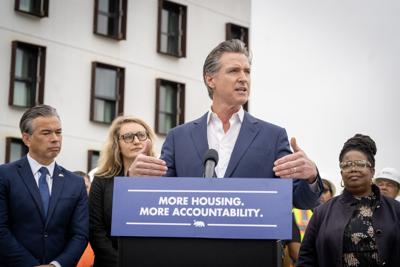


California Gov. Gavin Newsom speaks at a signing event for a package of housing bills on Sept. 19 in San Francisco. Photo courtesy the Office of the Governor.
Governor Gavin Newsom has officially signed close to 800 bills into California law, most of them set to go into effect Jan. 1, 2026. This year, Newsom vetoed around 13% of the bills that made it to his desk.
Following the end of the California legislative session in early September, Newsom had roughly one month to either sign or veto legislation passed in the state Assembly and Senate. On Monday, the governor completed his part of the legislative process and signed 794 bills while vetoing 123.
“Our children deserve to feel safe at home, in school and in the community,” said Newsom of Assembly Bill 495, the Family Preparedness Plan Act, which will allow more relatives to be deemed as guardians for children whose parents have been detained or deported.” He added, “we are putting on record that we stand by our families and their right to keep their private information safe, maintain parental rights and help families prepare in case of emergencies,”
Authored by Assemblymember Celeste Rodriguez (D-San Fernando), AB 495 expands on current caregiver legislation, making it possible for a wider range of family members to be named as temporary guardians. The bill would also require schools and daycare facilities to distribute guidance for families to be prepared in times of crises like family separations.
“This is a crucial step toward protecting children and families at a time when they are facing the terror of separation,” said Rodriguez, adding, “by creating additional protections and tools that strengthen parental rights and community preparedness, we are ensuring that no child is left without a safety net and reinforcing California’s commitment to safety and compassion for all families.”
The bill was supported by over 30 child welfare and immigrant advocacy organizations. Opponents of the bill said it would make it easier for strangers to pose as family members.
“AB 495 safeguards families from exploitation and confusion during separations, giving parents the power to designate trusted loved ones to be caregivers and keep their children out of harm's way,” said Angelica Salas, executive director of the Coalition for Humane Immigrant Rights (CHIRLA). She added, “CHIRLA is a proud co-sponsor of this bill because every child deserves safety and protection, and every parent deserves the right to plan for their family's future without fear.”
One of the 123 bills Newsom vetoed was SB 388, presented by Sen. Alex Padilla (D-San Diego). The bill sought to establish a California Latino Commission to advise and make recommendations on policy that affects the roughly 15 million Latinos in the state. Newsom said the commission would result in “ongoing implementation costs in the millions of dollars” when existing agencies already do this work.
“With significant fiscal pressures and the federal government's hostile economic policies, it is vital that we remain disciplined when considering bills with significant fiscal implications that are not included in the budget, such as this measure,” wrote Newsom in his veto message.
One of the education bills that was vetoed, Senate Bill 414, was another controversial piece of legislation.
SB 414 was an accountability bill that would have created a new Education Office of Inspector General to conduct forensic audits of charter schools. The bill also proposed alterations to the oversight, auditing and funding of nonclassroom-based charter schools while establishing statewide contracting requirements to prevent the misuse of public funds.
“I deeply appreciate the efforts of the author and the negotiating parties to develop legislation that builds on these recommendations and the findings of the State Controller,” wrote Newsom in a veto message, adding, “however, this bill falls short. While the oversight and auditing provisions are meaningful, other sections are unworkable, would face legal challenges and require hundreds of millions of dollars to implement.”
In 2019, the San Diego District Attorney’s office prosecuted 11 individuals within the Academics Arts and Action Education (A3) charter network of 19 schools, for fraud of around $400 million.
State Controller Malia Cohen released a statement Monday supporting the veto, saying “while well-intentioned, this bill would have unnecessarily duplicated the powers and duties already vested in the State Controller’s Office.”
On Monday, Newsom also signed SB 40, authored by Sen. Scott Wiener (D-San Francisco). The bill will cap insulin copays at $35. Among many of Wiener’s bills that Newsom signed was SB 79, a housing bill that allows new housing to be built in high-density areas.
The governor also signed laws to ban ultra-processed foods in schools, raise the hourly wage for incarcerated firefighters battling active wildfires from $1 to $7.25 and lower the volume of commercials that rise to a level louder than the content being watched.






(0) comments
Welcome to the discussion.
Log In
Keep it Clean. Please avoid obscene, vulgar, lewd, racist or sexually-oriented language.
PLEASE TURN OFF YOUR CAPS LOCK.
Don't Threaten. Threats of harming another person will not be tolerated.
Be Truthful. Don't knowingly lie about anyone or anything.
Be Nice. No racism, sexism or any sort of -ism that is degrading to another person.
Be Proactive. Use the 'Report' link on each comment to let us know of abusive posts.
Share with Us. We'd love to hear eyewitness accounts, the history behind an article.