
by CALÓ News Editorial Board

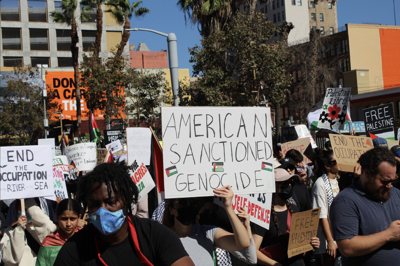
Protesters march through Downtown Los Angeles during a pro-Palestine demonstration on October 21, 2025. (Image credit: Michelle Zacarias)
Last month, Israel’s security cabinet approved the first phase of a cease-fire agreement in the Gaza Strip, bringing a temporary halt to the fighting after two days of intense debate that highlighted the deal’s precarious nature. The agreement, brokered by international mediators and supported by U.S. officials from both the Biden and Trump administrations, aims to provide humanitarian aid to Palestinian civilians, facilitate the exchange of Israeli hostages and Palestinian prisoners and open the door for potential long-term peace talks.
However, this cease-fire agreement comes after more than a year and a half of devastating violence, with Palestinian casualties estimated to be over 46,000 and many more missing in the rubble. While the October 7 attacks, which tragically claimed 1,100 Israeli lives, are often cited as the catalyst for the recent escalation, many recognize that the roots of the conflict go much deeper, dating back more than 76 years due to the ongoing violence of apartheid and displacement.
Amid these developments, President Donald Trump also made bold statements about U.S. involvement in Gaza, suggesting that the U.S. should “take over” the region to stabilize the situation and redevelop the land. Trump's remarks sparked debate over the possibility of a military occupation, drawing sharp criticism and forcing his administration to walk back on several elements of the proposal.
There is an undeniable political shift unfolding in this country, and the mounting threats to our democracy are becoming harder to ignore. Yet, the political landscape of greater Los Angeles has long stood as the epicenter of progressive policy and Latino leadership. In communities across Southern California, particularly those with large Latino populations, there is a profound and growing solidarity with the Palestinian people.
Many Latinos, especially the younger generation, see clear parallels between their struggles for immigrant rights, racial justice and indigenous sovereignty and the Palestinian fight for self-determination. This shared sense of struggle has fueled calls for a ceasefire, spurring activism and public outcry in support of peace and an end to violence.
However, it is crucial to recognize the role of the media in shaping public perception of these issues. Too often, narratives surrounding such solidarity are distorted, minimized or outright ignored. The media’s failure to contextualize these connections—particularly the broader geopolitical and human rights dimensions—has contributed to polarization, fueling division rather than fostering understanding.
As we enter a second Trump presidency, the media has a responsibility to tell these stories in their full complexity, highlighting the ways in which different communities in this country, including Latinos, are drawing connections between their own histories of resistance and the global fight for justice. Without this crucial context, we risk not only misrepresenting these movements but also eroding the very democratic ideals we claim to uphold.
This is why we believe that Israel's actions will continue to alienate a new generation of Latino leaders and voters. As millions of Latinos are further politicized and energized by the hate and vitriol of the Trump administration, people sadly will not remember the atrocities of October 7th and instead focus on the destruction and death inflicted in Palestine, the over 40 thousand dead, and the abandonment of common sense policies that protect Palestinian and Israeli lives. We support the call for a ceasefire, the advancement of a two-state solution and opposition to any occupying force in the Palestinian territory. We are committed to amplifying the voices of marginalized communities, whether in the neighborhoods of Los Angeles or across the globe.
The CALÓ News Editorial Board publishes separately from the newsroom.








(0) comments
Welcome to the discussion.
Log In
Keep it Clean. Please avoid obscene, vulgar, lewd, racist or sexually-oriented language.
PLEASE TURN OFF YOUR CAPS LOCK.
Don't Threaten. Threats of harming another person will not be tolerated.
Be Truthful. Don't knowingly lie about anyone or anything.
Be Nice. No racism, sexism or any sort of -ism that is degrading to another person.
Be Proactive. Use the 'Report' link on each comment to let us know of abusive posts.
Share with Us. We'd love to hear eyewitness accounts, the history behind an article.