
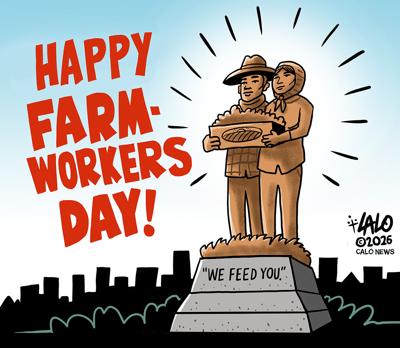

After the horrible revelations about farm labor leader Cesar Chavez, many felt that we should not put anybody on a pedestal. I slightly disagree. In the spirit of the renaming of the March 31 holiday in California, I believe that immigrant farmworkers are worthy of our praise. Under the hardest working conditions, and pay that is not close to what they deserve, they show up to work day after day to feed this country.
The first state to rename César Chávez Day to National Farm Workers Day was California, ensuring that the holiday honors the people at the center of the movement. Revelations about César Chávez’s sexual violence has compelled a nationwide re-naming of holidays, schools, streets and monuments. With renewed attention on the movement, we have an opportunity to redouble efforts to protect and support farm workers. These vital frontline workers are so much more than their labor. Farm workers deserve to thrive. We must reinforce legislative and non-profit structures that support them in full and holistic ways.
I grew up hearing stories from my father’s childhood as a Mexican American migrant farm worker during the Great Depression,working long days under the hot sun for pittance pay. His parents and 11 siblings followed the crops from Texas to the Midwest and back throughout his childhood, and he never even attended elementary school.
This fact always shocked me because I was a child who loved going to school. Despite his lack of access to education, my father taught himself to be fully literate in both English and Spanish, as well as how to read music and play a variety of instruments: guitar, bajo sexto, button accordion and piano accordion. He died when I was 17 years old, so I never got to ask him about everything I would like to know now. How did he learn reading, writing, math and history outside of school? How did he learn music without a teacher? Did he have childhood friends? Did he ever have time to play?
It wasn’t until I was in graduate school studying literature that I got to read for the first time a book written from the perspective of migrant farmworkers—the 1971 classic “And the Earth Did Not Devour Him” by Tomás Rivera. That book brought my father back to life for me. In Rivera’s book, and others such as the 1995 masterpiece Under the Feet of Jesus by Helena María Viramontes, the characters’ lives are written in vivid detail. They are parents and children, young and old, lovers and loners, sacred and secular, who all have hopes and dreams for themselves and their families. They do not live to work. They work very hard and barely get to survive.
For good reason, by and large, farm worker justice focuses on basic human rights. Farm workers provide the fruits and vegetables that feed a nation everyday, yet they face exploitative work conditions, toxic exposure, poverty pay, and harsh housing conditions. One way to help farm workers is to support thecall in California for a $26 an hour minimum wage.Farm worker advocacy groups have identified that amount can make positive health impacts on farm workers.
Yet, farm worker justice involves more than just a pay raise. As Fannie Lou Hamer pledged, “Nobody’s free until everybody’s free.” Freedom means the opportunity to live a full life, inclusive of mental health and self-expression. A non-profit in the Bay Area calledThe Botanical Busunderstands this lesson.
The Botanical Bus “strive[s] to increase access to healthcare, reduce health disparities and improve health outcomes so that Latine and Indigenous immigrants experience healing justice, radical belonging and community care,” as stated on their website. They take their services via a mobile unit to the communities at vineyards, farm worker housing, and community centers. Especially impactful is their bilingual and bicultural approach to healthcare that integrates culturally-affirming practices such as “herbalism, nutrition, massage, acupuncture, and somatic therapy.” This approach ensures that farm workers’ own knowledge and practices are featured, too.
A combination of support for a $26 an hour farmworker minimum wage and donations to organizations such as The Botanical Bus can work toward more holistic support for one of the most important communities among us.







(0) comments
Welcome to the discussion.
Log In
Keep it Clean. Please avoid obscene, vulgar, lewd, racist or sexually-oriented language.
PLEASE TURN OFF YOUR CAPS LOCK.
Don't Threaten. Threats of harming another person will not be tolerated.
Be Truthful. Don't knowingly lie about anyone or anything.
Be Nice. No racism, sexism or any sort of -ism that is degrading to another person.
Be Proactive. Use the 'Report' link on each comment to let us know of abusive posts.
Share with Us. We'd love to hear eyewitness accounts, the history behind an article.