
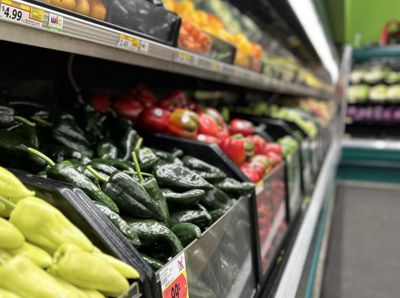

SNAP benefits help families, children, disabled and elderly people buy food. (Photo by Amairani Hernandez.)
For generations, the United States has been a refuge to immigrants seeking safety from conflict in their homeland, work opportunities when industries have dried up, a better quality of life and more. Immigrant families lead many of the service-based jobs the American workforce has abandoned. Los Angeles is home to 3.6 million immigrants who pay billions of dollars in taxes and comprise a majority of the essential services workforce.
But in an expensive county like Los Angeles, these jobs may not cover all living expenses, including the ability to purchase nutritious food. As a result, many immigrant families rely on federal food assistance programs, like the Supplemental Nutrition Assistance Program (SNAP)—known as CalFresh in California—to help make ends meet.
As of April 1st, over 10,000 people throughout Los Angeles were at risk of losing access to CalFresh, including refugees, asylees and other immigrants who are legally allowed to be in the United States. This is the result of new restrictions on immigrant eligibility for SNAP put in place by H.R. 1, or the “One Big Beautiful Bill,” that passed last July. These restrictions reduce families’ spending power and, as a consequence, also negatively impact local economies.
In Mid-City, Mandeep Singh operates a family-run store, Pickford Market, which is accustomed to high foot traffic after the nearby school lets out for the day. His store joined the Healthy Markets LA program in 2018 to become a healthy retailer for the community it’s served for the last 26 years. The program provided him with new refrigeration and shelving to offer his customers healthy food options like produce and pantry staples. Since the program, he saw an increase in sales by families using their CalFresh benefits to purchase produce to make home-cooked meals. But this past April, he reported a 25 percent decrease in CalFresh sales compared to the same time last year, a year that saw the passage of H.R. 1 and the implementation of its eligibility restrictions.
Mandeep says, “It's hard to watch. These are families we see every week, people who count on being able to buy fresh food for their kids. The loss isn't just in the numbers; it shows up in the conversations at the register, too.”
But this isn’t the first time that Congress has used SNAP policy to target immigrants. In 1996, President Bill Clinton’s “welfare reform” bill restricted immigrants’ access to public benefits by introducing arbitrary waiting periods. H.R. 1 is just the latest version of that same playbook.
This moment is especially dangerous because of the broader environment in which these SNAP cuts are taking effect. Immigration enforcement via ICE has ramped up dramatically and aggressively across the country. Los Angeles neighborhoods have been a direct target as ICE arrests tripled in 2025 compared to the prior year, and most detainees had no criminal record.
The federal government is actively considering a new “public charge” rule that could jeopardize immigrants’ path to legal status simply for using the public benefits for which they are eligible. Together, these forces mean that immigrants are either losing SNAP eligibility or may opt out of receiving those they qualify for, afraid that seeking help could lead to deportation or put their immigration future at risk.
Together, these actions by the federal government have created an avoidable hunger crisis for immigrant communities, disproportionately impacting counties like Los Angeles that have large immigrant populations. To prevent a bad situation from getting worse, community-based advocacy organizations like the LA Food Policy Council (LAFPC) are taking matters into their own hands.
At the community level, LAFPC will be hosting its annual Food Leaders Lab program this summer. The goal of this program is to empower immigrant community members and immigrant-serving organizations with the skills and space to craft a comprehensive, locally focused immigrant food justice policy agenda.
At the county level, we are urging the Los Angeles County Board of Supervisors to allocate $20 million to fund a county-level immigrant food justice grocery voucher program for those who are now ineligible for CalFresh benefits. The county has the authority and resources to provide food to immigrants regardless of their status. The Board of Supervisors should choose to act now before more families go deeper into poverty.
At the state level, Governor Newsom’s May revision to the state budget proposal maintains the planned expansion of the California Food Assistance Program (CFAP), a program for income-eligible Californians who do not qualify for CalFresh. The expansion will allow CFAP enrollment for all older adults regardless of immigration status beginning October 2027, but younger adults and the humanitarian immigrants newly excluded from CalFresh are not eligible for CFAP. We call on the Governor and the Legislature to expand CFAP to income-eligible Californians—no exceptions, no delays, no exclusions.
At the federal level, Congress is now working on the farm bill, which is legislation passed roughly every five years that governs SNAP policy. We call on Congress to use the farm bill to reverse the SNAP funding cuts and immigrant eligibility restrictions outlined in H.R. 1. Congress should also pass the LIFT the BAR Act to remove the arbitrary waiting period that has blocked immigrants from accessing CalFresh since 1996.
The immigrant communities of Los Angeles deserve to be nourished. Our local, state and federal elected officials have the power to keep them from going hungry.







(0) comments
Welcome to the discussion.
Log In
Keep it Clean. Please avoid obscene, vulgar, lewd, racist or sexually-oriented language.
PLEASE TURN OFF YOUR CAPS LOCK.
Don't Threaten. Threats of harming another person will not be tolerated.
Be Truthful. Don't knowingly lie about anyone or anything.
Be Nice. No racism, sexism or any sort of -ism that is degrading to another person.
Be Proactive. Use the 'Report' link on each comment to let us know of abusive posts.
Share with Us. We'd love to hear eyewitness accounts, the history behind an article.