
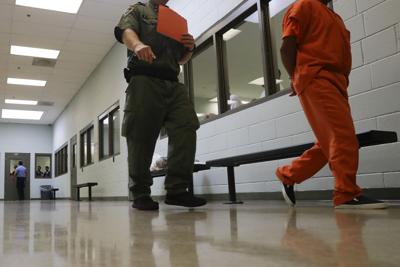


In this Wednesday, Aug. 28, 2019, photo shows a guard walks a with a detainee in the intake area at the Adelanto ICE Processing Center in Adelanto, Calif. The facility is a privately operated immigration detention center run by the GEO Group, which can house up to about 1900 total immigrant detainees, both male and female. (AP Photo/Chris Carlson)
On an August day in 2025, Celestin Dima had reason to celebrate. A judge at Arizona's Eloy Immigration Court had just ruled that sending the African asylum-seeker back to his home country would likely bring further persecution.
He’d fled Burkina Faso, a landlocked nation in West Africa, where he was outed as gay, kidnapped, and later targeted by the military and tortured by police. Dima had sought refuge in the United States, and was detained after crossing the U.S.-Mexico border in 2024.
Under any previous administration, lawyers say, the immigration judge’s decision would have led to his release.
Instead, nearly a year after the ruling, Dima was still locked inside an Immigration and Customs Enforcement detention center while the government looked for another country willing to take him in. The process, known as third-country removal, can take months or years, if successful at all.
“When I arrived in the United States, the hope was to live peacefully, without being afraid of what I am,” Dima said. “But the reality is another thing.”
Dima was one of at least 120 immigrants whom ICE continued to detain in Arizona after judges barred deportation to their home countries, according to an AZCIR analysis of more than 1,200 habeas corpus petitions—federal lawsuits challenging the legality of a person’s detention.
The true number is almost certainly higher, as the analysis captures only immigrants who were able to challenge their detention in federal court from January 2025 through March 2026.
Many in Arizona remained in custody for months—and in some cases, over a year—while the Trump administration sought to deport them to countries where they had never lived. More than half were detained beyond the six-month mark at which the Supreme Court said the government risks running afoul of constitutional limits, AZCIR’s analysis shows.
Attorneys argue these prolonged detentions violate the Fifth Amendment’s guarantee of due process because there is no realistic prospect of deporting immigrants in the foreseeable future. The Supreme Court has ruled the government cannot indefinitely detain people under these circumstances.
"(The goal is) to promote this uncertainty—to promote this fear—so that individuals might abandon any efforts to remain in the United States," said Matthew Boaz, an assistant professor at the University of Kentucky law school specializing in third-country deportations.
The immigrants identified by AZCIR had been granted one of two types of humanitarian relief: withholding of removal or protection under the Convention Against Torture. Both protect people from being sent to countries where they are likely to face persecution. Unlike asylum, the protections do not provide permanent legal status, leaving open the possibility of removal elsewhere if another country agrees to accept them.
The Trump administration has seized on that distinction in an effort to ramp up removals, despite federal judges routinely siding with detainees who’ve challenged the practice in court and ordering their release.
“ICE is applying the law as written. If a judge finds an illegal alien has no right to be in this country, we are going to remove them. Period,” an ICE spokesperson said in a written statement.
Though the immigrants caught in this legal limbo represent a sliver of those affected by the administration's broader deportation campaign, scholars say targeting them is less about the number of people ultimately removed than the message it sends to others seeking refuge in the United States.
“It doesn’t matter that you prove you fled real harm,” said Yael Schacher, a director at the nonprofit Refugees International. “You’re not welcome here.”
 The Eloy Detention Center, a privately run ICE immigrant detention facility, is shown here on Friday, April 10, 2020. Photo by Nicole Neri | AZCIR
Dima arrived in the U.S. in late July 2024, hoping to receive asylum.
But because he crossed the border between official ports of entry, a Biden-era rule made him ineligible.
Dima instead was granted withholding of removal from Burkina Faso, protecting him from deportation home. Before a federal court overturned the rule in May, it had funneled many asylum-seekers toward these more limited protections.
To win withholding, immigrants must show they would likely face persecution because of their race, religion or other protected characteristic if returned home, a higher legal standard than asylum. Those with serious criminal convictions don’t qualify. The Convention Against Torture requires immigrants to prove they would likely be tortured if sent back.
More than 3,800 people were granted one or both forms of relief in fiscal year 2025, according to the Congressional Research Service. Over several decades, tens of thousands more have won these protections.
Though ICE has long had the ability to deport these immigrants to third countries, it historically did so only in extraordinary circumstances, such as when someone posed a threat to national security. In 2017, for example, only 21 people with withholding were removed from the U.S., less than 2% of those granted the protection that year.
These removals were rare largely because other countries had little incentive to accept people who weren’t their own citizens. As a result, people with these protections were typically released and allowed to live in the U.S. with a work permit.
That changed under the second Trump administration.
The Department of Homeland Security directed officials to review the cases of individuals who had been granted withholding of removal or CAT protections, including many who had been living in the U.S. for years and believed their immigration cases had been settled.
Among those detained in Arizona facilities was a Colombian mother separated from her two young children during a routine ICE check-in in Baltimore before being transferred to Eloy, AZCIR found. Another was an Iraqi man showing early signs of dementia who was arrested by ICE agents in his front yard after living in the U.S. for more than 30 years. Judges had previously ruled both would likely face torture if returned to their home countries.
AZCIR’s analysis found that immigrants redetained under similar circumstances were held for nearly four months, on average.
Once detained, immigrants can be removed to third countries with little notice. Most lack legal representation, and many never file habeas petitions challenging their detention. Even those who do can be deported before a judge has the chance to rule.
“To be told, suddenly, from out of nowhere, because of a change in policy, they are at risk of being removed to a third country where they've never lived before,” said Ginger Jacobs, an immigration attorney in San Diego. "It's shocking, and it's extremely scary.”
“To be told, suddenly, from out of nowhere, because of a change in policy, they are at risk of being removed to a third country where they've never lived before. It's shocking, and it's extremely scary.”
Ginger Jacobs, immigration attorney
After a judge ruled in August 2025 that Dima couldn’t be deported to Burkina Faso, ICE began searching for another country willing to accept him.
Officials first sought to deport him to Ghana, where homosexuality is punishable by up to three years in jail. A judge ruled he could not safely be deported there, either. ICE also raised Cameroon and Uganda—which has one of the world’s harshest anti-LGBT laws—as options.
The possibilities terrified Dima.
He recalled telling an ICE official at a hearing: “If you send me back to the countries you mentioned, it's better to send me to my own country. Even if they kill me there, it’s better than sending me to countries where they burn homosexuals.”
Dima also feared that if he was deported to another country, that country would send him back to Burkina Faso, a process known as chain refoulement. Immigrants the U.S. has sent to third countries have repeatedly been returned to the countries they originally fled, effectively bypassing the protections American immigration judges had put in place. The deportations have been made possible by more than $32 million in agreements the Trump administration negotiated to persuade foreign governments to accept people with no ties to their countries.
“We are not supposed to, under domestic law and international conventions that were signatory, return people to situations where they’re going to be tortured or going to be persecuted. And this results in exactly that happening,” said Katharine Ruhl, an attorney at the Florence Immigrant and Refugee Rights Project who represented Dima.
While detained in Eloy, Dima became depressed and anxious, growing so sick with worry that he stopped eating for stretches at a time. After repeatedly refusing food, he said, he was placed in solitary confinement for two weeks. ICE said the move was intended to allow medical staff to more closely monitor his condition.
Immigrants’ rights groups have repeatedly characterized conditions at Eloy as inhumane, citing physical abuse and medical neglect. Officials there have used solitary confinement to coerce people into self-deporting, according to detainees, and there have been at least 16 reported deaths and five suicides.
“There is no real difference between the inside of a prison and the inside of an immigration detention center,” said Keith Hilzendeger, a federal public defender in Arizona. “The effect on the person is the same.”
“There is no real difference between the inside of a prison and the inside of an immigration detention center. The effect on the person is the same.”
Keith Hilzendeger, federal public defender
As of June, more than 8,000 of the roughly 66,000 people in immigration detention nationwide had been held for at least six months, the constitutional benchmark for prolonged detention. That number had more than doubled since September 2024, the last month of the Biden administration for which data was available.
After winning withholding of removal or CAT protection in detention, immigrants in Arizona were held in detention for an average of seven months, AZCIR found. Their total length of detention, including time spent waiting for a judge to grant them protections, averaged nearly a year.
Arizona ranks among the top five states nationally in immigration detention book-ins, an NPR analysis found, with plans to open at least one more detention center this year. It costs taxpayers about $150 per person per day to detain an immigrant, according to DHS.
In March, the Florence Project filed a joint habeas petition on behalf of Dima and eight others who remained detained despite winning withholding of removal, arguing their indefinite detention was unlawful.
Among them were a woman from Iran arrested after filming a video about the country’s Kurdish minority, an Iranian convert to Christianity who had participated in the Women Life Freedom movement, and a Chilean man tortured because he belonged to the Indigenous Mapuche people.
By June, Dima had been in detention for almost two years.
“I’ve lost hope,” he told AZCIR from his cell. “Right now, I don’t even know what I want.”
“To this day, I regret coming to the United States.”
Around 11 a.m. on June 30, a bus pulled into the parking lot of a small church in Phoenix.
Twelve people got out. All were just released from ICE detention.
Dima was among them.
To his surprise, a federal judge had granted his habeas petition the day before, ordering Dima and the other detained immigrants on the Florence Project’s joint petition released within 48 hours.
Dima sat at a table inside the church looking stunned, a volunteer recalled. Next to him was a man from Afghanistan and another from Cameroon. They ate plates of grapes and cherries with Costco roast chicken prepared by volunteers.
“I cannot express myself—the way I’m feeling,” Dima later said with a chuckle.
In ordering the immigrants’ release, U.S. District Judge Diane J. Humetewa rejected the government's reliance on potential third-country deportation to justify their continued detention. “Unconstitutional removal cannot cure unconstitutional detention,” she wrote.
Arizona has seen a historic number of habeas corpus petitions challenging prolonged immigration detention. In nearly 90% of cases analyzed by AZCIR, judges sided with immigrants who’d won withholding or CAT protections and ordered their release. That excludes cases dismissed because of deportations or transfers.
“I couldn’t understand the legal justification for their continued detention,” said Luis Campos, a Tucson immigration lawyer. “They were detained simply because the government felt it could detain, and they weren't being challenged on it.”
Still, for every individual who is released, there are many more who are stuck in detention without legal representation.
“We’re up against a bit of a tidal wave,” Ruhl said. “We have many more clients who we have not been able to represent because of our limited capacity, who are in the same circumstance.”
In July, Dima arrived in New York City hoping to start a new life. He moved into a shared room at a friend’s apartment in the Bronx and made plans to apply for a work permit.
But he couldn’t escape the threat of deportation. Even after winning a habeas case, immigrants can be redetained if the government says it has found a third country willing to accept them.
Dima rarely left the apartment. He feared the bulky GPS bracelet ICE had strapped to his ankle would attract the attention of police. Ahead of his first mandatory check-in with ICE, he struggled to sleep and lost his appetite.
“I keep worrying,” Dima said. “Every day, I sleep maybe three hours or four hours.”
His first check-in was on July 17, less than three weeks after his release from detention in Arizona. That morning, Dima woke early and went to the ICE field office in Lower Manhattan for a 7 a.m. appointment.
Within hours, ICE had taken him back into custody. Officials told him they planned to deport him but would not say where.
Mapping Celestin Dima's Detention
“It’s just completely unimaginable to be in the custody of the government not knowing what is happening,” said Marlene Berroa Rodriguez, an attorney with nonprofit Make the Road NY who took on Dima’s case.
Dima was transferred to a detention center in New Jersey, where he told an advocate immigrants were packed 10 to a cell beneath bright lights that never turned off. He reported that he couldn’t sleep and soon lost his sense of day and night.
Two weeks later, after another transfer, guards woke him before dawn at another detention center outside Dallas, put him in chains and drove him to an airport, according to Dima’s lawyer. By then, his attorneys had learned through a court filing that the government planned to deport him to the Central African Republic, though Dima was still in the dark.
He spent the day shackled on the plane, his lawyer said.
Shortly before takeoff that evening, officials removed him from the plane. A judge had temporarily blocked his deportation.
Instead of leaving the country, Dima returned to detention.
Olivier Touron contributed French translation for this story.
This article first appeared on Arizona Center for Investigative Reporting and is republished here under a Creative Commons Attribution-NoDerivatives 4.0 International License.










(0) comments
Welcome to the discussion.
Log In
Keep it Clean. Please avoid obscene, vulgar, lewd, racist or sexually-oriented language.
PLEASE TURN OFF YOUR CAPS LOCK.
Don't Threaten. Threats of harming another person will not be tolerated.
Be Truthful. Don't knowingly lie about anyone or anything.
Be Nice. No racism, sexism or any sort of -ism that is degrading to another person.
Be Proactive. Use the 'Report' link on each comment to let us know of abusive posts.
Share with Us. We'd love to hear eyewitness accounts, the history behind an article.