
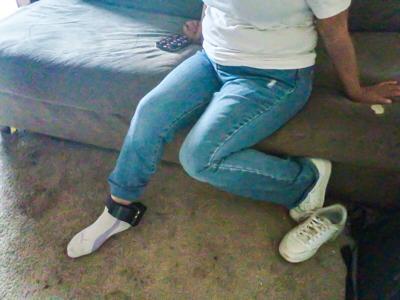


Maria shows the ankle monitor fastened by ICE agents prior to her release. (Credit Araceli Martinez)
This story was originally published by American Community Media.
OXNARD, Calif. — On the morning of September 18, as the first rays of sun began to appear in the sky, María made her way to the strawberry fields in Oxnard, California. Riding with a friend, she was barely a block from her home when their car was suddenly surrounded.
“Three or four vehicles approached, with masked men inside. They flashed their lights ordering us to pull over,” recalled María, 35, who asked that we only use her first name for fear of government reprisals.
“They told us they were looking for a man,” she continued. “My friend told them he wasn’t the person they were looking for, but they demanded he show ID. And when they realized that he was undocumented, they detained him immediately.”
‘My world came crashing down’
Oxnard, located in Ventura County, is an agricultural community about an hour north of Los Angeles. The city — where nearly 80% of residents identify as Latino — is home to a sizable migrant farmworker population, many of them, including María, from Mexico’s Indigenous Mixteco community. Many are also undocumented.
A single mother of four — ages 17, 12, 10 and 2, all born in the US — María first came to Oxnard in 2007 after leaving her home in Oaxaca, in the far south of Mexico.
It had been months since she had last worked. Her friend, the man arrested by Immigration and Customs Enforcement (ICE), had offered to drive her to a nearby farm that morning where he said she might find a paying job. Later, as María watched nervously while agents handcuffed her friend, she decided to speak out in his defense.
“Why are you taking him if he isn’t the one you were looking for,” she demanded. “At that moment they turned toward me and said they would arrest me, too, for asking questions and complaining,” María recounted.
In what seemed a matter of seconds, María found herself being handcuffed and boarded onto a van alongside her companion. The van then quickly made its way toward an ICE facility in the nearby city of Camarillo, about 10 miles east of Oxnard.
This is the moment, María says, that her world came crashing down.
From mass raids to targeted arrests
María’s encounter with ICE is emblematic of a shift in tactics by the agency. In place of high-profile mass raids, including one last year in Camarillo that resulted in the death of a local farmworker, agents are instead increasingly targeting individual immigrants at regional airports, during immigration status checks and at local jails, among other locations.
Still, despite the pause in the deployment of massive ICE units in cities and towns nationwide, arrests are at record levels, reaching an unprecedented 51,000 in August, according to the Department of Homeland Security (DHS). California has the third highest number of arrests in the country behind Texas and Louisiana.
A minor miracle
“They kept asking me my name and where I was from. I didn’t want to answer, but they kept pushing, so I pointed to my backpack and told them that my [Mexican] consular registration card was in there,” said María.
Once inside the ICE facility, she continued to ask why she’d been arrested. “You spoke too much, that’s why,” came the reply, according to María. ICE agents then said, “You should have thought about it before speaking up to defend your friend.”
More terrifying for María, the agents told her that she would spend the next three months in detention before being deported back to Mexico.
“I burst into tears. I was terrified thinking I would never see my kids again,” María shared. She pleaded with the agents to be taken back to her home. “’You’re staying here,’ they told me again and again, and I couldn’t stop crying.”
From Camarillo, María was later taken to an ICE processing facility in Thousand Oaks, about 16 miles further east. Then, seven hours later, María says something of a miracle happened.
The agents removed her handcuffs and the shackles around her ankles. In their place they fastened an ankle monitor. “They also installed an app on my phone with the days and times they would be coming to my house to check on me,” she said, “and the days that I would need to come to their offices.”
María was let go, with a stern warning. “If you miss an appointment or fail to comply with all we ask, we’ll come not just for you but for your whole family. We’ll deport all of you,” they told her.
Hunting immigrants
Laura Valdez is an activist with VC Defensa, Ventura County’s rapid response network. She met Maria when she was first released from ICE’s Thousand Oaks facility.
“She lives in an apartment complex densely populated by people from [the Mexican states of] Oaxaca and Guerrero that is in the crosshairs of Migration,” she explained. “It’s fenced in so [agents] can’t enter. Instead, they spend their time hanging around the place, waiting for immigrants to come out to hunt them. Three months ago they took four men and a woman. They released her later because she was breastfeeding.”
Valdez added, “We have sentries in all the neighborhoods, and sometimes we can stop the kidnappings that ICE carries out … but even when we get an alert, as in the case of María, they are still sometimes detained.”
A triumph, and a call to action
Juan José Gutiérrez is with the advocacy group Full Rights for Immigrants Campaign based in Los Angeles. He spoke with María as part of an effort to help her secure legal assistance shortly after her release, which he described as “exceptional.”
“Maybe they took pity on her, because she is an Indigenous woman, because she doesn’t speak Spanish well, she has four children, and she didn’t stop crying from the time she was detained until she was released,” said Gutiérrez.
“And although they released her with a shackle on her ankle and constant appointments with immigration, it was a triumph for her and her family,” he added.
But he warned arrests will continue until the community more forcefully stands up in defense of immigrants.
“We have not responded with the energy that the moment we live in deserves,” he said flatly.
This story was produced as part of “Aquí Estamos/Here We Stand,” a collaborative reporting project of American Community Media and community news outlets statewide.





(0) comments
Welcome to the discussion.
Log In
Keep it Clean. Please avoid obscene, vulgar, lewd, racist or sexually-oriented language.
PLEASE TURN OFF YOUR CAPS LOCK.
Don't Threaten. Threats of harming another person will not be tolerated.
Be Truthful. Don't knowingly lie about anyone or anything.
Be Nice. No racism, sexism or any sort of -ism that is degrading to another person.
Be Proactive. Use the 'Report' link on each comment to let us know of abusive posts.
Share with Us. We'd love to hear eyewitness accounts, the history behind an article.