







(left to right) Phoebe Unterman, Teresa Morán, Julio Cienega, Citlalli Velasquez, and Morán's husband sitting in front of the home where Cienega and his family could possibly be evicted. Photo by Brenda Verano
In the heart of Silver Lake, two working-class, immigrant families who have lived in their homes for more than 30 years are soon to face a sheriff's eviction in the coming weeks.
Julio Cienega and his wife, Maria Anes Soliz, are one of two families who have begun looking into affordable storage units. They’ve lived at 628 N. Occidental Blvd., in Silver Lake, for more than three decades. There they have created memories, raised both of their daughters and organized weekly food distributions for families affected by the current immigration enforcement raids in Los Angeles.
Today, all of that is in jeopardy after a newly appointed judge ruled to evict both elderly families, at a time when overall homelessness in the City of L.A. increased to 45,194 people in 2026.
“There are so many memories in this house. It’s very sad to see how that fades away so fast,” Cienega told CALÓ News.
Judge Cherisse Heidi A. Cleof, who was appointed to serve in the Los Angeles County Superior Court by Gov. Gavin Newsom earlier this year, granted Cienega’s landlord’s motion for summary judgment, a request made to decide a case without a full trial, asserting that there are no further relevant disputes in the family's housing case.
These families, organized as the North Occidental Tenants Association with the Los Angeles Tenants Union (LATU), have fought three rounds of Ellis Act evictions since landlord Farid Muhammad purchased their homes in 2021.
LATU organizers say this case is a clear example of landlords misusing and abusing the Ellis Act, a 1985 California state law intended to help mom-and-pop landlords who were permanently leaving the rental business.
Housing advocates like Citlalli Velasquez with LATU believe the outdated state law — which allows property owners to legally evict residential tenants if they withdraw the property from the rental market — has created a loophole to displace tenants from rent-stabilized units, flip properties or re-rent them at much higher market rates.
“We believe that the landlord is using this law in bad faith, just like there's a misuse of this law across the city. We've been trying to raise the alarm with the city's housing department and politicians to get more enforcement and strengthen the protections that tenants have around bad faith actors of this law,” Velasquez said. “The city’s housing department just rubber stamps every single Ellis Act eviction that comes its way. Right now, we need every single bit of rent-controlled housing that we can in L.A.”
The two families at Occidental Boulevard have said they’ve experienced harassment from the current landlord, including physical assault, threats to change the locks, refusal to make repairs, denial of rent to create a case for nonpayment, reduction of services and even the destruction of some of their belongings.
The families’ lawyer told CALÓ News that despite the multiple pieces of evidence presented to the judge, she did not grant them a trial.
“The tenants presented voluminous evidence including housing department complaints and citations, text messages, photos and videos, documenting a wide array of harassment, including, pressuring tenants into accepting cash for keys, physical harassment, removal of maintenance services and denial of rental payments,” the families’ lawyer said in a statement to CALÓ News. “The tenants also presented documentary evidence that the landlord lied about his intentions for the property in order to obtain a mortgage. The judge ruled that none of this evidence established a defense to eviction, which is directly in conflict with the law.”
Food distribution for families affected by ICE
Despite the constant threat of eviction, Cienega has found ways to keep showing up for his community. He, along with LATU and other community partners, has organized weekly food distribution for members of the community affected by raids and ICE kidnappings.
Community members gather in his backyard, organize, pack and get ready to distribute food for many families that feel unsafe walking to the grocery store because of the fear of being racially profiled and detained by federal agents.
According to Phoebe Unterman, an organizer with LATU, the tenants, including Cienega and Soliz, began organizing food donations last year to bring food assistance support for tenants in Echo Park and Silver Lake.
“Last summer, a lot of the tenants we work with were not leaving the house because it wasn't really safe to do so; many were also struggling financially and needed resources like basic groceries,” Unterman said. "We wanted to make sure that it was a place where people could come and feel safe, where they didn't have to wait in a long line while with everything that was going on with the ICE raids.”
Each week, about 20 to 30 families arrive at Cienega’s and his neighbors' backyard to pick up supplies. That has all stopped for now. Last week was the first week in over a year when the food distribution was closed.
“Today feels different. Today we would have been doing the food distribution and the house would have been so lively,” Cienega said. “Now, the fridges are empty and we’ve packed a lot of the stuff in case we have to go soon.”

Teresa Morán and her husband. Photo by Brenda Verano
Teresa Morán is one of the volunteers of the food distribution. In addition to packaging and organizing the food the mutual aid group receives, she also makes drop-offs to many of her neighbors in her apartment complex, most of whom are elders in mixed-status families.
She is also one of the hundreds of people facing eviction due to the Ellis Act. She and her husband have lived in a different apartment also in Silver Lake, just blocks away from Cienega, for more than 35 years. That's all at risk now too since the building was purchased about two years ago for $1,880,000 by Jacobson Investment Group.
The Jacobson Investment Group has bought and sold dozens of what they call “multifamily transactions,” por housing buildings throughout L.A., including South Central L.A., Boyle Heights, Silver Lake, and Long Beach.
Shortly after the new owners bought the apartment complex, they were notified that everyone living in the apartment complex had to relocate, citing the Ellis Act.
“The majority of the people in the apartment complex are elders like me and my husband,” she said. “The new owners are a real estate corporation and we have never met them; we have never had any type of contact with them. LATU tried to reach out on our behalf to ask if they could meet with us and they refused.”
Similar to Cinega’s case, Morán’s landlord has also stopped accepting their rent, she said.
Morán has become her husband's primary caretaker and says she has never lived anywhere else besides Silver Lake.
“Mentally, our housing situation has affected us a lot. I wake up every day thinking and worrying about what will happen to us next. If we were to be evicted, we would have no place to turn. Rent is very expensive right now and my husband, who already has problems walking and moving, has turned depressed,” she said.
Rampant use of the Ellis Act in LA
According to UCLA's Lewis Center for Regional Policy Studies, the loss and replacement of rent-stabilized housing in L.A. is in fact tied to Ellis Act filings. According to the 2025 research, only 26% of rent-stabilization ordinance removals through Ellis Act filings are tied to known affordable replacement development projects.
Most replacement units through Ellis Act filings do not end up as affordable housing and are instead designated at market rate.
LATU organizers say the Ellis Act has turned into a strategy for landlords to avoid tenant protection obligations so they can return units to the market at unrestricted rent prices.
“Many people, myself included, had no idea what the Ellis Act was. When I was talking to my neighbors, they had never heard of it,” Cienega said. “It sounds like a great idea for landlords, but what about us?”
The Anti-Eviction Mapping Project, which gathers data from the Los Angeles Housing Department (LAHD), estimates there has been a destruction of 32,000 rent-controlled units throughout L.A. through the Ellis Act from 1994 to today.
“This isn't just happening obviously in Silver Lake, but throughout L.A., although these neighborhoods have been hit the hardest by the use of the Ellis Act,” Velasquez said. “Landlords are alleging that they're getting rid of the whole building from the rental market that would have been rent-controlled housing for working-class people, but we know that with the Olympics coming, there's also an incentive for landlords to flip those buildings and turn them into hostels or Airbnbs.”
Catching these “bad actors" and misusing the Ellis Act can be hard now, as there is no official oversight process for this.
In 2023, the L.A. City Council approved a motion introduced by current mayoral candidate Nithya Raman and council member Enisses Hernandez to prevent “bad faith” evictions under the Ellis Act in response to widespread cases.
The motion directed city departments to report on mechanisms to prevent bad-faith evictions under the act and created guidelines to protect tenants from fraudulent withdrawals of rent-stabilized units.
But that motion was set to expire in 2026.

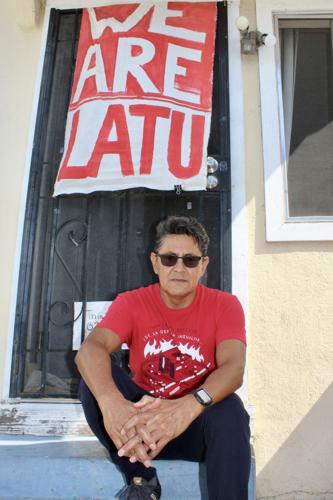
Julio Cienega sitting outside his home. Photo by Brenda Verano
LATU said that with little oversight and enforcement from the city's housing department, the burden is on tenants to prove that their landlords are acting in “bad faith," something particularly hard to do if they are denied their only avenue to share this: a jury trial.
In a comment to CALÓ News, Raman said similar mass eviction cases that target rent-controlled units invoking the Ellis Act are what prompted her 2023 motion to “reform our processes to deal with offenders who are skirting the law by exploiting loopholes, such as harassment behaviors like refusing to collect rent or neglecting the property during the one-year extension period in order to push tenants out.”
Raman said these types of evictions are contributing to the loss of affordable housing and the displacement of vulnerable tenants.
“Unfortunately, we sometimes see [the Ellis Act] applied in bad faith when owners use it to evict tenants as a means to temporarily withdraw units from the housing market, only to re-rent them at exorbitant prices down the line,” she said. “While the properties on North Occidental are not located in my district, they exhibit the current challenges with the structure of the Ellis Act. It is my hope that Judge Cleofe grants a jury trial for the eviction proceeding she is presiding over so that impacted tenants can make their case.
Gentrification at the heart of the issue
The possible eviction of several of these families is a larger issue that has struck Silver Lake and Echo Park for years. Today, Silver Lake and Echo Park are dealing with an alarming pace of change driven by gentrification.
Both Cienega and Morán said newcomers have completely transformed the area, not just culturally but also economically.
Morán arrived at the border of Echo Park and Silver Lake in 1980 from El Salvador due to the civil war. “Eventually all my family went back, but I stayed,” she said. “I went to school and got a license to be a preschool teacher assistant and I did that for 35 years.”
Back then, most of her neighbors in Silver Lake were predominantly Latinos. Since then, she said each year her neighborhood changes more and more.
“Most of the Latinos here have left and now most of the people living in this community are white,” she said. “In Sunset Boulevard, there were so many small restaurants, with owners who were Latino, from Japan, and from Cuba, and now not only are the owners white, but everyone inside is too. I think many Latinos left because of the rent.”
Today, the average rent for an apartment in Silver Lake generally ranges from $2,450 to $2,600 per month.
“Silver Lake is one of the probably most gentrified parts of the city. These buildings where these people are fighting to stay in their homes are some of the remaining parts of what Silver Lake used to be, which was an immigrant working-class neighborhood," Velasquez said. “We're fighting with the families here to stay in the neighborhood that they've called home for decades.”
Calling for a fair trial
Today, the families, housing advocates and their legal team are working to get the families a new trial and are urging Judge Cleof to reopen their cases and allow the families to defend their case in court.
"It's already really difficult for tenants to have the courage and the resources to fight any type of eviction case and secure legal representation. To be denied by a judge their right to a trial is, we think, unjust ” Velasquez said.
Cienegas said that although he is sad and worried about the end of the food distribution, he will continue to fight to argue his case.
Cienega and his neighbors have also started a GoFundMe to obtain funds that will go into supporting storage and moving costs as they demand a right to a fair trial.
“I know I have rights. By her decision to dismiss the case, she is not only negating my rights but also not respecting the rights of many other community members and people like me,” Cienega said. “But I will continue fighting regardless of the outcome, if that means I can help a family like mine to not go through something like this.”








(0) comments
Welcome to the discussion.
Log In
Keep it Clean. Please avoid obscene, vulgar, lewd, racist or sexually-oriented language.
PLEASE TURN OFF YOUR CAPS LOCK.
Don't Threaten. Threats of harming another person will not be tolerated.
Be Truthful. Don't knowingly lie about anyone or anything.
Be Nice. No racism, sexism or any sort of -ism that is degrading to another person.
Be Proactive. Use the 'Report' link on each comment to let us know of abusive posts.
Share with Us. We'd love to hear eyewitness accounts, the history behind an article.