

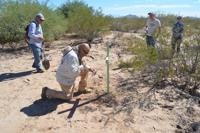

Peter Lucero kneels before a cross he helped place during a trip to a remote area in Pinal County, Arizona, on Oct. 7, 2025. Lucero helps Alvaro Enciso, who has been placing crosses in memory of migrants who have lost their lives in the Sonoran Desert. (César Barrón/CALÓ News)
Alvaro Enciso has been planting crosses in the desert for over a decade.
“I'm marking the locations where migrants died crossing the border looking for the American dream," he said. “I'm also honoring the lives of these people that have names and have families and people who love them. They had plans and all that ended here in our backyard, the Sonoran Desert.”
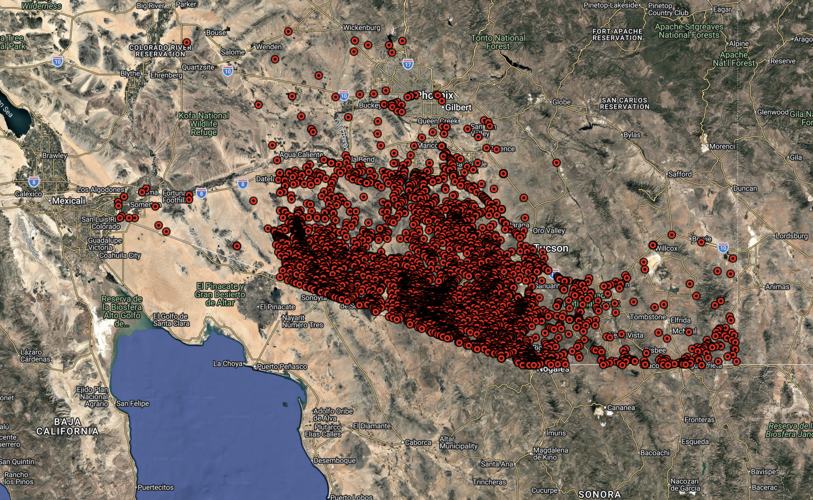
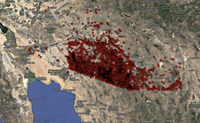
For Enciso, the human cost of the border wall is real, measured by two wooden planks nailed together to form a cross and painted colorfully to honor the lives lost to a dream unfullfilled. Where the two planks intersect, he paints a red dot, representative of the dots seen on the Humane Borders map, where he gets the exact coordinates for where to plant the crosses.
Migrant deaths in the desert have reached a new high — over 4,500 men, women and children’s remains have been found and documented since 2000, according to new data from Humane Borders and the Pima County Office of the Medical Examiner.
The report also reveals that migrant deaths in the Sonoran Desert remain at similar levels as previous years — despite increased investment in border security by the current administration. The organization documented 19 migrant deaths in July and 13 in June. So far this year, the remains of 73 people have been located in Arizona compared with 59 at this time last year and 103 for all of 2025, according to the report.
“It's looking like any other year, frankly,” said Octavio Fuentes, executive director of Humane Borders. “And of course, the deaths that are recorded are just the ones that have been recovered, knowing that there are likely tens of thousands of remains in the desert that will never be recovered, just lost to the desert and the desert has its way of cleaning itself up.”
The Sonoran Desert spans Sonora and Arizona, with the U.S.-Mexico border intersecting this hot, rugged and unforgiving terrain. With high temperatures, especially during the spring and summer months, the desert becomes a dangerous route for people hoping to covertly enter the United States.

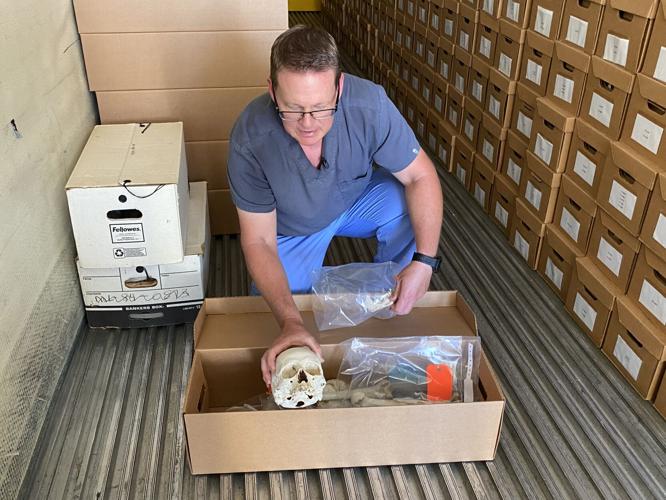
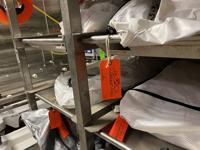
Chief Medical Examiner Doctor Gregory Hess shows how some remains are stored in a trailer at the PCOME facility. The Pima County Office of the Medical Examiner keeps remains that could be identified in the future, according to a 2023 interview. (Laura Holansky, Circa 2023 for UA Border Reporting class)
U.S. Customs and Border Protection (CBP) documented over 20,000 land border encounters in Arizona in 2026, not counting those who died on their journey to the U.S.
Most die from dehydration and exposure, the Humane Border report states, but some also die from hypothermia, drowning, blunt force trauma and unknown causes. Among the dead found in July, five had passed less than a day after they were found, the report states. Fuentes and Enciso argue that these deaths were preventable.
“It's just exacerbating something that's existed for decades and while we can easily point at the Trump administration and say it's happening because of [them], it's just a continuation of the prevention through deterrence policy that drives people into the desert,” Fuentes said. “That is the cause of these deaths. People dying in our desert is not accidental. This isn't happening because people are just choosing to — they’re being forced to because there is no other avenue.”
Prevention Through Deterrence is a U.S. Border Patrol strategy adopted in 1994 designed to discourage people from trying to enter the U.S. between ports of entry. Miles of border wall and surveillance pushed people to the most remote parts of the desert to try and cross through undetected. The strategy didn’t deter people and instead the number of people who’ve died in the desert has increased.
“The idea was that once people started dying out there, the word would get back to Latin America and then they would stop (coming),” Enciso said. “But they never understood the desperation of being poor, the desperation of having no other options in life — that either you come to El Norte or you're not going to have a good future and you may lose your life. This is the only option (for some), to make the trip full of uncertainty, full of danger.”
Trump makes good on border security promise — at a high human cost
Border security has been a top priority for President Donald Trump. The Department of Homeland Security (DHS) said in an August statement that the border remains “more secure than at any point in history,” with levels not seen in over three decades and a 94% decline in apprehensions compared to the previous administration.
In part, these numbers are due to increased funding from the passing of the One Big Beautiful Bill Act last year, directing billions of dollars to border enforcement, including $46.5 billion for the construction of a new border wall in various sectors; $4.1 billion to hire additional CBP personnel and a combined $5.9 billion for new technology and border surveillance. Additionally, the Secure America Act, passed in June, secured roughly $70 billion in funding for CBP and Immigration and Customs Enforcement (ICE) until 2028.

Humane Borders map tracks deceased migrants since 1981, when the first death was documented. At least 4,500 remains have been found since the organization began tracking deaths. (Humane Borders)
The cornerstone of Trump’s second-term border wall enforcement is the “smart wall,” a border barrier system that includes a combination of primary and secondary 30-foot steel bollard walls, waterborne barriers, patrol roads and surveillance technology, according to CBP.
“While the border remains historically secure under the leadership of President Trump and Secretary [Markwayne] Mullin’s tough enforcement of the existing laws, smugglers will try any tactic if they think it will result in profit,” said a CBP spokesperson in a written statement to CALÓ News. “Smuggling individuals… through dangerous environments such as the open ocean, underground tunnels, over barriers, or deep deserts, is nothing new. These criminal networks prioritize profit over human lives, creating false hope that often ends in tragedy.”
But Fuentes points the blame for the deaths at the federal government, saying that the administration's efforts to reduce legal migration have given people no other option. Since he’s been in office, Trump has imposed travel bans on 39 countries, paused visa issues affecting 75 countries and greatly restricted travel into the country, according to the Migration Policy Institute.
“Even people that have otherwise, based on international law, had the right to present themselves seeking asylum, that avenue is closed,” Fuentes said. “People that are refugees, all these different people that are trying to gain access into the U.S. for different reasons, they just don't have an in.”
Despite this, people will continue to try and enter the U.S., even if that means risking their lives crossing a deadly desert. And as border construction continues, migrants are only pushed into the most remote areas.
“If [migrants] had an ability to be able to move back and forth… maybe we wouldn't have to have what's called the immigration crisis, because people would have more freedom of movement,” Fuentes said.

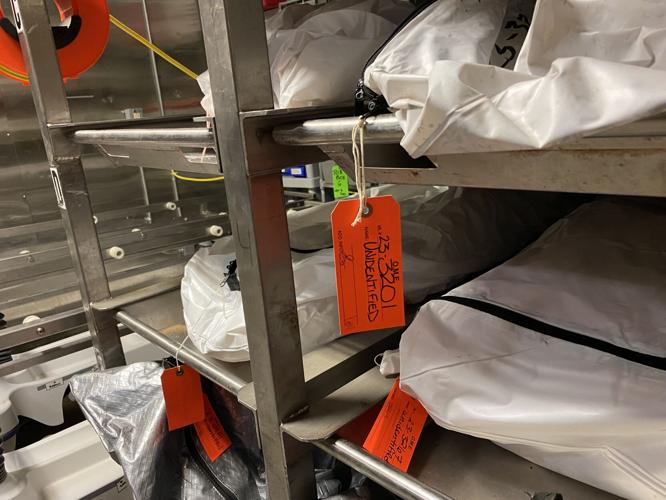
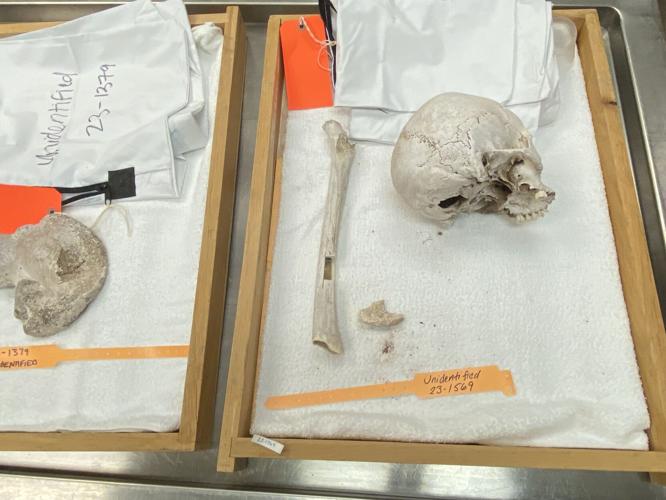
The remains of an unidentified body are stored at the Pima County Office of the Medical Examiner. (Laura Holansky, Circa 2023 for UA Border Reporting class)
When comparing the Humane Borders’ map of deaths in July to The Border Chronicle’s Wall Watch — a community-powered mapping project that provides an accurate, continuously updated record of the international border — one can see that the deaths align with the gaps in the border wall, where the Trump administration is looking to expand construction.
“No border — doesn't matter how high it is, how technologically implemented it is — [is] not going to stop people from coming,” Enciso said. “We need to understand that there's no way that we're going to stop migration.”
The human cost of border politics in southern Arizona
Enciso has placed more than 2,000 crosses in the desert since he began in 2013. As he works on the crosses each day, he thinks about the people who are waiting to hear from that person [and] how they will never receive a response.
“About one third of the deaths, we don't know who they are,” Enciso said. “So when someone is unidentified, the family keeps hoping that this person one day will knock on the door and say, ‘I'm back’ or make a phone call and say, ‘hey, you know, I'm here’ or send an email or whatever. But that's not going to happen because the medical examiner has the bones; we just don't know who those belong to.”
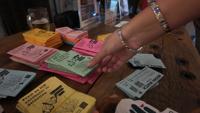
The Pima County Office of Medical Examiner's (PCOME) takes in the remains of people that were recovered in the county. Its staff works to identify them and find cause of death. They use their personal belongings to guide them — like an ID from their country of origin or a name written on a folded piece of paper. Sometimes, however, bodies are left unidentified, their bones placed in boxes with notes about where they were found and any observations about their skeletal remains.
In 2025, PCOME processed the remains of 4,400 people. Migrants make up just a fraction of that number, numbers that PCOME has gathered over decades of recording their deaths.

Skeletal remains of an unidentified person at the Pima County Office of the Medical Examiner. (Laura Holansky, Circa 2023 for UA Border Reporting class)
Since 2001, PCOME has had 4,088 cases of Undocumented Border Crossers (UBC), according to their UBC Deaths Report. The highest number of remains processed was in 2021 with 223 cases. Since then, the numbers have declined with a 24-year low in 2025, with 95 cases. In 2026, to date, PCOME has processed 97 cases. PCOME’s data also demonstrates that July has historically been the most deadly for migrant deaths.
“It's become so normalized that people just see this as an annual occurrence, rather than an ‘effing’ tragedy that shouldn't occur,” Fuentes said.
There is no federal requirement or centralization for medical examiners to document and store data on migrant deaths in the borderlands, leaving it as somewhat of a black hole of information. But through collaborations with nongovernmental organizations, Pima County has been able to gather the data and analyze migrant deaths since 2001 — something not all border counties have the resources to do.
“We have all these people that have disappeared and their families wanting to know what happened to their loved ones,” Enciso added. “In addition to the deaths we have this suffering, what I call the constant presence of absence, because when someone is missing, they’re going to be missing forever.”
Humane Borders, a beacon of life-saving aid in the desert
Humane Borders has about 40 water stations strategically placed throughout the borderlands — big, blue barrels full of water that have a 30-foot flagpole with a blue flag attached. The hope is that the flag can be a beacon of life for those in need of water.
In the past, right-wing organizations have vandalized the barrels by puncturing holes into the barrels or simply letting the water run. Despite this, volunteers are out in the borderlands every day, and checking the barrels is a part of their regular routine. They check water levels and ensure the water is clean and safe to drink. All of the barrels are permitted, either by the federal government, county or landowners.
In addition to tracking migrant deaths in the area, their mission is to save lives in the Sonoran Desert, whether that be migrants, hikers, four-wheelers or Border Patrol agents.
When Fuentes thinks of the Humane Borders report, one question permeates his mind.
“How far away did they die from one of our water stations?” Fuentes asked. “Could it have been the difference between a drink of water, just being able to sustain life long enough to be able to to be found by border patrol, by someone search and rescue that would have been able to save their lives?”
Susan Barnett is an independent journalist in southern Arizona covering the immigrant and Latine community. She is a recent graduate from the University of Arizona, where she received her Master of Arts in Bilingual Journalism. She previously worked at La Estrella de Tucson and co-founded Tucson Spotlight.




(0) comments
Welcome to the discussion.
Log In
Keep it Clean. Please avoid obscene, vulgar, lewd, racist or sexually-oriented language.
PLEASE TURN OFF YOUR CAPS LOCK.
Don't Threaten. Threats of harming another person will not be tolerated.
Be Truthful. Don't knowingly lie about anyone or anything.
Be Nice. No racism, sexism or any sort of -ism that is degrading to another person.
Be Proactive. Use the 'Report' link on each comment to let us know of abusive posts.
Share with Us. We'd love to hear eyewitness accounts, the history behind an article.