

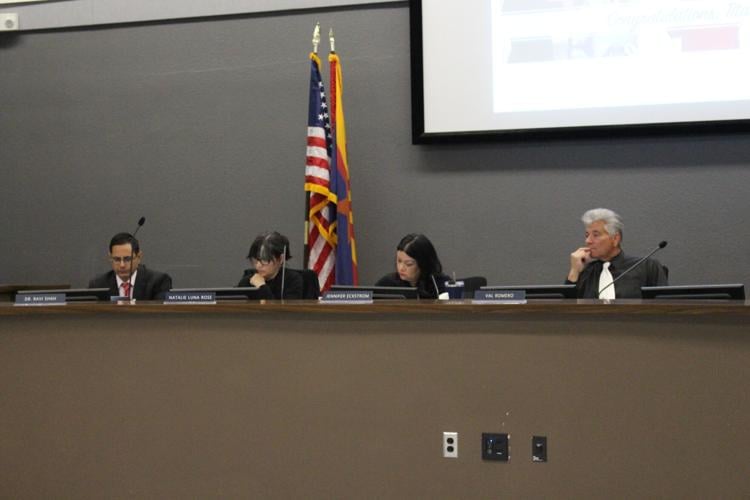


Tucson Unified School District board members listen as students and teachers make public comments during a meeting on March 18, 2026. Teachers presented the board with a petition, making demands for the district to strengthen its policies regarding potential immigration enforcement in schools. (Stephanie Casanova/CALÓ News)
TUCSON – Tucson teachers have been at the forefront of protecting their students from immigration enforcement, working alongside the district, being proactive and filling any gaps they see as they prepare for the possibility of immigration agents showing up at their schools.
At more than half of Tucson Unified School District (TUSD) schools, teachers have formed Immigrant Support Teams (ISTs), where they’re using a toolkit to make more individualized plans for how to respond if ICE agents ever enter their schools.
Educators are also demanding that the TUSD board do more to protect students. In March, they presented a petition to the school board with about 1,300 signatures from educators and school staff asking that they strengthen the district’s potential ICE presence plan and ensure accountability.
District-wide, the TUSD school board recently created the Immigrant Support and Response Task Force in response to some of the issues teachers brought up at a January board meeting, but have yet to move on all the demands outlined in the petition presented in March.
Immigration agents have yet to enter a school in Tucson, but in January, ICE agents pulled a car over and detained three people just outside of Drachman Montessori K-8 Magnet School, where children were walking on the outskirts of the grass field. That incident, paired with incidents in Minneapolis and Chicago where agents detained children, led to a heightened fear in immigrant communities in Tucson.
Jim Byrne, president of the Tucson Education Association (TEA), the union that represents TUSD educators, said the work teachers and the district are doing is preventative so that everyone is prepared in case enforcement escalations like the ones seen in the Midwest happen in Tucson.
“I think it’s a two-way street,” Byrne told CALÓ News about the relationship between ISTs at individual schools and the district-wide task force.
He would like to see both groups share and implement ideas together. Some ideas will come from teachers who spend more time with students and understand their fears, and other ideas may be coming from the district through the task force to Immigrant Support Teams that can inform students and other staff at their schools about those plans, Byrne said.

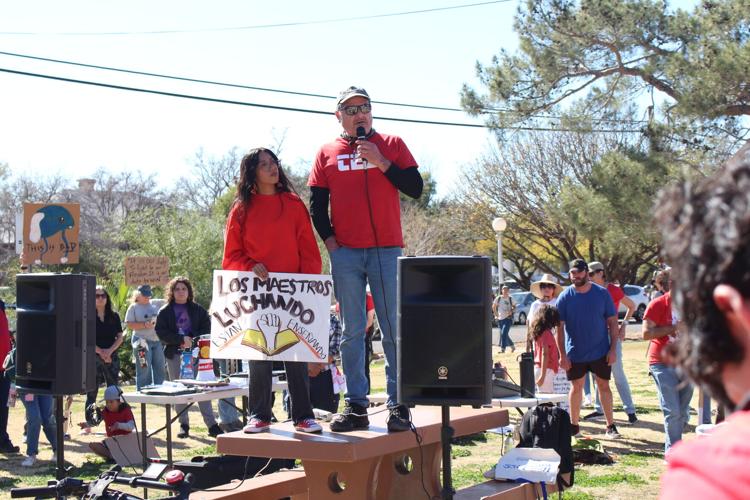
Jessica Ramirez Perea and Julian Barcelo, first-grade teachers at Davis-Romero Bilingual Elementary Magnet School, share their demands to abolish ICE and make Tucson a sanctuary city at an educators' rally on Friday, Jan. 30, 2026, at Catalina Park on Fourth Avenue in Tucson.
Meeting the demands of students and their families
On January 21, 2025, the day after President Donald Trump’s inauguration, the Department of Homeland Security issued a directive allowing immigration agents to enter schools, churches and healthcare facilities, all places that were once considered “sensitive” areas.
Educators, students, parents and families were concerned, Byrne said. Union members started talking with TUSD administrators and attorneys about improving the district’s current policy.
He started researching other school districts, and came across Chicago Teachers Union’s “Sanctuary Toolkit,” a document that outlines how schools can create sanctuary teams to support and protect students and build a response plan or a plan of action if immigration agents try to go into the school. He made a copy of the document, edited it to fit TUSD and replaced “sanctuary” with “immigration support.” Before releasing his version of the toolkit, he sent out a message to TEA members asking who would be interested in creating an Immigration Support Team in their school.
“The response was tremendous right away,” Byrne said. “I think within the first few days, there was over 80 respondents at over 40 schools, which is about half of TUSD.”
Along with a resource list the district had put together, which included law firms, advocacy groups and other organizations that support immigrant families, the union distributed the Immigrant Support Toolkit. They created packets with red Know Your Rights cards, orange cards with the Rapid Response phone number and other resources and made those available for families at 40 schools, Byrne said.
Teachers and school staff got to work creating teams to protect their students from immigration enforcement. Around that same time, the district held their first training going over what school employees should do if ICE shows up on a campus. During the Fall semester, as new people were hired onto the district, some staff members requested that their principals hold the training again. The district held a second training, mandatory for all TUSD staff, in February.
As interest grew with a new semester, Byrne sent out the interest form for ISTs again and saw another uptick in signups. They now have more than 200 names at more than 50 schools, all union members staying involved and informed on how they can protect students and their families from immigration enforcement.

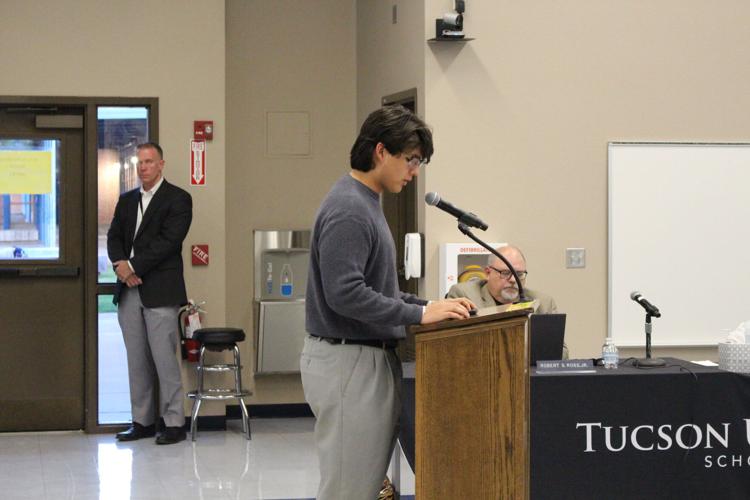
Raul Grijalva Gomez speaks to Tucson Unified School District board members during a meeting on March 18, 2026. Grijalva Gomez, a junior at Pueblo High School, said the district’s policies regarding ICE agents entering schools should be more proactively shared with students. (Stephanie Casanova/CALÓ News)
‘More must be done’
On March 10, students, a parent and a group of teachers, many of them on ISTs, spoke at the school board meeting during public comment.
Raul Grijalva Gomez, a junior at Pueblo High School and co-chair of MEChA, or Movimiento Estudiantil Chicanx de Aztlán (Chicanx Student Movement of Aztlán), asked the district to more clearly communicate its policies and procedures regarding immigration enforcement in schools with students and parents. He said students should not have to go out of their way, having to request information about district policy and organizing a field trip to attend a district board meeting, in order to learn about the district’s plans to address immigration enforcement if it happens in schools.
“We also felt that existing procedures, although shared with staff, were not properly communicated with students,” Grijalva Gomez said. “Many students and parents alike feel scared, completely unaware that an effort is even being made.”
He asked that TUSD collaborate with community partners like Rapid Response “to add another line of defense against ICE.”
Eliseo Gomez, a teacher at Pueblo High School, also addressed the board, acknowledging what the board has done so far to protect students.
“But I need to say that more must be done,” he said.
He presented the board with the petition, which included four demands:
Create a clear and concise plan to address ICE presence, including the possibility of remote classes if necessary.
Provide clarity and accountability for district policies related to ICE. This includes disciplinary actions for school employees who don’t follow TUSD policy and a directive to send immigration agents to the TUSD legal department offices to have warrants verified, rather than asking school employees to verify warrants.
Implement training on how to address ICE presence for students and staff that interact with students. The training should be trauma-informed and culturally sensitive and the district should also provide mental health and mutual aid services in partnership with community organizers.
Designate funds to implement the petition’s demands.
Gomez told CALÓ News in March that he hopes the demands made in the petition are taken seriously.
“That [TUSD] task force is uniquely poised to actually implement these demands,” he said. “So they are able to put these in place or at least go into negotiations with the district to implement these demands. And I want to see these not get watered down.”
Byrne said some of the demands in the petition, like implementing a clear and concise plan to address ICE presence, were things the district has already been doing.
The district’s policy emphasizes TUSD’s commitment to being a place for “students to learn and thrive in a safe environment free from investigations and enforcement of immigration status.” The policy states that immigration agents or any law enforcement officers need to have a valid judicial warrant in order to enter district property. Officers need parent permission to access a student’s records or to interview a student. School staff is already directed to send any judicial warrant to the district’s legal department for review.
“Our district has long-established policies and protocols, aligned with local and federal law, that ensure that all students have access to a high-quality education without fear of immigration enforcement,” said Karla Escamilla, director of communications for TUSD.
Other demands, like appropriating funds, have proven difficult as the district has said it needs to cut $10 million from its budget next fiscal year. They also are discussing ways to partner with community organizers to keep students and families safe during upcoming graduations without taking attention away from celebrating students on their big day, Byrne said.
As the district weighs its options regarding the petition, TUSD schools continue organizing.
Some schools have more than a dozen team members while others have one or two staff members working through the toolkit. Red “Know Your Rights” cards are available for families and students at front offices of each school, Byrne said.
“I want to get our schools as safe as possible so they remain open and kids can get a high quality public education from our great educators,” Byrne said. “And I know assuaging some of those fears means getting staff as trained up as possible, and that there's these sort of markers that parents can see and students can see, hear and feel that that campus feels as safe as possible and okay to come.”
Stephanie Casanova is an independent, bilingual journalist from Tucson, Arizona, covering community stories for over 10 years. She is passionate about narrative, in-depth storytelling that is inclusive and reflects the diversity of the communities she covers.












(0) comments
Welcome to the discussion.
Log In
Keep it Clean. Please avoid obscene, vulgar, lewd, racist or sexually-oriented language.
PLEASE TURN OFF YOUR CAPS LOCK.
Don't Threaten. Threats of harming another person will not be tolerated.
Be Truthful. Don't knowingly lie about anyone or anything.
Be Nice. No racism, sexism or any sort of -ism that is degrading to another person.
Be Proactive. Use the 'Report' link on each comment to let us know of abusive posts.
Share with Us. We'd love to hear eyewitness accounts, the history behind an article.