
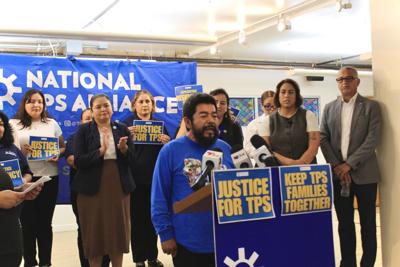


Jose Ramirez, a TPS holder for over 30 years, at a press conference on Thursday morning. Photo by Brenda Verano
Local immigrant rights organizations said at a press conference on Thursday morning that failure by the federal government to issue a decision on Temporary Protected Status (TPS) for Salvadorans has placed many mixed-status families in limbo and brought fear and confusion to thousands of communities in Los Angeles and other cities throughout the U.S.
“When that announcement will come is unknown, and that breeds more uncertainty, adding to community anxiety and fear,” said Laura Urias, legal director for the Central American Resource Center of Los Angeles (CARECEN-LA).
Lorena Zepeda, a TPS holder for more than 30 years, is one of the thousands of Salvadorans for whom the prolonged uncertainty has been an emotional toll.
Zepeda, who is a mother and who, in her time in the U.S., has been a community organizer with the National TPS Alliance for over eight years, said she is unsure of what might happen to her and her family in the next few weeks.
“Today we are here to let people know about [TPS Salvadorans]' contribution to this country,” she said at Thursday's press conference. “We are working every single day, paying our taxes and our mortgages. We have worked in every industry.”
Jose Ramirez, a TPS holder for over 30 years, said bringing back TPS protections is not enough and that he, along with many other immigrants, deserves a pathway to citizenship.
“I've been living in the U.S. for over 30 years, contributing economically and through my labor for this great nation. At the same time, I, like many others, have contributed to the economy of my own country, El Salvador, with the weekly and monthly remittances that I send over,” Ramirez said.
For now, and until further notice, approximately 200,000 Salvadorans with Temporary Protected Status (TPS) continue to be protected from deportation and may continue to work legally in the United States with a valid work authorization or work permit.
In a statement to CALÓ News, a DHS spokesperson said an announcement regarding El Salvador’s TPS will be made at the “appropriate time,” and Salvadoran TPS holders "retain protection” until an announcement is made.
Emi MacLean, a senior staff attorney at the ACLU of Northern California, who focuses on criminal justice and immigrant rights litigation, said the federal government cannot leave thousands of Salvadorians in the dark.
The U.S. Department of Homeland Security is required to publish notice at least 60 days before a TPS termination can take effect, but no such notice has been published to date.
If the federal government does not issue a determination, the law provides for an automatic six-month extension of TPS. Today, it remains unclear whether DHS has made an internal decision that has not yet been publicly announced.
“Because of the fights that we have engaged in with the National TPS Alliance and others, in the courts and in the street, TPS was not ended during the first Trump administration,” MacLean said. “We will continue to fight today and tomorrow as long as necessary. They deserve better than the uncertainty that this administration has placed them in this time.”
TPS was created by the U.S. Congress in 1990 as part of the Immigration Act to provide haven and deportation relief to foreign nationals whose home countries were suffering from armed conflict or environmental disaster.,The very first TPS designation in U.S. history was granted in 1990–1991 for Salvadorans by the George H.W. Bush administration because of the country’s civil war.
After expiring in 1992, TPS for Salvadorans was renewed once again in 2001, after two devastating earthquakes that hit the country and left millions of people homeless and in poverty. Since then, it has been systematically extended.
During President Donald Trump's second term, DHS has ended TPS for more than 1 million people from 13 countries, many of whom are in Latin America, including Nicaragua, Venezuela, Honduras, and others like Haiti, Afghanistan and Syria.
L.A. Mayor Karen Bass, who was also present at Thursday's press conference, said the immediate legal and economic consequences of ending TPS will have a devastating ripple effect on families, employers and communities nationwide.
“There is no threat here. There is no danger here. There is only a community that has contributed to the life and the economy of this city,” she said.
Last year, Salvadorans in the U.S. sent $9.9 billion in remittances to El Salvador, representing 24% of the country’s gross domestic product, according to El Salvador’s central bank.






(0) comments
Welcome to the discussion.
Log In
Keep it Clean. Please avoid obscene, vulgar, lewd, racist or sexually-oriented language.
PLEASE TURN OFF YOUR CAPS LOCK.
Don't Threaten. Threats of harming another person will not be tolerated.
Be Truthful. Don't knowingly lie about anyone or anything.
Be Nice. No racism, sexism or any sort of -ism that is degrading to another person.
Be Proactive. Use the 'Report' link on each comment to let us know of abusive posts.
Share with Us. We'd love to hear eyewitness accounts, the history behind an article.