

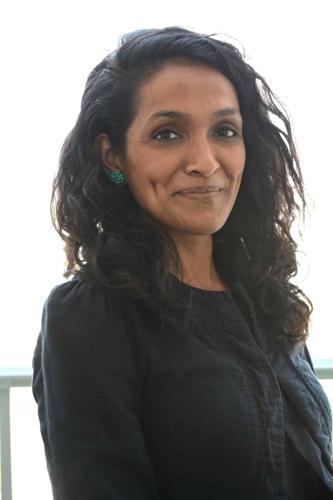


Nithya Raman was born in India and moved to the U.S. as a child. Photo courtesy of Nythia Raman
In just days, Los Angeles residents will be voting on who they think is the best fit to lead and govern the second-largest city in the United States. Ahead of the mayoral race, if none of the numerous candidates gets 50% of the vote in the June 2 primary, the top two vote-getters will advance to a Nov. 3 runoff.
Facing incumbent Mayor Karen Bass are community advocates, entrepreneurs and engineers running for the four-year term position, including Rae Chen Huang, Bryant Acosta, Adam Miller and former reality star Spencer Pratt, among others.
In the final stretch ahead of the primary, candidate Nithya Raman also looks to convince voters that she is the best choice for becoming the city's top administrator responsible for running the city government, managing the municipal budget and appointing key officials.
According to a new poll released by the Los Angeles Times and UC Berkeley on Thursday, Bass, who has been endorsed by former Vice President Kamala Harris, is leading the race with 26% of the vote, followed by Raman at 25%, higher than a few weeks back, and television personality Pratt with about 22% of the vote.
Similar polls also predict Raman will win about 20% of the vote, with Bass and Pratt ahead.
Last week, she sat down with CALÓ News for a 40-minute exclusive interview where she provided details on her campaign.
Raman, who was born in India and moved to the U.S. as a child, entered the 2026 mayoral race later than her opponents, filing her paperwork and officially joining the contest just hours before the candidate filing deadline.
She told CALÓ News she decided to run after seeing the viable candidates on the table and wanting to give voters a different choice.
"We're in a moment where a lot of people understandably are feeling real frustrations with the city after a very tumultuous year last year between the fires and the raids, but also just a general degradation of many of our essential city services,” she said. “This mayor has not been leading these moments with the urgency and the focus that we really deserve.”
Today, as a councilmember for the City of Los Angeles’s 4th district (CD-4), Raman already represents roughly 260,000 people in areas covering Central L.A., the eastern Santa Monica Mountains and portions of the southern San Fernando Valley.
As mayor, the number of people she would represent will jump to approximately four million residents in L.A., the majority (47%) being Latinos.
“Latinos are an integral part of this city and its future,” she said.
Raman said a lot of the city-wide issues, such as housing and homelessness, are also the top issues affecting Latino families. “For many Latino families here in L.A., they are actually facing a higher rent burden, evictions at higher rates and economic and housing insecurity at higher rates than other residents. These are things that are at the core of my [mayoral] platform,” she said. “I want to make this city work for them and I will do everything in my power to do so.”
During her time on the council, Raman has authored and passed several landmark ordinances with her fellow council members, including the rent stabilization ordinance, which was the city's first major rent-control structural change in 40 years; the tenant anti-harassment ordinance to protect renters from landlord harassment; the right to counsel legislation, which provided qualified tenants with free legal representation in eviction cases and the motion that established L.A. as a sanctuary city, prohibiting any city resources, including property or personnel, from being utilized for any immigration enforcement.
Despite working closely with the rest of the council on many of these ordinances throughout the almost six years since she's been in city hall, none of the 15 council members, including members seen as progressive, have endorsed her.
When asked about this, Raman said she feels proud of her campaign despite that lack of support.
"I think people are doing what they feel like they need to do to support their constituents,” she said. “I’m just doing what I feel like is important, for us to stand up for the city. We have a moment right now where we have a very broken status quo and there's a lot of dissatisfaction across L.A. with the way that our city is functioning. We can do better. Residents across L.A. have been very excited about my campaign. I think this message of a hopeful Los Angeles is really resonating. That's all I can do.”

Today, as a councilmember for the City of Los Angeles’s 4th district (CD-4), Raman already represents roughly 260,000 people. Photo courtesy of the City of L.A.
In the CD-4 race of 2020 and in her re-election in 2024, Raman had been endorsed by the Los Angeles chapter of the Democratic Socialists of America. This time around, during her mayoral race, she does not have the group’s official support.
Leslie Chang, the co-chair of the DSA‘s L.A. chapter, told the L.A. Times that DSA opted against an endorsement, as Raman didn’t reach out to the group’s leaders for support until after she declared her candidacy.
“DSA sees politics as a collective,” Chang told the Times. “That is very much the case when someone is running for office. It should never be about an individual doing something on their own.”
Today, Raman is endorsed by a variety of labor and community organizations, including ACCE Action, New American Leaders Action Fund, Asian Democrats of L.A. County, the Park La Brea Residents Association, the Pro-Housing Democratic Caucus, Housing Action Coalition andUrban Environmentalist L.A., among others.
During the interview, she was also asked about the specific policies she hopes to implement if elected, including those related tot housing, the Olympics, immigration and environmental justice.
The interview has been edited for clarity and length.
Housing
How do you respond to working-class Angelenos who fear progressive housing policies have changed neighborhoods without affordability? How would you prevent “housing abundance” from becoming a synonym for displacement?
“I think the way you address the need for more housing in Los Angeles, while still protecting communities that are facing gentrification and displacement pressures, is really planning for it. We can allow for greater density and more housing to be built in wealthier neighborhoods [and] less diverse neighborhoods that have historically resisted building more housing. At the same time, protect neighborhoods that are facing real displacement pressures and real gentrification pressures by ensuring that any new legislation includes really strong protections for tenants. All of this is a policy that I have already fought for. As mayor, I want to establish an office of tenant protections so that the city machinery is really focused on ensuring that residents who are here have support from the city to stay in their homes.”
Police and public safety
How would you govern a city where the Los Angeles Police Department still has enormous political power? Do you believe L.A. can reduce homelessness and crime without expanding policing?
“I have governed a district for a little over five years and have worked very closely with LAPD to address crime, to ensure that residents have access to public safety resources when they need them and to work very closely across multiple divisions to ensure that the district is served well. That's exactly the same relationship that I would employ when I'm in office.
“But for addressing homelessness, what we've done in our district is really what I want to take citywide, which is to address street homelessness, which can be much better and more effectively addressed by bringing people indoors and off the streets. In the [CD-4] district, we've had a 54% reduction in tents and encampments over a period of just three years. That has brought improved public safety outcomes to people who are on the streets and in the neighborhoods where these encampments were. For me, this is a humanitarian crisis and a public safety crisis and a public health crisis and one that I want to tackle head-on. People in the richest country in the world, in the second-largest city, should not have people sleeping on the streets.
Going back to the police, we know that the City of L.A. has a big budget when it comes to the LAPD. What are your thoughts on people who feel uneasy about the LAPD budget increasing?
“The biggest driver of costs for LAPD had come from their contracts. I voted against a new contract that was signed by [Bass] in 2023 that significantly increased funding through contracts for LAPD. Now we're paying about half a billion dollars more annually for fewer officers than we did before and because we're paying so much more, we're actually unable to fund other key aspects of public safety response, like 911 call takers who can help calls be answered quickly or build out an unarmed response across the entire city. I want to build out a holistic system of public safety response that does include LAPD but also ensures that we are funding LAPD in ways that allow us to fund every other aspect of public safety and ensure that the city is set up such that when you call for help, the right person shows up.”
Immigration and ICE
It's been almost one year since the ICE raids began here in L.A. The city now calls itself a sanctuary city, but immigrants still live in fear. What would your administration do to protect undocumented Angelenos?
“I'm very proud that I co-authored our Sanctuary City Ordinance and helped pass it through the city council before this second Trump administration came into power, but I recognize that a lot of immigrants across the city are feeling real fear right now because of the actions on our streets. I, too, am an immigrant, so this is an issue that I feel very deeply. I want to make sure that the city is doing as much as possible to make sure immigrants are feeling safe, that we're expanding funding for deportation defense [and] that the mayor's office can be a backbone for organizing in response to ICE's actions. Right now, we have a situation where a lot of responses to ICE have been led by community organizations. The city should be a support for that [and] make sure that resources are going to where they're needed. I also want to make sure LAPD is upholding what is in our sanctuary city protections. We have a police chief who has, in many ways, lost the trust of immigrants on this issue because LAPD has been seen as collaborating with ICE in some instances. He has said that he will not enforce laws that are being put in place to help keep Angelenos and immigrants safe, like the state mask ban. I think that we need leadership at LAPD and actions at the LAPD that are really reassuring immigrants that our local law enforcement stands with them.”
Do you think the city should cut contracts or financial ties with companies connected to detention centers?
“I think that we should be doing as much as possible to stand up against this. I have supported efforts to ensure that we don't have detention centers being operated within the City of L.A. borders. I want to do as much as possible for the city to divest from companies that are involved in this horrifying violence. I will explore every pathway that the city can use in order to ensure that we're doing that.”
2028 Olympics
The 2028 Summer Olympics are a couple of years away. What guarantees that residents also receive the economic and social benefits of the games and that they don’t only benefit developers and corporate sponsors? How would you ensure the ordinary Angeleno also benefits from the games?
“I think a big piece is ensuring that spending that's happening for the Olympics contracts is also going towards local businesses, including immigrant-owned, minority-owned businesses and Latino-owned businesses. I have worked within the city to improve and support small businesses that want to access city contracts [by] making that procurement process easier for them. I think we need to do much more of that in advance of the Olympics and really work with LA28 to see how much of that money that's being spent on the Olympics can be spent on not just local companies but really minority-owned companies.”
Political Identity
We've had Mayor Bass also run her campaign on a progressive stance in the past. What does the word "progressive" mean to you now in 2026? And how does that differ from what we've seen from Bass?
“I'm a proud progressive. I have fought for progressive values throughout my time on council and in this campaign as well. But to me, progressive government means that you believe in the power of government to work well for residents. It has to deliver for Angelenos and today, at a time when so many of the challenges feel like they are not going to be addressed, I feel an urgency to make sure that this city really delivers. We need to be actively supporting renters. We need to make sure that we are driving the cost of housing down. We need to make sure that we're addressing homelessness in a really visible, palpable way, bringing thousands more people indoors and off the streets. If we don't do that, people will lose faith in progressive government.”
Environmental justice
In L.A. we have seen the effects of the 2025 wildfires and this weekend we saw oil spills pour onto the streets in East L.A. and enter storm drains that flow into the Los Angeles River. What is your vision when it comes to environmental justice in such an industrial city like L.A.?
“I've done a lot of work on trying to ensure that we are upholding our values on environmental justice in the city. I sat on the [South Coast Air Quality Management District] and have fought for people who are dealing with emissions from industrial activities to get relief. I've also supported efforts to end neighborhood oil drilling here in L.A. and will continue to do that going forward to ensure that we're addressing the harms of those practices, which have continued to pollute the air and the ground. This requires effort and resources being put towards these issues from the city. There are still thousands of oil wells across Los Angeles and we need to ensure that communities have access to clean, safe neighborhoods. We have an environmental platform that really focuses on how our city can do better on those issues.
_______________________________________________________________
Early in-person voting centers opened in all Voter’s Choice Act counties on May 23, 2026. In addition, in-person early voting locations throughout California will open on Saturday, May 30, 2026, with June 2 being the last day to vote in-person or return a ballot by 8 p.m. Vote-by-mail ballots need to be postmarked by Election Day so make sure to mail it at least five days before June 2.





(0) comments
Welcome to the discussion.
Log In
Keep it Clean. Please avoid obscene, vulgar, lewd, racist or sexually-oriented language.
PLEASE TURN OFF YOUR CAPS LOCK.
Don't Threaten. Threats of harming another person will not be tolerated.
Be Truthful. Don't knowingly lie about anyone or anything.
Be Nice. No racism, sexism or any sort of -ism that is degrading to another person.
Be Proactive. Use the 'Report' link on each comment to let us know of abusive posts.
Share with Us. We'd love to hear eyewitness accounts, the history behind an article.