
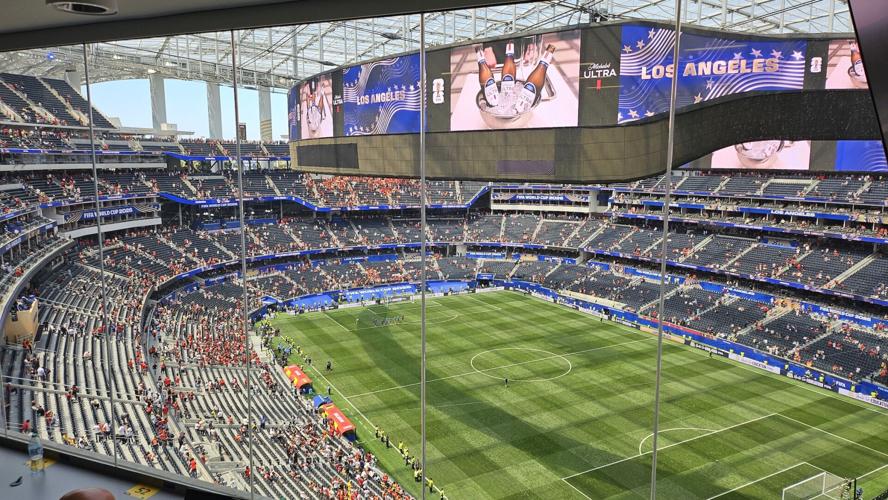



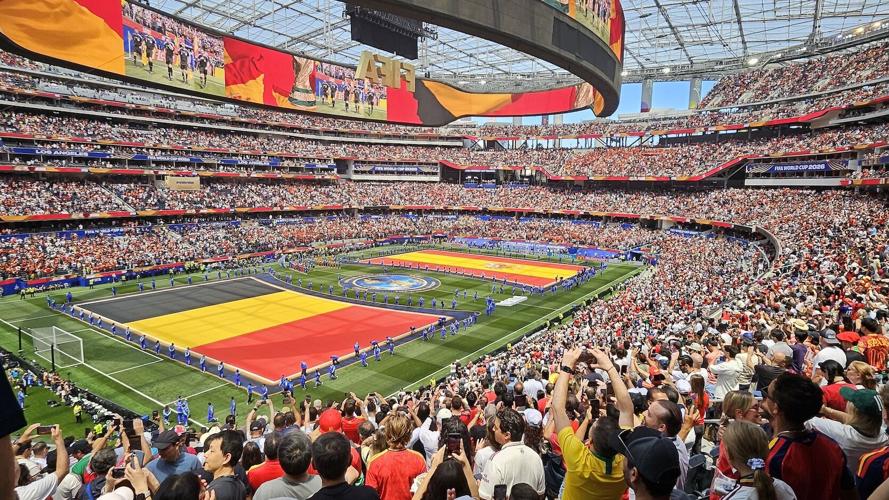

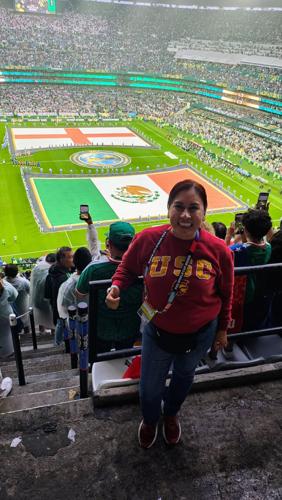


Covering the matches at LA Stadium. (By Jacqueline García)
Spain became the FIFA Men’s World Cup 2026 champion on Sunday defeating Argentina 1-0 in extra time. This is Spain’s second global title; their first one was in 2010.
I must say that even though I’m not a fútbol expert, I am a World Cup fan and this year was very special for me, both professionally and personally, as Canada, USA and Mexico were the co-hosts.
For quite some time, I remember being a fan of the tournament, probably because it is also a popular Mexican sport. From the 2002 South Korea/Japan World Cup when my brother used to turn on the TV in the middle of the night so we could watch the games while mom slept, to the 2010 South Africa World Cup when a group of college friends and I were on a road trip to Denver, CO and I had them listening to the Mexico match on the radio. It was frustrating when mountains would cut the radio signal. Social media was still in its infancy, so we relied heavily on TV, radio or print.
What I experienced
For this World Cup, I covered 10 games in two countries–USA and Mexico–including both opening ceremonies. I know the World Cup has long divided opinions because of the politics involved or the countries that participate. However, I want to share more about what I saw in the stadiums, the fans and the pride for their teams and countries.

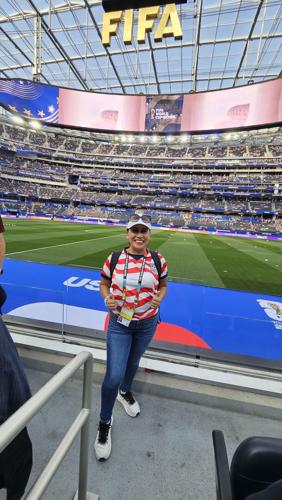
Covering the USA game at SoFi Stadium.
I was also one of the proud fans because the games were being played in both of my homes. I am Mexican American, proudly born in Puebla, Mexico and raised in Los Angeles. I was definitely rooting for Mexico and the USA.
It was almost impossible not to feel passionate about the matches every time I saw the hinchas walking to the stadiums in large groups, some of them with trumpets, drums and other instruments, and all with big hopes of becoming victorious.
It was also worthy of respect to see how many of these hinchas would leave the stadium defeated, but hopeful.
I saw it with Paraguay. After the opening ceremony on June 12, USA defeated Paraguay 4-1. The fans didn’t give up; neither did the team, which came back stronger, beating Germany in the round of 32 on penalties and was barely defeated by France 1-0 in the round of 16.
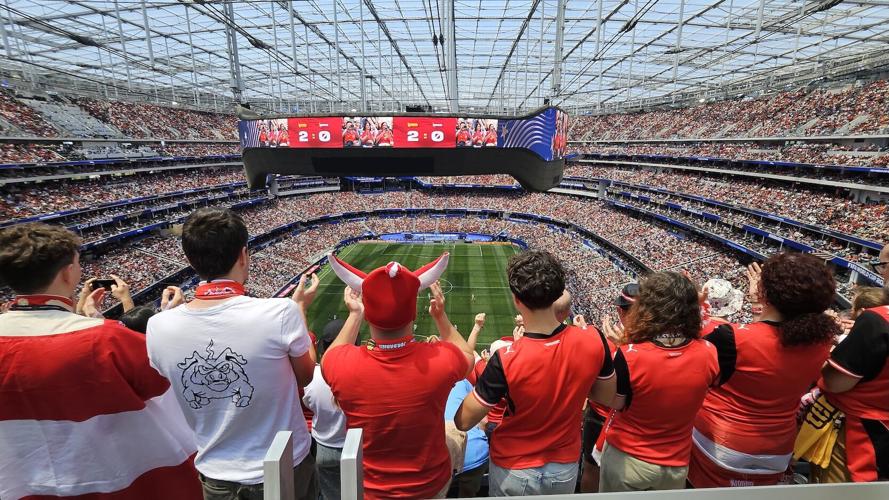
I saw it with Canadians screaming out of their lungs the victory of their country against South Africa 1-0 and Austria fans who never stopped playing the drums, chanting and cheering for their country even when they were losing to Spain 3-0.

Austria fans cheering for the team even when losing. (By jacqueline García)
I saw it with Switzerland as the team was defeating Bosnia and Herzegovina 4-1 and there were loud “La la lalala” chants and waving of their flags. And even when Iran played against Belgium and all the fans recreated the popular human wave. It was beautiful to see that.
There were also the bittersweet moments. One was when Turkey defeated the USA at SoFi Stadium in the group match where neither team was the real winner of the night. Turkey was out of the World Cup and was playing their last game against the USA, who had already advanced to the next round.
The final score was 3-2 with Turkey’s third goal in the last seconds of the match. Turkey left the tournament proud of defeating one of the co-hosts and USA fans sang loud and proud “Take me home, country roads” at the end of the game, sad for the loss but happy because they had advanced.
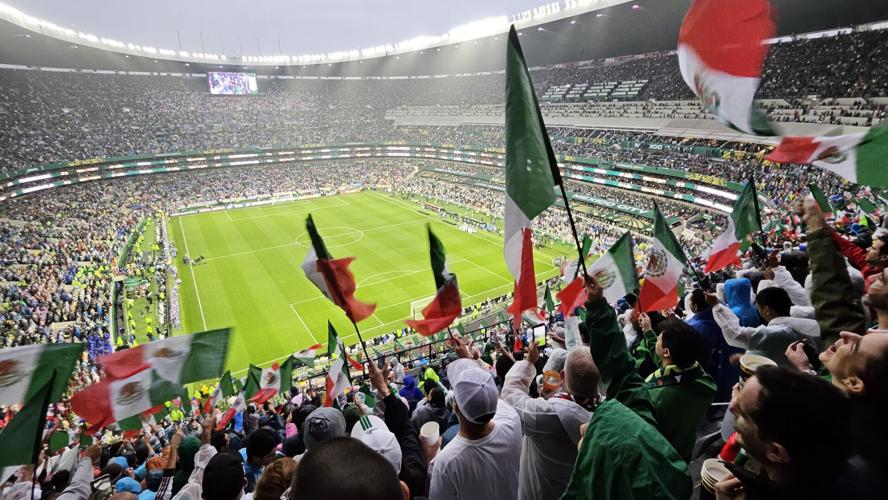
Another one was when England defeated Mexico 3-2 at home in the round of 16. It was a great match, but it wasn’t enough. What started as a frantic and exciting evening turned into sadness and tears as El Tri was left out of the World Cup.

At the Mexico vs. England game. (By Jacqueline García)
Before the game, I followed a batucada band, a fast-paced all-percussion ensemble of Afro-Brazilian style music, that paraded through the streets of Mexico City until arriving at Estadio Azteca. The rain started but didn’t deter anyone from entering the most anticipated game.
The rain came stronger with lightning and thunder. The game was delayed one hour, but fans were not intimidated by the fury of Tlaloc, the god of rain.
I was soaked from head to toes. My poncho just covered my torso and my backpack. My shoes were so wet and while it was uncomfortable, the adrenaline of seeing so many other reporters at the press room under the same conditions put me back on track.

Covering the Mexico vs. England game on July 5, 2026.
I moved out of the press room to enter the stadium. It was just the second time in my entire life that I had entered Estadio Azteca. The first time was at the opening ceremony of the World Cup on June 11, 2026.
That moment was part of history and I was there to witness it in person. The happiness I felt in my heart, the pride I felt for my ancestors and the love I had for my job at that moment were indescribable. The match itself was chaotic with an agonizing ending. Mexico fought. We saw it. But it wasn’t enough.
I saw the sadness of thousands of fans at the stadium and most of them stayed after the game, waving their flags as if there was a tiny hope of redemption. As if the time could go back and Mexico’s loss would somehow turn into a victory.
It didn’t happen.
Fans quietly started walking outside the stadium. The rain started again and nobody seemed to care.
I followed a small group led by a man dressed as an Aztec warrior holding a speaker playing the song “Querida” by Juan Gabriel. While there was so much melancholy in the lyrics, there was also a beautiful camaraderie among strangers who would get closer and sing the chorus loud and proud.
I recorded the moment. And I also sang the song.
After that, I went to the press mixed zone. I saw the Mexican players walk past reporters and neither was interested in giving an interview. At the end of the line, almost by force, goalkeeper José Raúl "Tala" Rangel and defender Israel Reyes briefly stopped to talk to the media but didn’t say much. There was nothing to say.
But it was very gratifying to see the England coach, Thomas Tuchel, speak so well of Mexico and almost apologizing for winning at their home. He was very gracious and, after all, that’s the game.
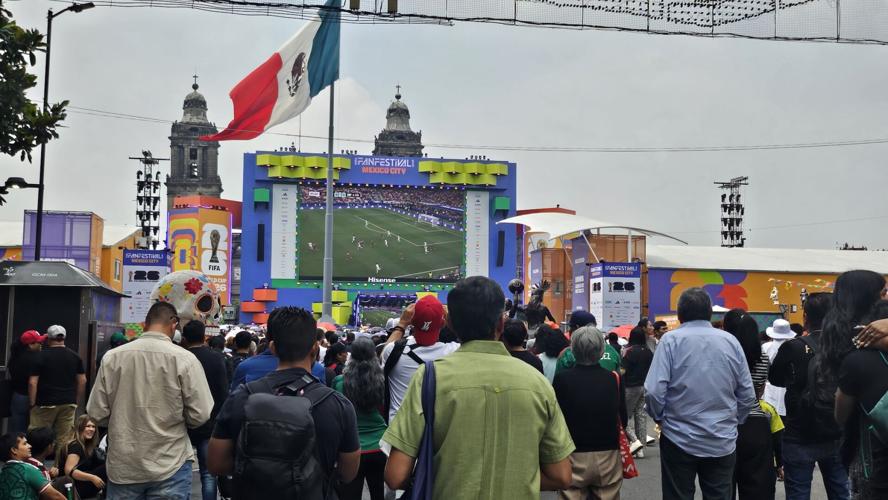
The next day I visited El Ángel de la Independencia and witnessed how workers were removing the large screens that were placed along Reforma Ave. and around the angel so fans could watch the games. I visited the Zócalo where there was a FIFA Fan Zone and while Spain was playing, the ambiance in the area was somber.

Fans at the Zocalo in Mexico a day after Mexico lost. (By Jacqueline García)
The pain was temporary. The party didn’t stop for Mexicans, and as good co-hosts, they continued being the soul of the party. From making people “fly” in the air with the “quiere volar” phrase, wearing the Mexican jersey even when Mexico was out, to even singing the traditional “Cielito Lindo” when Spaniards defeated Belgians.
The World Cup everyone will remember
Every time I watch a World Cup, I learn something new from other countries, their culture, their tradition and their pride.
This year was no exception. While I wasn’t able to cover any of the games where Curacao or Cape Verde played, I must say I was astonished after learning their stories. For example, Curacao’s coach Dick Advocaat, who returned to lead the team just a few months before starting the World Cup and became the oldest manager in tournament history at 78.

Game of Spain vs. Belgium. (By Jacqueline García)
Or Cape Verde’s goalkeeper, Josimar José Évora Dias aka Vozinha, who also proved that age is just a number. At 40, he played for his country and stopped Spain, tying 0-0. And the game against Argentina placed Vozinha and the team to higher standards. While the game ended with Argentina winning 3-2, several commentators said Argentina didn’t really win, but survived against Cape Verde.
For the non-believers that small countries should not be in the tournament, they showed that they were truly up for the challenge.
At the end of the day, we may not be able to change politics or the reality that the world lives. But for a month, many of us were happy and were on the same page celebrating our countries.
Let’s hope that with more people traveling and learning from one another in every World Cup we can be more inclusive, accepting and understanding of others.
As Spanish writer Miguel de Unamuno said, “El fascismo se cura leyendo y el racismo, viajando,” (Fascism is cured by reading, and racism is cured by traveling).







(0) comments
Welcome to the discussion.
Log In
Keep it Clean. Please avoid obscene, vulgar, lewd, racist or sexually-oriented language.
PLEASE TURN OFF YOUR CAPS LOCK.
Don't Threaten. Threats of harming another person will not be tolerated.
Be Truthful. Don't knowingly lie about anyone or anything.
Be Nice. No racism, sexism or any sort of -ism that is degrading to another person.
Be Proactive. Use the 'Report' link on each comment to let us know of abusive posts.
Share with Us. We'd love to hear eyewitness accounts, the history behind an article.