
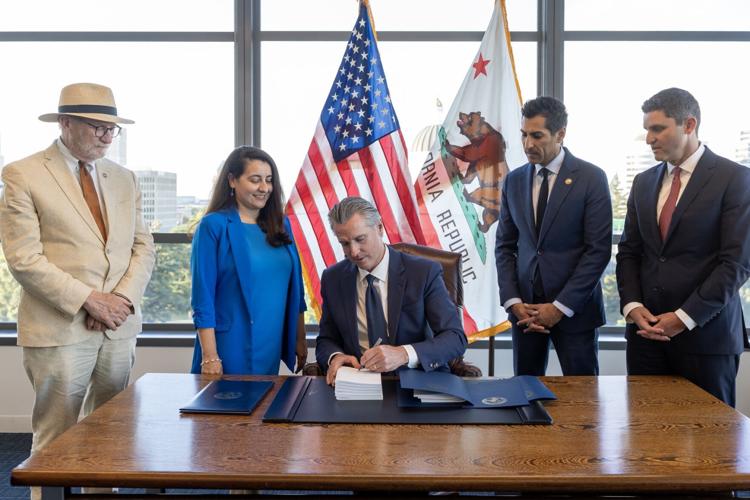




Gov. Gavin Newsom signing the final state budget of his administration on June 29. (Courtesy of Governor's Press Office)
Gov. Gavin Newsom has officially signed and/or vetoed the final bills of his administration. This year, California legislators sent thousands of bills to the governor’s desk – many of those bills had to do with one of, if not the most, contentious issues in the country right now: immigration.
The Democratic supermajority in the Legislature passed dozens of laws aimed at curbing the scope of President Donald Trump’s mass deportation agenda in California. While immigration enforcement is largely dictated by federal law, lawmakers made it clear they believe California still has some say over what can be done within the state.
“We may not be able to dictate federal immigration enforcement policy, but we can make clear that activities taking place in California will be subject to California law,” Newsom said in a video message. “This is about stepping up – stepping up where the federal government has failed our diverse communities.”
Newsom, widely presumed to be gearing up for a 2028 presidential run, has been praised for the bills he did sign - including ones to make 911 calls in detention centers public and restrict arrests near courthouses - though immigrant rights activists are equally disappointed about the bills the governor declined to sign into law.
The wins
The governor signed a law banning what he referred to as an “Orwellian practice” of using shock gloves during immigration detention arrests.
Assemblymember LaShae Sharp-Collins (D-San Diego) introduced the law following an August notice from the Department of Homeland Security stating the agency would spend up to $20 million to purchase thousands of electroshock gloves by next March.
Sharp-Collins’ AB 2760 would make the use of these gloves, by either state or federal law enforcement, illegal and bans local and state law enforcement from purchasing them.
“California has a responsibility to protect the dignity and safety of every person in our communities, and AB 2760 does exactly that,” Sharp-Collins said in a statement. “I am grateful to every person who advocated for this timely and decisive action.”

The ICE detention center in California City sits on a desolate stretch of land roughly six miles from the city center. (Photo by Amairani Hernandez.)
Many of the bills Democrats sent to Newsom had to do with addressing worsening conditions in the state’s eight private detention facilities.
Newsom signed bills to create a civil detainee’s bill of rights, cementing basic rights inside detention centers, require public review of any new proposed detention centers and indefinitely extend a requirement for the California Attorney General to engage in reviews of the conditions within detention facilities.
Sen. Sasha Renée Pérez’s (D-Alhambra) hard-fought battle to begin the process of establishing an oversight protocol through the California attorney general’s office was also signed into law.
“No human should have to endure eating moldy food, drinking dirty water or being denied medical care,” Pérez said in a statement. “California must act.”
The governor signed laws from Sen. Scott Wiener (D-San Francisco) that would make it easier for Californians to sue federal agents who violate their Constitutional rights, as well as expand last year’s mask ban to state law enforcement, which Wiener hopes will allow the law to hold up in court this time.
Another new law will impose a first-in-the-nation 25% tax on income generated for private companies that operate detention centers and redirect that revenue into a fund for immigration support services.
The bill originally imposed a 50% yearly tax on the companies, though it got watered down throughout the legislative process.
“For years, private corporations have made hundreds of millions of dollars locking people up for ICE while California families and communities are left to deal with the consequences,” said bill author Assemblymember Matt Haney (D-San Francisco). “Now, California is the first state in the country to say: if you are going to make money off mass detention and family separation in our state, you are going to pay for the harm you cause.”
The losses
Local and state law enforcement are already prohibited from cooperating with federal immigration enforcement, but another bill from Pérez would have enacted stricter restrictions, required public disclosure on any interagency cooperation and specified that state agencies cannot engage in racial profiling.
Newsom vetoed Pérez’s SB 1105, writing that while it was a “noble intent,” he had concerns it would result in unintended consequences for public safety that require information sharing, like the Joint Terrorism Task Force between the state and federal government.
The governor wrote it “would be unwise to jeopardize this apparatus for the purpose of restating existing projections into law.”
Pérez disagrees.
“The Legislature sent a clear message to the Governor that existing laws were not enough to prevent the rampant abuse from these task forces, with local law enforcement participants often breaking California’s laws against racial profiling and use of force,” Pérez said in a statement. “California had the opportunity to lead in protecting its residents, but Governor Newsom has left his state’s residents vulnerable to their rights being trampled by the federal government.”
The Coalition for Humane Immigrant Rights Los Angeles (CHIRLA) co-sponsored the bill. In a statement, Executive Director Angelica Salas said the veto leaves immigrant communities more vulnerable.
“Throughout the legislative process, we listened to concerns from law enforcement and took significant amendments to address those concerns while preserving the protections our communities need,” Salas said. “That is why the Governor's veto is especially disappointing.”
Newsom vetoed Assemblymember Mark Gonzalez and Assembly Speaker Robert Rivas’ “Get the Feds Out” Act that would have automatically barred people who work for federal immigration enforcement from local and state employment, calling it “a step too far.”
Newsom did, however, sign another bill that bars federal immigration enforcement officers or agents who were found to have specifically committed some sort of misconduct during that employment from becoming a local or state peace officer.
The governor also received backlash for vetoing a bill (for the second time) that would have cleared the path for undocumented students to work on their college campuses.





(0) comments
Welcome to the discussion.
Log In
Keep it Clean. Please avoid obscene, vulgar, lewd, racist or sexually-oriented language.
PLEASE TURN OFF YOUR CAPS LOCK.
Don't Threaten. Threats of harming another person will not be tolerated.
Be Truthful. Don't knowingly lie about anyone or anything.
Be Nice. No racism, sexism or any sort of -ism that is degrading to another person.
Be Proactive. Use the 'Report' link on each comment to let us know of abusive posts.
Share with Us. We'd love to hear eyewitness accounts, the history behind an article.