
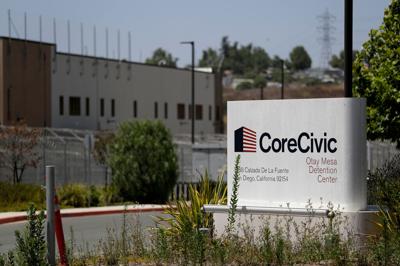



A sign for the Otay Mesa Detention Center sits in front of the building, in San Diego, July 7, 2020. AP Photo/Gregory Bull, File)
When the Assembly Appropriations Committee killed Sen. Sasha Renée Pérez’ detention oversight bill recently, the senator got back to work to ensure some version of the bill passes the Legislature by the end of session, which takes place next week.
It’s a mad dash to the Aug. 31 finish line, so Pérez opted into a gut-and-amend to get her bill through. Essentially, the senator gutted SB 957, which previously dealt with social media privacy laws and replaced it with a similar, albeit watered-down, version of her detention facility oversight bill. The updated bill has one more committee to pass through before it gets on the Assembly floor.
“I just don’t think that we can wait to take action on this issue, and saying that it’s too costly or saying that ‘we need more time,’ OK, well then let’s take the time,” Pérez told CALÓ News. “There’s no reason to wait. Californians, I think, really want us to address what they see as a crisis.”
Pérez’ SB 995, the Masuma Khan Justice Act, seemed sure to pass after getting through most committees plus a Senate floor vote with bipartisan support. But a high price tag caused the bill to get the axe in the Assembly Appropriations Committee.
The bill would have developed an oversight framework for detention facilities in the state and given the California Department of Public Health (CDPH) authority to inspect these centers to ensure basic health standards are met. CDPH estimated the bill would cost anywhere between $14 million to $21 million.
In addition to high costs, CDPH and Appropriations leadership were also concerned over how the framework would be implemented and how long that would take.
Finding a new path forward
Pérez told CALÓ News last week she was not yet giving up on getting detention oversight passed before the end of this session but did not specify how she was moving forward – now, that move is clear.
The senator chose a legislative maneuver called gut-and-amend. She took a bill that had broad support, SB 957, and replaced its language to reflect more closely to SB 995’s goal of a new oversight framework.
SB 957, now the Protecting Vulnerable Immigrant Detainees Model Act, was originally intended to require social media companies to inform users within 30 days if their personal information is subpoenaed by federal agencies, and inform the California attorney general if that information is given to the federal government.
The attorney general under the original bill would have been tasked with developing an oversight system to track and monitor such subpoenas.
This line in the original SB 957 is what has allowed Pérez to shift gears toward detention oversight, since there are strict rules in place regarding gut-and-amend bills. The Assembly requires any bill that is amended to “be germane,” or simply related (at least somewhat) to the original bill.
To meet this rule, Pérez watered down her original oversight idea and is now focusing on having the attorney general, by Dec. 31, 2027, develop an oversight plan for detention facilities instead of social media companies. The amended SB 957 will require the governor to “direct the appropriate state agency to cooperate” with the attorney general’s oversight plan.
A recent report from Attorney General Rob Bonta’s office found "cruel, inhumane and unacceptable" conditions in the state’s detention centers. The report also detailed the deaths of six individuals detained in the state.
“Given what the [attorney general] has already documented, we need a long term plan for detention oversight due to the changing legal landscape,” Ronald Coleman Baeza, on behalf of bill co-sponsor Coalition for Humane Immigrant Rights (CHIRLA), said during a Tuesday Assembly Judiciary Committee hearing.
“Now is the time to ensure California has a consistent, ongoing, regulatory structure for inspections, compliance and enforcement at the state level to protect all people held in detention,” Colman Baeza said.
What’s next?
With the legislative session coming to an end on Aug. 31, Pérez has limited time to get her bill through.
The amended SB 957 passed in the Assembly Judiciary Committee Tuesday with a party line vote. It will appear in the Assembly Health Committee on Thursday and if it passes there, heads to the Assembly floor for a final vote.
Pérez said she wants to get this to the governor’s desk as soon as possible, but if the bill fails in the next few days, she will “absolutely” reintroduce it next session.
The senator also said she will continue to work on social media freedom of speech issues, the original purpose of SB 957, in the future.





(0) comments
Welcome to the discussion.
Log In
Keep it Clean. Please avoid obscene, vulgar, lewd, racist or sexually-oriented language.
PLEASE TURN OFF YOUR CAPS LOCK.
Don't Threaten. Threats of harming another person will not be tolerated.
Be Truthful. Don't knowingly lie about anyone or anything.
Be Nice. No racism, sexism or any sort of -ism that is degrading to another person.
Be Proactive. Use the 'Report' link on each comment to let us know of abusive posts.
Share with Us. We'd love to hear eyewitness accounts, the history behind an article.