
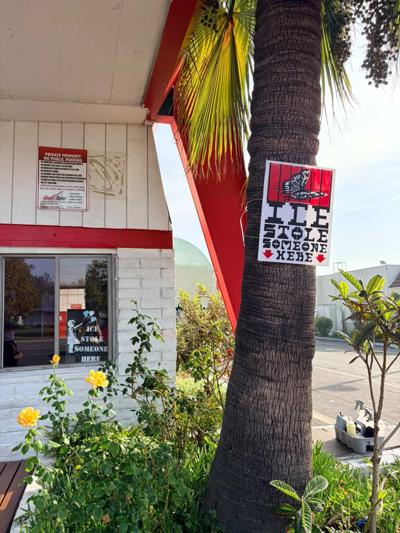


The new and previous signs for "ICE stole someone here." (Citizens4Ontario)
Journalism is a cruel mistress. From the moment I chose it as my profession at 16, I witnessed my own high school teacher quit and become a political strategist. My second journalism teacher also eventually quit and went into marketing.
Many consider it a cutthroat industry, and in many ways it is. The competitive nature of trying to scoop other publications is ever-present.
When I entered the lobby of the Annenberg School for Communication and Journalism to attend the SoCal Journalism Convening on November 21, it was a strange feeling of seeing the familiar setting, but now without the screens that surrounded the area when I studied there. It is now a much simpler area, with a few tables laid out.
I couldn’t help but remember my time at the school, what I learned and the disconnect that I felt from my fellow classmates and teachers. I loved journalism but I also felt as though the emphasis on public service was dimmed by focusing on pursuing careers that served corporate entities rather than people.
As federal immigration enforcement operations intensified across Los Angeles, more than 50 journalists from LA's independent newsrooms came together at USC Annenberg to ask an urgent question: What does journalism look like when it's designed to serve communities rather than extract from them?
CALÓ News reporter Michelle Zacarias organized the convening in partnership with LA Public Press Editor-in-Chief Michelle Zenarosa.
It was during one of the exercises during the convening that I realized why I had an issue with some of the practices that I had been taught. The exercise asked how to cover a story in a way that would not bring harm to a person being detained by federal agents while also making sure we do not center the narrative that the authorities want us to do. I realized that my first thoughts were exactly that.
I’d been taught to contact the authorities to get their version, to try to contact the person’s family, even though it may be that in some way that could expose them to further danger. I stood there as people offered other options and I knew that I had finally found what I knew was missing from the vision that I knew about journalism.
Many years ago, during my Latino graduation, they gave us a chance to say a few words. My grandmother got mad at me when I didn’t thank my parents in my graduation speech. She was right. I owed my parents the acknowledgement of their sacrifices to get me there. Instead, I said a few pretentious words about “being a voice for the voiceless.” After years in the field, I know that people are not voiceless.
When Maria Elena Martinez from Tribuno del Pueblo said at the convening that we are “making spaces for working-class voices,” it resonated with me because that is what I had meant all those years ago, when my career was just starting.
The convening offered a new way to look at journalism and I felt reinvigorated to continue in this field. Maybe we can challenge the cutthroat nature of journalism. Maybe we can work together in L.A. to serve people instead of corporate interests and offer a new era of journalism for the people by the people.







(0) comments
Welcome to the discussion.
Log In
Keep it Clean. Please avoid obscene, vulgar, lewd, racist or sexually-oriented language.
PLEASE TURN OFF YOUR CAPS LOCK.
Don't Threaten. Threats of harming another person will not be tolerated.
Be Truthful. Don't knowingly lie about anyone or anything.
Be Nice. No racism, sexism or any sort of -ism that is degrading to another person.
Be Proactive. Use the 'Report' link on each comment to let us know of abusive posts.
Share with Us. We'd love to hear eyewitness accounts, the history behind an article.