
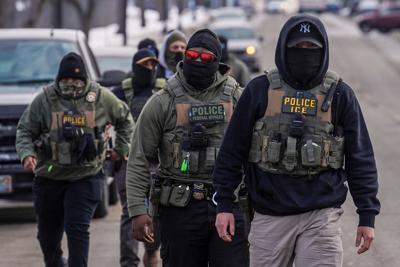


Federal agents walk down a street while conducting immigration enforcement operations in Minneapolis, Feb. 5, 2026. (AP Photo/Ryan Murphy, File)
Unauthorized immigration has been one of the biggest issues that Donald Trump has campaigned on since 2015. Trump vilifies undocumented immigrants as dangerous criminals and campaigned on reducing how many enter the United States by securing the borders. So why risk collapsing an island so close to Florida and risking a major refugee crisis coming to U.S. shores? The current U.S. fuel blockade against Cuba all but guarantees all these problems.
Ever since the 1960s, the Caribbean island of Cuba, 90 miles south of Florida, has been one of the largest sources of immigrants to the United States. The armed revolution against Fulgencio Batista in the 1950s and its aftermath caused many Cubans to leave their island and U.S. sanctions, including a trade embargo, were designed to weaken the economy and eventually make it collapse. Sometimes, as conditions got worse in Cuba, Fidel Castro encouraged his citizens to leave if they wanted to, such as the Mariel Boatlift of 1980. In addition U.S. laws, such as the Cuban Adjustment Act of 1966, have encouraged Cubans to leave their island and come to the U.S. with promises of asylum.
After 1991, Cuba lost its biggest source of foreign aid when the Soviet Union collapsed and has been in decline ever since. Now in the 2020s, Cuba is crumbling and is at its weakest. The Trump Administration, with Cuban-American Marco Rubio as Secretary of State, is taking advantage of the crisis to finish off what is left of the communist government. Their chosen method is cutting off any access to oil and fuel to the island. The U.S. Navy has seized Venezuelan oil tankers and Mexico has been threatened with tariffs if they sell any more oil to Cuba.
The effects of this fuel blockade on Cuba have worsened everything in Cuba. Electricity blackouts are happening every day on the island as the power grid has failed. Fuel for cooking food or driving cars is all gone, worsening a humanitarian crisis and ensuring a total collapse. Former Secretary of Defense Robert Gates has recently warned of a mass migration crisis if Cuba totally collapses. There are lessons to learn from another crisis with Cuba’s neighbor Haiti in the 1990s when a fuel embargo was placed on that island against a repressive dictatorship. The results were a mess.
From 1991-1994, Cuba’s neighbor Haiti had come under the repressive rule of a military dictatorship when a group of generals overthrew Jean Bertrand Aristide, the first freely-elected president of Haiti, in September 1991. The United States condemned the coup and the George H.W Bush Administration responded with economic sanctions on Haiti, including a fuel embargo, like what is being done against Cuba today. The U.S., Mexico, Venezuela and other nations in the hemisphere stopped selling any oil to Haiti.
The goal of the sanctions was to make the military junta of General Raoul Cedras step down and allow the legitimate president back into office.
Haiti is the poorest country in the Americas and the hope of the U.S. was that the dictators would fold fast. Cedras and his military regime, however, remained defiant and refused to leave and kept repressing anyone who opposed them. The conditions in Haiti worsened for everyone as a result of the fuel embargo and sanctions, causing blackouts and starvation.
The combination of military repression and economic collapse by sanctions and dictatorship mismanagement led to a severe Haitian refugee crisis, with thousands of refugees getting on boats and heading to Florida. In addition, many Cubans were also leaving their country and sailing to the U.S. as their economy began tanking without Russian aid.
By 1994, the U.S. had lost its patience with the refugee crisis and the stubborn military dictatorship. The sanctions were not working fast enough to make the dictators leave. So the U.S. launched a military intervention in Haiti named Operation Uphold Democracy and the Haiti army, despite their posturing of resisting a U.S. military attack, largely gave up with limited clashes. The Haitian generals stepped down and left Haiti and Aristide was restored to office to finish his term, only for another crisis to break out from 2001-2004, resulting in another armed U.S. military intervention in 2004.
We’ve all heard the phrase “you break it, you buy it,” if you accidentally break something at a store. For the United States, that applies to the deliberate mission of collapsing the communist government in Havana. The U.S. will inherit a Cuban refugee crisis that will likely overwhelm the U.S. Coast Guard. In addition, the U.S. may launch a military intervention and occupation of Cuba and attempt nation building. Rebuilding Cuba after so much effort to collapse it makes all the work harder and more costly for the U.S.
There must have been a better way to do all this.





(0) comments
Welcome to the discussion.
Log In
Keep it Clean. Please avoid obscene, vulgar, lewd, racist or sexually-oriented language.
PLEASE TURN OFF YOUR CAPS LOCK.
Don't Threaten. Threats of harming another person will not be tolerated.
Be Truthful. Don't knowingly lie about anyone or anything.
Be Nice. No racism, sexism or any sort of -ism that is degrading to another person.
Be Proactive. Use the 'Report' link on each comment to let us know of abusive posts.
Share with Us. We'd love to hear eyewitness accounts, the history behind an article.