
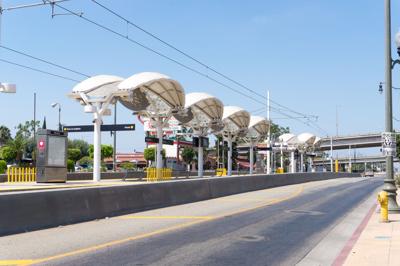


Maravilla Metro Rail stop in East Los Angeles. (Tero Vesalainen/Getty Images)
Earlier this month, the New York Times published an amazingly out-of-touch article about Los Angeles. In the Travel section’s “36 Hours” column, the paper ran a feature dedicated to “The Eastside of Los Angeles,” highlighting restaurants and attractions in the area.
Unfortunately, none of the places in the article are on the Eastside of Los Angeles, which set off abacklash on social media. As journalist Sahra Sulaimanwrote on X, “The NYT is contractually obligated to explain the Eastside to us once a decade while categorically erasing actual Eastside neighborhoods.” L.A. Times columnist Gustavo Arrellanoweighed in withseveral critical posts, concluding, “Que pendejo.”
This controversy can be seen as a reflection of the New York/L.A. rivalry, or the annoyance that Angelenos feel when outsiders write about our beloved City of Angels. It is still astonishing how clueless the Times can be when it comes to the country’s second-largest city. This includes overlooking Latino communities in a city where Latinosare the largest racial/ethnic group.
Any reader of this article might suspect that something was amiss from its first line: “It’s a relatively recent label: the Eastside,” writes Genevieve Ko. That is like saying the south side of Chicago, or Manhattan’s east side are “relatively recent” labels. These terms have been around forever.
According to the New York Times, L.A.’s Eastside includes Silver Lake, Los Feliz, Hollywood and downtown. The article states that the Eastside is a place more about “vintage t-shirt vibes” than geography.
This take is way off. While there are plenty of distinctions that locals argue over, in Los Angeles the term “the Eastside” is generally used to describe neighborhoods east of downtown. Trust me, as a native Angeleno, no one from Silver Lake ever says, “I’m from the Eastside.”
But this controversy is about more than a local dispute over neighborhoods. It is about who is deemed worthy by the media of coverage and attention. It shows how some national news outlets only cover Latino communities when they are in crisis, whether because of ICE raids ordangerous explosions.
Then there are the article’s random observations, such as: “To feel like a true Eastsider is to brunch in someone’s backyard.” Huh? L.A.’s Eastside is home to many working-class Latino and immigrant families. I have family and friends all over the Eastside. The idea of “true” Eastsiders hosting brunches in their backyards is honestly hilarious.
Some readers of the New York Times’ piece might assume that the writer is an out-of-towner, an uninformed New Yorker. Yet the writer’s bio states that she is from Monterey Park, a city that “directly borders East L.A.”
Any blame for this misguided article should not rest with the author alone. The New York Times editors could have called her piece “36 Hours: Los Angeles” because that would be a more appropriate title. The Times’ fact-checkers might have suggested that she reconsider her assessment of the Eastside’s borders. Even the Times’ photo editors did the writer wrong, as the picture accompanying her story is the Broad Museum – which is situated in downtown L.A.
What’s sad here is the missed opportunity. L.A.’s Eastside consists of vibrant communities, such as Boyle Heights and Lincoln Heights, that are full of amazing, affordable restaurants and clubs. Omitting these neighborhoods from an article about the Eastside is an insult to area residents. Consider that the Times article ignores all the Chicano and Mexican American culture in East Los Angeles, while it highlights a restaurant in... Thai Town?
The New York Times could have shared an accurate story about the Eastside with its13.8 million subscribers. Instead, the Times’ story plays into the stereotype of the paper being for an affluent, white audience – who presumably would never venture near the real Eastside.
Then again, in 2018, the Times published a story referring to Olvera Street as the source of “all useless items in the world.” Readers were offended and the Times’editors apologized. How ironic that one of the top newspapers in the world can seem so insular and provincial. Their Eastside article makes the case for having more Latino journalists in national newsrooms.
Perhaps it’s laudable that the Times attempted to cover Los Angeles’ Eastside in a feature story. Yet if the Times gets credit for effort, its latest edition of “36 Hours” is still a failure in execution. L.A.’s Eastside communities deserve better – and so do New York Times readers.






(0) comments
Welcome to the discussion.
Log In
Keep it Clean. Please avoid obscene, vulgar, lewd, racist or sexually-oriented language.
PLEASE TURN OFF YOUR CAPS LOCK.
Don't Threaten. Threats of harming another person will not be tolerated.
Be Truthful. Don't knowingly lie about anyone or anything.
Be Nice. No racism, sexism or any sort of -ism that is degrading to another person.
Be Proactive. Use the 'Report' link on each comment to let us know of abusive posts.
Share with Us. We'd love to hear eyewitness accounts, the history behind an article.