
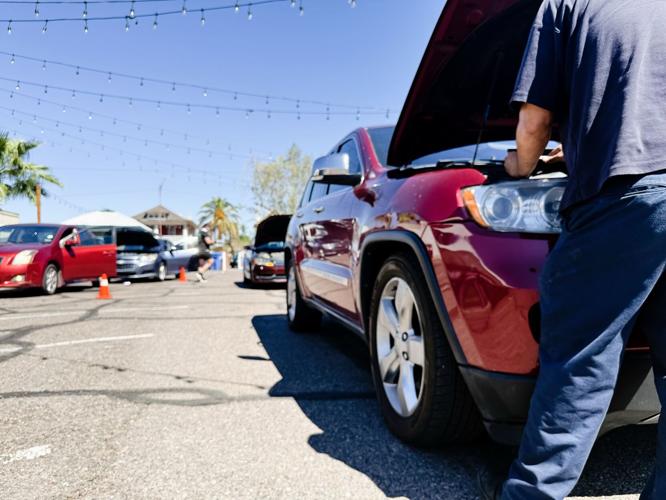


A volunteer works on a vehicle as cars line up for free light inspections and repairs during Puente Human Rights Movement’s brake-light clinic in Phoenix on Sept. 19, 2026. (Miguel Torres/CALÓ News)
Blanca did not want to be last in line to get her brake light fixed.
The woman in her 50s showed up at Puente Human Rights Movement's Phoenix office early Saturday, about two hours before a free brake light clinic was supposed to begin.
She works long hours; some nights until 2 a.m., and her old truck is her only way home.
Blanca, whose full name is not being disclosed for her safety, said she has a work permit, but fears that being Latina and having darker skin can draw an officer's attention and something as simple as a bad light could provide the reason for a stop.
"That's why I'm here, because it worries me," she said.
Organizers say they have heard repeatedly from families whose encounters with immigration authorities began with traffic stops, while Phoenix-area law enforcement agencies say their officers do not use routine stops to enforce federal immigration law.


In its recent report titled “Agents of Chaos and Cruelty,” the ACLU documented hundreds of ICE enforcement incidents, displaying how aggressive immigration enforcement tactics have turned everyday community spaces into potential detention zones.
The clinic is one small community response to that gap and an attempt to remove one reason for a stop while families navigate what police can legally do.
Blanca had heard about Puente's previous clinic but couldn't make it. This time an aunt warned her to get there early.
“‘What if you don't make it in?’” Blanca remembered thinking. "So I got up early and came over."
Numerous ICE-related traffic stop calls lead to clinic
By the time the clinic got going, "Pelotera a la Bola" by Uno & Airam Páez could be heard down the street.
The music came from a small, one-story white building surrounded by a blacktop parking lot that looked a little like a repurposed used-car lot. For a few hours, it looked even more like one. The lot was filled by sedans, pickups, SUVs and vans, most built sometime within the last 20 years.
Judith Coronel, an organizer with Puente, said the idea grew out of calls the organization had been receiving from families.
As one of Phoenix's leading rapid response organizations, Puente regularly hears from people seeking help after an encounter with Immigration and Customs Enforcement (ICE) or after a loved one is detained.
She said more and more families described situations where people were driving to work, stopping for gas and had been pulled over for something as small as a taillight or license-plate light.
"So we thought… ‘how can we help, kind of, mitigate this?,’” Coronel said.

Proposition 314: What it is and how ACLU Arizona and community organizers are informing, preparing and protecting their communities against the law that targets migrants.
They learned about a car light clinic in California, reached out to organizers and got a list of commonly needed bulbs and tools. Then they spent about three weeks preparing its first clinic in August.
Four people volunteered to work on cars, including professional mechanics and community members experienced with car repairs. The group raised money for bulbs, received donated parts and got help buying some supplies at wholesale prices through a community connection at an auto-parts shop.
The effort came together because of trust built over 20 years of community service, Coronel explained.
That trust is crucial, especially when the testimony and incidents being documented by Puente don’t always line up neatly with what law-enforcement agencies say they do or don’t do — like traffic stops that lead to an immigration detention.
In an emailed statement to CALÓ News, the Phoenix Police Department said that its officers "do not enforce federal immigration laws or participate with ICE." Officers may work with federal agencies on serious criminal investigations, the department said.
But Phoenix police also said it does not track traffic stops involving immigration referrals or transfers as a separate category, making it difficult to produce a simple count of how often a police-initiated traffic stop involves immigration authorities.
The city's Office of Accountability and Transparency — created in 2021 to provide civilian oversight of Phoenix law enforcement — accepts anonymous complaints submitted by residents. The office has not received reports involving traffic stops, Phoenix officers assisting immigration authorities or people being held at a stop while immigration agents arrive, according to Dan Wilson, Phoenix's communications director.
The Maricopa County Sheriff's Office (MCSO) said deputies are prohibited from contacting ICE during roadside traffic stops and do not engage in immigration enforcement.
But ICE agents remain stationed at the county jail's intake facility and screen everyone being booked, whether the person is suspected of a misdemeanor or felony and regardless of citizenship status, the sheriff's office told CALÓ News.
That means that even when MCSO doesn’t engage directly with ICE during a stop, a criminal traffic offense can result in a booking rather than a citation, placing the impacted person on ICE’s radar.

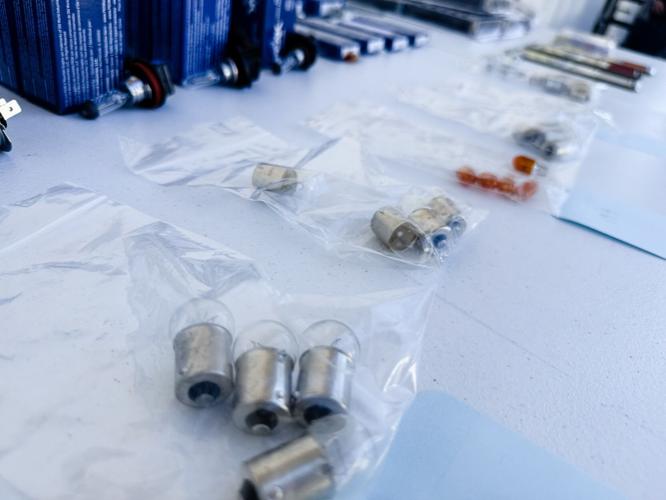
Replacement bulbs and other lighting parts are laid out for volunteers to use during Puente Human Rights Movement’s free brake-light clinic in Phoenix on Sept. 19, 2026. (Miguel Torres/CALÓ News)
The cost of a broken light
By 10:45 a.m., at least nine cars had arrived and two had been completed.
Getting to a bulb was not always as simple as popping open a hood. On some newer vehicles, volunteers had to remove panels or reach through a wheel well. A repair that took five minutes on one car could take half an hour on another.
For Olga González, the repair needed on her car was more complicated than Puente could handle that morning.
She already knew her lights were bad. She had taken the car to a mechanic before and was told that replacing both lights could cost as much as $1,000.
“I can only use it during the day,” González said. She uses the car to pick up her daughter, who attends cosmetology school, and also uses it for work as a driver.
She said she had not driven at night for the past two months because she did not want to cause an accident or be stopped by police.
"Right now, with the police, you just do not know," González said. "Maybe it will be a ticket or maybe it will not. Maybe they will start looking into your immigration status."
John Mitchell, an immigration rights attorney with the ACLU of Arizona and a former deportation defense lawyer, said a misdemeanor stop and immigration concerns can easily become tangled.
Under Arizona's existing immigration law, an officer can contact federal authorities to verify immigration status in some circumstances, but that does not give police authority to keep someone on the roadside indefinitely, he said.
"It is still very much unconstitutional for a police officer to keep someone at the scene of a violation just for the purpose of verifying their status or bringing ICE or CBP to the scene," Mitchell said.
The problem for someone who gets pulled over is figuring out what to do with that difference in real time. Mitchell's simplest advice was not to assume every question an officer asks has to be answered.
A person can remain silent, though he understands it’s not always that simple when facing someone trained to extract information.
If someone believes an interaction with police may affect their immigration case, Mitchell recommended they seek advice from a immigration attorney after the incident.
If hiring an attorney is not realistic, he suggested obtaining documents such as the police incident report and looking for low- or no-cost legal consultations, often offered by local migrant rights organizations like Puente.

As heightened immigration enforcement activity makes its way into Phoenix and Tucson areas, these groups are stepping up to support immigrants.
In some immigration cases, a person can ask a judge to suppress, or exclude, evidence obtained through severe constitutional violations so the government doesn’t use it to try to prove the person is removable from the country.
Those motions do succeed in some cases, Mitchell said, but it is difficult, especially when most people are representing themselves in immigration proceedings.
Holding agencies accountable can be just as hard, he added.
Community organizations are part of that accountability system because people often initially report questionable encounters there, Mitchell said. ACLU lawyers also use public-records requests to look for patterns that could become legal cases.
The legal process, he said, can be "daunting and often inaccessible," while major civil-rights cases sometimes begin with the experience of one person or a handful of people.
Repairs at no cost — or even a name
By the end of Saturday’s clinic, about 25 cars had come through, Coronel said. The group’s first clinic drew only about six.
Coronel said part of the difference was simply time. People had to hear about the clinic from someone they trusted and believe there really was no catch.
One man was waiting for the hidden fee or a registration requirement; he couldn’t believe it when he heard they didn’t even want his name.
“We have worked so hard to earn and keep that trust,” Coronel said.

A Friday morning traffic stop in Tucson, Arizona, led to ICE detaining three people from Venezuela. Journalist Susan Barnett shares an eyewitness account of the encounter.
With more people showing up this time, she expects word of mouth to spread further. Puente is already planning another clinic for early November.
The group is taking donations and raising funds for more repairs through its "Sponsor a Light" effort, where donations starting at $20 are encouraged via a sponsor site to help “reduce unnecessary traffic stops and keep our community safer.”
The lights in Blanca’s truck had been fixed before the day ended.
She had one less thing to worry about on the nights she leaves work at 2 a.m., she said.
“It really, really, really worries me,” she said. “That they might get me over a traffic thing, over a light bulb.”








(0) comments
Welcome to the discussion.
Log In
Keep it Clean. Please avoid obscene, vulgar, lewd, racist or sexually-oriented language.
PLEASE TURN OFF YOUR CAPS LOCK.
Don't Threaten. Threats of harming another person will not be tolerated.
Be Truthful. Don't knowingly lie about anyone or anything.
Be Nice. No racism, sexism or any sort of -ism that is degrading to another person.
Be Proactive. Use the 'Report' link on each comment to let us know of abusive posts.
Share with Us. We'd love to hear eyewitness accounts, the history behind an article.