

Last summer, President Donald Trump’s H.R. 1 bill made significant changes to Medicaid, including nearly $1 trillion in spending reductions and stricter eligibility requirements affecting millions of people with low incomes and those with disabilities.
Under H.R. 1, certain Medi-Cal recipients will face new work and community-engagement requirements, more frequent eligibility reviews and changes to immigration-related eligibility. These requirements could put eligible adults at risk of losing health coverage if they cannot meet the requirements, provide the necessary documentation or meet renewal deadlines, which will be conducted every six months starting in 2027. These cuts and stricter eligibility requirements will only place an even greater burden on those who need assistance the most.
Los Angeles resident Miguel Lugo is an individual living with cerebral palsy. He shared that next year his eligibility for Medicaid is severely at risk and fears these new policy changes — not only does Lugo live with cerebral palsy, he is also a stroke survivor with underlying conditions that require more medical attention than the average person. “There's a good chance that I won't be able to access healthcare,” he said in an interview with CALÓ News.
Not only will he be affected through his Medicaid, but also through a reduction of In-Home Supportive Services (IHSS) that he relies on daily. Lugo shared that he relies on his support staff 24 hours a day, seven days a week, and that the slightest reduction in the amount of support he needs throughout the day due to H.R.'s “1 cut" will mean having to choose between having a meal, taking a shower or using the restroom. "I'm facing very serious decisions that I'm going to have to make when it comes to my health,” he said.
Lugo relies on four caregivers who help him throughout his day; he explained that they are his biggest support system and that these cuts not only affect him directly but also his staff.
“They also rely on Medicaid as well. So, if they are not able to go to the doctor and keep themselves healthy, then they will not be able to come to work and to support me, which means they will not be supporting themselves,” he said. “It's a domino effect. This is going to affect every single one of us in one way or another. There's no way around it.”
Lugo is enrolled in the Self-Determination Program through the regional center system, which gives individuals full control over choosing services and supports that help them meet their own goals.
This program relies heavily on Medicaid funding and any upcoming cuts in 2027 will have ripple effects on programs like these. As a result, the critical support staff that Lugo relies on is set to be reduced in hours.

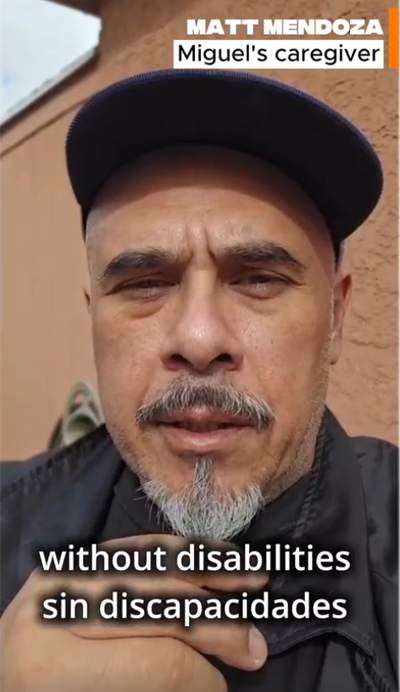
Matt Mendoza is one of the four staff caregivers for Miguel Lugo, who is at high risk of getting hours at work reduced.
“Too many people who live without disabilities are making decisions for people who are living with disabilities. These decisions will affect the lives of many drastically,” said Matt Mendoza, one of Miguel’s staff caregivers. “Individuals like Miguel, who I support daily, will not be able to do the normal tasks that we as individuals who live without disabilities take for granted.”
Since the passing of H.R. 1, more than 200,000 L.A. County residents have been disenrolled from full-scope Medi-Cal coverage as a result of the federal funding cuts and the number is only expected to increase over the next several years.
“Miguel’s been working a lot with me physically, so he's been going to the gym a lot; he's been walking a lot; his overall health is just a lot better because of this. If the Medicaid [cuts] happen in January, chances are that my hours are going to get cut, and so will the other people that work with him, and because of that, most likely his health is going to deteriorate again,” said Eliezer Parra, another staff caregiver for Lugo. “We need Congress to really turn this thing around. We need to stop this because it really affects people like Miguel, not to mention the people that work for him like myself.”
Throughout the midterm election cycle, Lugo dedicated his efforts to not only raising disability awareness but also the importance of civic engagement to protect those affected by H.R. 1’s healthcare policy shifts with the non-profit he works with called Disability Voices United.
“Both issues were extremely important for me to highlight because with the new Congress that is coming in, we need this new Congress to roll back as many of our cuts as possible that are going to be implemented. The new Congress does have the power to roll [back], reduce and amend some of those cuts,” said Lugo. “It’s important to stay informed so that we can stay healthy.”
Ultimately, reductions to Medicaid jeopardize essential in-home assistance and health coverage for individuals with disabilities while also adding challenges like food insecurity.
The Central Valley has the highest Medicaid enrollment of any congressional district in the country, with over 65% of residents relying on Medi-Cal, the state’s version of the program, for their healthcare needs.
Daniel Herrera, who resides in the Central Valley, shared that he is concerned for his mother's health, as she received a letter a month ago from Medi-Cal asking for certain requirements that she may not meet due to her immigration status.
In 2024, the Pew Research Center estimated that California is home to about 1.8 million undocumented individuals, many of whom became eligible for health care coverage through Medi-Cal and Covered California when the Affordable Care Act passed in 2010.
Just this year the Department of Health Care Services (DHCS) implemented a Medi-Cal enrollment freeze for certain undocumented adults who receive state-funded full-scope Medi-Cal through the Adult Expansion programs.
Although this freeze prevents new enrollments for undocumented adults, individuals already enrolled in full-scope Medi-Cal will remain eligible as long as they complete their annual renewal on time.
Now with the new work requirements, certain Medicaid applicants and enrollees are required to demonstrate 80 hours per month of qualifying activities, including employment, participation in work programs, community service or school enrollment.
“This year, Medicaid or Medi-Cal is coming up with new requirements for new eligibility in terms of whether they’ll be accepted or not, and right now, my mother doesn't work. She doesn't really do community service; she’s always having health issues,” Herrera said. Noting that these changes that are happening will impact his family, as they are her sole caregivers.
For many low-income residents, these changes are the most significant disruption to their health coverage in years, with 87% of children being affected as well as nearly 82% of Latino constituents in the district.
Herrera's mom, who decided not to disclose her name due to safety reasons, shared that she has no idea what the new policy means when it comes to accessing care now. “Due to my immigration status, I can't work, and I don’t know what the process of signing up for community services looks like. I fear that my health services will be taken away,” she said.







(0) comments
Welcome to the discussion.
Log In
Keep it Clean. Please avoid obscene, vulgar, lewd, racist or sexually-oriented language.
PLEASE TURN OFF YOUR CAPS LOCK.
Don't Threaten. Threats of harming another person will not be tolerated.
Be Truthful. Don't knowingly lie about anyone or anything.
Be Nice. No racism, sexism or any sort of -ism that is degrading to another person.
Be Proactive. Use the 'Report' link on each comment to let us know of abusive posts.
Share with Us. We'd love to hear eyewitness accounts, the history behind an article.